Showing posts with label world affairs. Show all posts

Friday, May 19, 2017

Normative Dimensions of the European Crisis

European Journal of Political Theory
Special Issue: Normative Dimensions of the European Crisis
April 16, 2017

Miriam Ronzoni - University of Manchester
Juri Viehoff - University of Zurich
Introduction: Normative Dimensions of the European Crisis

The project of European integration is arguably currently facing its deepest crisis since its inception. In less than 10 years, what looked like a steady process of political enlargement, institutional consolidation, and economic convergence has come to a halt (or has even shown signs of backsliding). The project is now threatened in its very existence. This is true both for the Eurozone and for the European Union (EU) more generally.

The global financial crisis has exposed the vulnerability of the Eurozone governance structure to exogenous shocks, and highlighted the problem posed by deep economic discrepancies between member states. The crisis has brought into focus the profound and often adverse consequences that current forms of economic and financial integration have for the adequate functioning of both domestic and supranational institutions. Responding to these difficulties, some significant changes have been made to the Eurozone’s mechanisms – initially in the form of conditional lending to indebted Eurozone member states, and subsequently through the establishment of the European Stability Mechanism, the incorporation of evermore stringent rules regarding national debt levels and deficits, and the implementation of debt-brakes through the Fiscal Compact. The Eurozone, however, continues to struggle to find the right balance between further integration on the one hand and protection of the diversity of welfare state arrangements and democratic institutions of individual states on the other.

Moreover, new institutions and practices (including, centrally, austerity programs) have been met with profound popular resistance especially in adversely affected countries. This has led to a grave legitimacy crises of Europe’s now fragile-seeming supranational institutions. Some scholars have suggested that this crisis calls for a further push towards supranational integration which, crucially, must replace austerity and debtor-punishment with genuinely democratic procedures and substantive economic solidarity in the form of an EU-wide redistributive mechanism (Habermas, 2015: 550). Other theorists have argued, to the contrary, that the Euro-system in particular, and the EU’s pro-market economic governance more generally, have failed member states, and that we should therefore revert to a ‘Europe of States’ in order to safeguard (or indeed rescue) both national democracy and national welfare systems (Scharpf, 2015: 394; Streeck, 2014: 272). By and large, however, the Euro-crisis, its institutional responses so far, and the political contestation it has encountered have remained relatively under-theorised by political philosophers – especially when compared to the detailed recent treatments by economists (see e.g. Krugman, 2012Sandbu, 2015Stiglitz, 2016).

To make matters worse, the whole EU, over and above the Eurozone, faces a deep legitimacy crisis. On the 23rd of June 2016, the United Kingdom voted in favour of leaving the EU. And as this special issue goes into print, Prime Minster Theresa May is pushing ahead to trigger Article 50 of the EU Treaty, formally giving notice that the UK will in fact exit the EU. Beyond its practical impact on the EU and the UK, ‘Brexit’ has great symbolic significance both in virtue of its modality (a popular referendum, thus symbolising the public rejection of what is largely perceived to be a technocratic, elitist, and undemocratic institution) and because the United Kingdom was already perceived as the EU member enjoying the highest level of autonomy within the Union. Brexit will be a first, and a first whose modalities and ripple-on effects are all but clear. Questioning EU memberships and the very existence of the EU has, moreover, ceased to be a taboo in many other countries, including several founding members like Italy, the Netherlands, and France. The role of policies of austerity, as well as the vitriolic popular debates that have split Europeans into ‘Northern-creditors’ and ‘Southern-debtors’, can hardly be overstated as we seek to understand this larger phenomenon of disaffection with European integration.

The aim of this special issue is to offer a range of perspectives and normative assessments of these recent events and to initiate further research into the fundamental issues raised by recent developments in European economic and financial integration. Specifically, the different articles investigate whether – and if so how – the economic and financial calamities, and the ensuing political crisis, demand a fundamental reassessment of the degree to which supranational arrangements of the kind we find amongst EU(-rozone) member states are (i) compatible with the advancement of social justice and democratic legitimacy within states and (ii) can realistically be designed so as to guarantee free and fair interaction amongst self-determining political communities.
Whilst building on the wealth of existing EU scholarship, the articles assembled here especially advance the existing debate along three dimensions:

First, they are all attentive to the quite profound changes that the Euro-crisis has brought to the project of European integration: Such changes have manifested themselves not merely in rapid institutional reforms in response to the crisis (e.g. massive extension of the mandate of the European Central Bank, highly intrusive prescriptions regarding the permissible level of debt and welfare provisions in Southern states, etc.), but also in dramatic shifts in public perception of the point and purpose of European institutions in more crisis-prone states.

Second, these articles seek to relate the existing normative EU literature both to wider theoretical discussions that have exercised political theorists in recent years (most notably to flourishing debates in international political theory and global justice) and to new conceptual tools that these discussions have made available (such as the practice-dependence approach as a method for assessing the normative performance of an institution; or the concept of demoi-cracy as an normative ideal for supranational institutions that is a genuine alternative to both intergovernmentalism and federalism).
Third, and related, they advance the existing debate by assessing the most pressing moral questions not merely in terms of the prevailing conceptual notions used in EU scholarship, many of which focus on questions of democratic procedure (viz. ‘democratic deficit’). Whilst questions of supranational democratic procedure must continue to play a prominent role in our normative assessment of European institutions, there is also room for assessing these institutions in light of other values, most obviously those bearing on political and distributive justice within and between states. These articles are therefore meant to update, advance, and enrich the existing political theory of European integration.

Andrea Sangiovanni and Juri Viehoff address the second and especially the third dimension, by exploring the compatibility of specific policies with relevant ideals of social justice, distributive fairness, and solidarity at the European level. But along the way, they also put forward arguments that are relevant to the first dimension, providing reasons in favour or against institutional proposals currently under discussion. Sangiovanni discusses, and rejects, the permissibility of in-work benefits, the welfare reform which David Cameron negotiated with the EU in the Winter of 2015/2016 in the hope of convincing the United Kingdom to remain in the EU after all. To make his case, Sangiovanni surveys and applies recent philosophical theories of discrimination, and marshals his own account as a justice-based objection to illegitimate differentiations between EU workers. Viehoff defends the idea of a European social minimum (a largely unconditional welfare contribution paid to each EU-citizen) as the object of a possible consensus among different relevant normative perspectives – i.e. as something which European federalists and intergovernmentalists, internationalists, and cosmopolitans about justice could all agree to. Stressing the particular urgency of such a proposal in the face of monetary integration, his case relies at least in part on recent Eurozone developments.

Inspired by recent applications of neo-republican thinking to questions beyond the state, Richard Bellamy takes by the horns fundamental questions about the EU’s institutional structure, asking in particular which model of sovereignty the EU should embody. The EU is often characterised as having challenged the sovereignty of the member states in ways that are both necessary and desirable. Bellamy disputes both these arguments, by defending state sovereignty as both functionally necessary and normatively desirable if citizens are to be able to reason publicly about issues of common concern, and to resolve their reasonable disagreements in a free and equal manner.

Finally, Francis Cheneval, Kalypso Nicolaïdis, and Miriam Ronzoni discuss the merits of the recently developed idea of demoi-cracy, according to which the EU does and should constitute an alternative to both federalist and intergovernmental institutional model. Drawing on the value of non-domination between heavily interdependent democratic states, Ronzoni offers a sympathetic reading of the normative ideal of demoicracy, but then introduces the distinction between institutional and normative ideals to raise doubts about whether demoicracy can be a distinctive institutional third way. In the final contribution to this issue, Nicolaïdis and Cheneval seek to move the recent scholarship on demoicratic theory a step further by exploring what they refer to as the social construction of the demoicratic reality. In so doing, they propose a conceptual framework for understanding how popular sovereignty could possibly be exercised concurrently by several rather than just one demos.


The Future of Western Democracies

Institute of European Studies, UC Berkeley

Ralf FuecksPresident, Heinrich-Böll-Stiftung

May 3, 2017


Thursday, January 28, 2016

China Rewrites the Global Rules

Despite worries over the end of the Chinese economic miracle and harder times because of the aftershocks of the 2008 financial crisis, global rebalancing is happening — and quickly.
by Philip S Golub
The International Monetary Fund’s executive board announced on 30 November that the Chinese currency, the renminbi (RMB) or yuan, would soon be included in the basket of currencies that make up its Special Drawing Rights (SDR), beside the US dollar, the euro, the British pound and the yen.


The decision recognised the growing role of the Chinese currency in international trade settlements. Since the launch in 2009 of a pilot programme for cross-border RMB trade settlements in Asia, the share of Chinese trade settled in RMB has risen from 3.2% to 25%, and should, according to the Financial Times, soon reach 46% (1). Offshore centres clearing the currency have been set up in Hong Kong, Singapore, Taiwan, London and Frankfurt. The RMB is still far from world reserve status, requiring full convertibility and complete capital market liberalisation, which China is not ready for and carries significant risks. But the RMB’s rise is a “momentous event in [...] international finance”, according to a former IMF economist (2) — the beginning of a slow shift towards a tripolar world monetary system no longer exclusively centred in the West.
“Great powers have great currencies,” says Robert Mundell (3). Like the gradual rise of the dollar to reserve status in the early 20th century, the internationalisation of the RMB is part of the larger story of China’s re-emergence as a semi-autonomous core of the world economy, and as the primary driver of the movement of East-West and North-South rebalancing that is a key feature of current world politics. China’s share of world GDP, in purchasing power parity (PPP), has risen in 40 years from less than 2% to over 16%, ahead of the US. Though Chinese economic growth declined with the “great recession” after the 2008 crisis, average per capita GDP (PPP) is now expected to increase within a few years (from $9,800 to $16,000, against $250 in 1980). Longer-range projections, which showed a growth trajectory similar to Japan in the late 20th century, suggest that per capita GDP will reach current Japanese or European levels by the mid-21st century. China is gradually regaining a position in the world economy in keeping with its demographic weight.

                                           Key South-South actor

It has become the core of South-South trade and investment linkage, supplanted Japan and the US as the leading trade partner of nearly all East Asian countries, and become a crucial actor in South American, African and South Asian trade. China is now Brazil’s leading trade partner, ahead of the US. There are similar trends in Chile, Argentina and smaller South American economies. South Africa’s export share to China has risen from 1.8% in 1998 to over 12%, while imports have risen from 3% to 15%. Indian exports to China have risen from 2.9% to over 10%, and imports from 2% to 12%.

This points to a re-patterning of the geography of world trade, and an East Asia-centric South-South trading system, with China at the core. Thanks to new regional and transcontinental linkages centred in East Asia, South-South trade (SST) has expanded more rapidly over 20 years than global trade. In 2013 SST was 25% of world trade, 21% of manufacturing exports, and 25% of exports of manufactures with medium and high technological intensity. Trade between developed countries fell from 46% to less than 30%. The result is a reduction of traditional single-market dependency in Latin American, sub-Saharan and Southeast Asian countries on Europe and the US. This has been accompanied, particularly in East Asia, by industrial upgrading: the “developing” world’s share of manufacturing value-added has risen from 8.8% to nearly 30%, and of merchandise trade from 25% to 47%.
China’s re-emergence has begun to alter the vertical North-South relations of the age of western empire and industry. This generates new dependencies: when China sneezes, emerging country partners catch colds — as with the current downturns for exporters of primary goods because of China’s slowing growth. The impact of the global crisis on China evinces the need for a sustainable development strategy focused on domestic improvements rather than export growth. Even so, we are witnessing a structural change in the global economic and political hierarchy.

                                       Bye-bye Bretton Woods?

Politics has lagged behind economics, but a gradual reordering of world politics is visible in the growing voice of the South in organisations and clubs (G20), its activism in world politics, and new international institution-building efforts bypassing traditional centres of authority. Frustrated by the slow pace of change, notably in the IMF and World Bank, China has been leading the effort of global South countries to create a new system to govern the world economy. In 2013 Brazil, Russia, India, China and South Africa (the BRICS) set up the New Development Bank (NDB),headquartered in Shanghai, with a capital base (money paid in and pledged) of $100bn; this will combine investment and monetary functions, serving as a lending institution for infrastructure development projects as well as a reserve facility for balance of payments issues. In 2014 China founded the Asian Infrastructure Investment Bank (AIIB), which, like the NDB, has a $100bn capital base (the Japanese-led Asian Development Bank has $160bn, the World Bank $220bn).

Full-text available at:

Wednesday, October 21, 2015

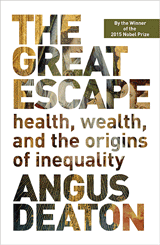
The Great Escape: Health, Wealth, and the Origins of Inequality

Angus Deaton, Winner of the 2015 Nobel Prize in Economics
bookjacket
The world is a better place than it used to be. People are healthier, wealthier, and live longer. Yet the escapes from destitution by so many has left gaping inequalities between people and nations. In The Great Escape, Angus Deaton--one of the foremost experts on economic development and on poverty--tells the remarkable story of how, beginning 250 years ago, some parts of the world experienced sustained progress, opening up gaps and setting the stage for today's disproportionately unequal world. Deaton takes an in-depth look at the historical and ongoing patterns behind the health and wealth of nations, and addresses what needs to be done to help those left behind.


Deaton describes vast innovations and wrenching setbacks: the successes of antibiotics, pest control, vaccinations, and clean water on the one hand, and disastrous famines and the HIV/AIDS epidemic on the other. He examines the United States, a nation that has prospered but is today experiencing slower growth and increasing inequality. He also considers how economic growth in India and China has improved the lives of more than a billion people. Deaton argues that international aid has been ineffective and even harmful. He suggests alternative efforts--including reforming incentives to drug companies and lifting trade restrictions--that will allow the developing world to bring about its own Great Escape.


Demonstrating how changes in health and living standards have transformed our lives, The Great Escape is a powerful guide to addressing the well-being of all nations.


Angus Deaton, winner of the 2015 Nobel Prize in economics, is the Dwight D. Eisenhower Professor of Economics and International Affairs in the Woodrow Wilson School of Public and International Affairs and the Economics Department at Princeton University. His many books include The Analysis of Household Surveys and Economics and Consumer Behavior. He is a past president of the American Economic Association.

Reviews:
"If you want to learn about why human welfare overall has gone up so much over time, you should read The Great Escape: Health, Wealth, and the Origins of Inequality."--Bill Gates

"[O]ne of the most succinct guides to conditions in today's world. . . . The story Deaton tells--the most inspiring human story of all--should give all of us reason for optimism, so long as we are willing to listen to its moral."--David Leonhardt, New York Times Book Review

"[A]n illuminating and inspiring history of how mankind's longevity and prosperity have soared to breathtaking heights in modern times. . . . [Deaton's] book gives a stirring overview of the economic progress and medical milestones that, starting with the Industrial Revolution and accelerating after World War II, have caused life expectancies to soar."--Fred Andrews, New York Times
"[A]n engaging and sure-footed guide to the 'endless dance between progress and inequality . . .'"--Martha C. Nussbaum, New Republic

"Is the world becoming a fairer as well as a richer place? Few economists are better equipped to answer this question than Angus Deaton of Princeton University, who has thought hard about measuring international well-being and is not afraid to roam through history. Refreshingly, Mr Deaton also reaches beyond a purely economic narrative to encompass often neglected dimensions of progress such as better health. . . . [T]he theme requires a big canvas and bold brushwork, and Mr Deaton capably offers both."--Economist

"[E]loquently written and deeply researched. . . . For those interested in world poverty, it is unquestionably the most important book on development assistance to appear in a long time."--Kenneth Rogoff, Project Syndicate


Table of Contents:
Preface ix
Introduction: What This Book Is About 1
1 The Wellbeing of the World 23
PART I LIFE AND DEATH
2 From Prehistory to 1945 59
3 Escaping Death in the Tropics 101
4 Health in the Modern World 126
PART II MONEY
5 Material Wellbeing in the United States 167
6 Globalization and the Greatest Escape 218
PART III HELP
7 How to Help Those Left Behind 267
Postscript: What Comes Next? 325
Notes 331
Index 351


http://press.princeton.edu/titles/10054.html

Wednesday, September 16, 2015

The European Crisis

Michael Walzer, Dissent Magazine
September 11, 2015

The crisis in Europe today is felt most dramatically and most painfully by tens of thousands of refugees. They are indeed in critical need of help, and many of them will die if their needs are not recognized and met. But this is also a crisis for the people of Europe, for they are the ones, right now, who must recognize and meet those needs, and if they fail to do that, the idea of Europe will die. The dream of a new kind of commonwealth, a commonwealth of mutual responsibility and liberal values, will be over; we will wake up to a grim day.
In 1938, in an earlier European crisis, with refugees clamoring to enter France, Leon Blum, the leader of the Socialist Party and the prime minister of the short-lived Popular Front government of 1936, gave a speech whose key sentences are worth repeating today. This is what he said:
Your house may already be full. That may be. But when they knock on your door, you will open it, and you will not ask them for their birth certificates or criminal records or vaccination certificates.
What a joy it would be to hear a Socialist leader in Europe today speak like that! François Hollande came close: “It is the duty of France, where the right to asylum is an integral part of its soul, its flesh. . . .” But he then announced that France would admit 24,000 refugees over the next two years—too few, given the numbers knocking on the door.
Blum in ’38 went on to say that the refugees would not necessarily stay in France. A more general solution to the crisis was required, as it is today, permitting the return of people to their homelands or their resettlement in different countries, which would share the burden of providing for them. But they needed a place, they need a place, right now: “How can you refuse them shelter for a night?” Blum asked. In Europe today, only the Germans and the Swedes have opted strongly against refusal; Italy and Greece are overwhelmed and eager to help the refugees on their way to other places. The EU as a whole is once again, as Europe was in the 1930s, a world of borders and refusals.
Faced with the desperate plight of the migrants, the countries of Europe (and other countries, too—I’ll come to them) face a clear choice: they can help stem the tide, by confronting the poverty, civil wars, and predatory governments that produce it, or they can take people in for the night and for many nights. I guess it isn’t actually a choice; some version of both is morally and politically necessary. Let me say something, very briefly, about each of them, starting with the second.
The immense task of providing shelter for a night has fallen on countries like Jordan, Lebanon, and Turkey, where several million refugees are now housed or tented in camps with inadequate, most often radically inadequate, shelter, sanitation, and health services. Even for this, the costs are enormous, and richer countries, most of whom don’t want to see these people at their borders, have nonetheless failed to help them, or to help them enough, where they are. Men, women, and children are fleeing the camps, on a very dangerous journey to those European borders, which are mostly closed to legal crossings. Illegal crossings are now a big business, which, like other businesses in our neoliberal world, produce many casualties. Stories of injury and death at the hands of traffickers have become commonplace, and they move us, though not very much. But the people won’t stop coming, so the crossings must be made legal and help provided on a scale that matches the wealth of the providers. Your house may be full. It doesn’t matter.
European leaders, led by Germany’s Merkel, have talked about dividing the burden by assigning quotas to each member state of the EU: so many refugees for you, so many for you. The numbers discussed have been too small, but as of this writing, no assignments have been made or accepted. Iceland has done better.
And what about the United States, where Liberty lifts its torch to welcome the huddled masses? There isn’t much of a welcome these days. We have taken in very few of the refugees from Iraq, very few even of the people who cooperated with U.S. occupation and whose lives were therefore in danger, and even fewer from Syria.* Our politicians are vying with each other in their enthusiasm for keeping out Mexicans, so why would they open the door to people from so far away? We should be assisting Europe or, better, embarrassing Europe, by taking in significant numbers of people—especially from parts of the world that we have helped to ruin. It should be easier for us, an immigrant society, than for the Europeans who persist in thinking of themselves, against a lot of evidence, as a land of anciently rooted and entirely homogeneous populations.
In a recent New York Times op-ed, Ross Douthat counseled prudence: advocates of opening the door are “blind to the realities of culture, the challenges of assimilation, and the danger and inevitability of backlash.” He is right, of course, about the realities, the challenges, and the danger, but what follows from being right? In the 1840s, the United States took in tens of thousands of Irish Catholic peasants fleeing the potato famine—immigrants who, our nativists insisted, would never learn the virtues of democratic citizenship (only Protestants could do that). And, yes, we got the backlash of the Know-Nothing Party, which was briefly a majority party in parts of the northeast. But sometimes dangers have to be met, not avoided.
What about other countries, where the dangers might be less threatening than in Europe? India and China seem sufficiently crowded, but Australia, New Zealand, Canada, Brazil, Argentina—surely these countries have room for some number of desperate people. The countries most responsible for the Syrian disaster—Iran, Russia, and Saudi Arabia—have taken in none at all of its victims; they should be welcoming Syrians by the thousands. Indeed, in all of these countries, and ours too, an influx of immigrants would, over time, strengthen the economy and enhance the culture. And, not to worry, if there is ever peace in their homelands, many of the refugees will go home.
Is there any way of bringing peace to their homelands, or of reducing poverty, or of replacing predatory rulers? Besides taking people in, we have a responsibility to help them where they are. Not having helped them where they are, and sometimes having hurt them, Europeans and Americans, and others too, must take them in. But, still, it would be a good thing to change the conditions that drive so many into exile. People don’t leave their homes willingly; it takes a disaster to produce large numbers of refugees, looking for a better place or just a place to rest for a while. A serious, sustained policy of investment, substantially funded but carefully and locally focused, could begin to reduce poverty in, say, the countries of sub-Saharan Africa. But politics is probably a more common cause of disasters than economics is, and wars, warlords, and tyrants require a more forceful intervention. We are rightly leery of anything like that. Overthrow a tyrant, like Qaddafi, say, and you get a chaos of thugs and zealots—and then thousands of people fleeing. What ought to be done?
I have a utopian solution, which is also politically incorrect. There are countries in the world today that ought to be, for a time, not-independent and not-sovereign. What the world needs, and what the UN might provide if it were the organization it was meant to be: a new trusteeship system for countries that are temporarily unable to govern themselves. The old mandate system of the League of Nations was not a great success, but it did not produce, and perhaps it prevented, disasters like the ones we are helplessly watching today. For the last decade and a half, Kosovo has been a kind of NATO trust—again, not a glorious example, for refugees are still fleeing, but at least the killing has stopped. So perhaps it isn’t crazy to suggest that Libya and Syria ought to be UN trusteeships, with some coalition of countries, different in each case, taking responsibility for maintaining law and order and providing basic services to the population—under strict UN supervision. I hesitate to suggest the countries that might serve as trustees, since I wouldn’t want to vouch for any country’s trustworthiness. But great virtue isn’t necessary, only a readiness to stop the killing, get rid of the killers, and provide enough stability for the citizens of the war-ravaged countries to begin rebuilding. That has to be their work.
...
Full-text available at:

Sunday, November 02, 2014

Shifting Sands: The United States in the Middle East


Joel S. Migdal
Columbia University Press 2014

Joel S. Migdal revisits the approach U.S. officials have adopted toward the Middle East since World War II, which paid scant attention to tectonic shifts in the region. After the war, the United States did not restrict its strategic model to the Middle East. Beginning with Harry S. Truman, American presidents applied a uniform strategy rooted in the country’s Cold War experience in Europe to regions across the globe, designed to project America into nearly every corner of the world while limiting costs and overreach. 

The approach was simple: find a local power that could play Great Britain’s role in Europe after the war, sharing the burden of exercising power, and establish a security alliance along the lines of NATO. Yet regional changes following the creation of Israel, the Free Officers Coup in Egypt, the rise of Arab nationalism from 1948 to 1952, and, later, the Iranian Revolution and the Egypt-Israel peace treaty in 1979 complicated this project. Migdal shows how insufficient attention to these key transformations led to a series of missteps and misconceptions in the twentieth century. With the Arab uprisings of 2009 through 2011 prompting another major shift, Migdal sees an opportunity for the United States to deploy a new, more workable strategy, and he concludes with a plan for gaining a stable foothold in the region.


Joel S. Migdal is the Robert F. Philip Professor of International Studies at the Henry M. Jackson School of International Studies, University of Washington, and has been writing about the Middle East and state-society relations worldwide for more than forty years. Among his books are The Palestinian People (with Baruch Kimmerling), Through the Lens of IsraelStrong Societies and Weak States, and State-in-Society.


Monday, October 27, 2014

The Arab Uprisings Explained


Edited by Marc Lynch
Columbia University Press 2014 

Why did Tunisian protests following the self-immolation of Mohammed Bouazizi lead to a massive wave of uprisings across the entire Arab world? Who participated in those protests, and what did they hope to achieve? Why did some leaders fall in the face of popular mobilization while others found ways to survive? And what have been the lasting results of the contentious politics of 2011 and 2012? The Arab uprisings pose stark challenges to the political science of the Middle East, which for decades had focused upon the resilience of entrenched authoritarianism, the relative weakness of civil society, and what seemed to be the largely contained diffusion of new norms and ideas through new information technologies.

In this volume, leading scholars in the field take a sharp look at the causes, dynamics, and effects of the Arab uprisings. Compiled by one of the foremost experts on Middle East politics and society, The Arab Uprisings Explained offers a fresh rethinking of established theories and presents a new framework through which scholars and general readers can better grasp the fast-developing events remaking the region. These essays not only advance the study of political science in the Middle East but also integrate the subject seamlessly into the wider political science literature. Deeply committed to the study of this region and working out the kinks of the discipline, the contributors to this volume help scholars and policymakers across the world approach this unprecedented historical period smartly and effectively.

Wednesday, September 10, 2014

Interview with Islam Expert John Esposito

September 8, 2014

John L. Esposito is University Professor, Professor of Religion & International Affairs and of Islamic Studies, and Founding Director of the Alwaleed Center for Muslim-Christian Understanding at the Walsh School of Foreign Service, Georgetown University. Previously, he was Loyola Professor of Middle East Studies, at College of the Holy Cross.
Past President of the American Academy of ReligionMiddle East Studies Association of North America, and the American Council for the Study of Islamic Societies, Esposito has served as consultant to the U.S. Department of State and other agencies, European and Asian governments, corporations, universities, and the media worldwide. He is a member of the World Economic Forum’s Council of 100 Leaders and the E. C. European Network of Experts on De-Radicalisation and an ambassador for the UN Alliance of Civilization.
His more than 45 books include The Future of IslamWhat Everyone Needs to Know about Islam,Islamophobia and the Challenge of Pluralism in the 21st CenturyWho Speaks for Islam? What a Billion Muslims Really Think (with Dalia Mogahed), Unholy War: Terror in the Name of Islam, Islam and Democracy(with J. Voll), The Islamic Threat: Myth or Reality?, and Islam and Politics, Political Islam: Radicalism, Revolution or Reform?. He is Editor-in-Chief of Oxford Islamic Studies Online and Series Editor of the Oxford Library of Islamic Studies, and is Editor-in-Chief of The Oxford Encyclopedia of the Islamic WorldThe Oxford Encyclopedia of the Modern Islamic WorldThe Oxford History of IslamThe Oxford Dictionary of Islam, The Islamic World: Past and Present, and Oxford Islamic Studies Online. His writings have been translated into more than 35 languages.
In this interview, Professor Esposito discusses his career, the current state of IR scholarship on Islam, the rise of ISIS, and Islamophobia.
How has the way you understand the world changed over time, and what (or who) prompted the most significant shifts in your thinking?
I have often marvelled that “an Italian-American kid from Brooklyn,” the first generation to graduate from high school and then college, raised and formed in an overwhelmingly Roman Catholic culture with minimal exposure to other religions and cultures, with the Capuchin Franciscans, training to be a priest, from the age of 14 until I left the monastery at 24 years of age, could become an academic, let alone have the life and experiences that I have had in my more than 40 year encounter with Islam and Muslims.
I received an MA in Theology from St. John’s University and taught at Rosemont College. It was here that I would suddenly find myself as a young theologian in a world that was torn by the Vietnam War, the civil rights movement, and Vatican II reforms in Catholicism.
In 1955, Will Herberg’s captured the landscape of America in Protestant, Catholic, and Jew. But, by 1965, theologians were talking about the impact of secularization on religion and theology: Harvard’s Harvey Cox inReligion In the Secular City and “God is dead” theology. By the early 1970s, Harvey Cox authored Turning East, the response to the influx of Hindu gurus, Zen and Sufi masters, and immigrants from the East.
An unexpected and major turning point in my life occurred at Temple University, where I went to major in Catholicism studied for my PhD in the late 1960s, and finished in 1974. In contrast to other institutions, all grad students in the Department of Religion, regardless of their major, were required to major in one world religion and minor in two others. I took a required one-year introductory course in world religions (Hinduism, Buddhism, Chinese and Japanese religions, and Islam) with Bernard Philips, a charismatic teacher and the founder of the department, and never looked back, caught up in a new world of Hinduism and Zen Buddhism courses, intending to major in Hinduism. To my astonishment, Philips pressed me to take a course in Islam. Having acquired faculty in Christianity, Judaism, Hinduism, Buddhism, and Chinese religions, Temple was now developing its Islamic studies component. I knew little about Islam and my images were from movies like The Exodus (1960) and its biased view of Arabs, and Lawrence of Arabia.
I had now made the astonishing discovery that there was another global Abrahamic faith, the second largest religion in the world. The children of Abraham included not only Jews and Christians, but also Muslims.
Like all great teachers, Ismail al-Faruqi combined scholarship with an energy and passion for his subject that was contagious. At Temple, I learned Islam from both texts and context, from books, and from Muslim professors and grad students who came from Nigeria and Egypt, Pakistan and Malaysia. This unique feature of the program provided immediate insight not only into the unity but also the diversity of Islam from North Africa to Southeast Asia. I learned not only from texts, but also from the perspectives of believers, seeing Islam as a living/lived faith. Much to my surprise and to the surprise of others, I changed plans and majored in Islam while minoring in Hinduism and Buddhism. The reaction of colleagues – theologians, family, and friends were quick to ask: “Why study Islam? You’ll never get a job.” And they were correct.
Religion, and particularly Islam, has enjoyed considerable attention from International Relations (IR) scholars since 9/11. Prior to this, however, both Islam and religion in general were generally under-explored intellectual terrains in IR scholarship. Do you think IR scholars are better placed to understand the role of religion in international politics now than they were before the 9/11 attacks?
In contrast to today, until only a few decades ago in the US and Europe, Islam and Muslim were invisible on our cognitive and demographic maps. Knowledge and coverage of Islam and Muslims were negligible in media, schools, and universities, the training for the military and Foreign Service Officers. Islamic studies was primarily focused on the past, emphasizing the study of texts and history, not the role of religion in modern politics and society. This trend was reinforced in the social sciences, informed by the reigning belief in modernization and development theory, which conflated development and modernization with the westernization and secularization of societies. Religion was a legacy from the past, irrelevant or an obstacle to modernization and the building of modern nation states. Some wrote of the passing of traditional societies and that Muslims would have to choose between Mecca or mechanization. Most professional associations – the Middle East Studies Association (MESA), American Historical Association, American Political Science Association, International Studies Association, even American Academy of Religion (AAR) – had little to no coverage of Islam and religion in the public square. Scholars of Islam were few and far between. In fact, Temple University was the first university, at least that I know of, to introduce the study of World Religions and Islam in 1968 and offer a degree in a Religion Department. Until that time, scholars of Islam were trained in departments of Arabic language and literature or history. Religion Departments were, in fact, predominantly staffed with experts on Christian scripture and theology with minimal or no coverage of Judaism. When, in the 1970s, departments began to respond and broaden their offerings, most introduced World Religions courses and emphasized an expertise in Hinduism and Buddhism, not Islam. The Iranian revolution would dramatically prove a “game changer.”
Iran’s Islamic Revolution of 1978-79 transformed many lives, not only those in Iran and other parts of the Muslim world, but also US/European-Iran relations. Given Iran’s strategic location and the Shah’s long relationship with the US and threat to American national interests (the oil fields and our oil-producing allies in the Middle East) and the hostage-taking of American diplomats in our embassy, Iran’s Revolution and fears of an “Islamic fundamentalist threat” made careers. Reporters like Ted Koppel and Nightline, with its subtitle “America held hostage,” other journalists, and especially specialists in Middle East and Islamic studies, were catapulted out of the ivory tower and onto the lecture, consulting, and television circuits. For some scholars, if the 1970s were quiet private years, the 1980s and 90s were high-profile and fast-paced public years.
Political and demographic change during the 1980s and 1990s moved interest in Islam and Muslim politics from the periphery to centre stage. For those of us in the field, the famine became a feast: book contracts, speaking engagements all over the world, consulting jobs, and media appearances. A decade later, Saddam Hussein’s invasion and occupation of Iraq, and followed by Osama Bin Laden, al-Qaeda, and especially 9/11 and subsequent attacks from London and Madrid to Bali, precipitated a “global war on terrorism” whose impact reinforced fears of a clash of civilizations, changed the dynamics of global politics, and resulted in a quantum increase in government agencies and terrorism experts and in security, Middle East, and Islamic studies, as well as the exponential growth of Islamophobia.
The horrific attacks by Al Qaeda on the World Trade Center and Pentagon, with subsequent terrorist attacks in London, Madrid, Bali, and elsewhere, and the rhetoric which called for a militant Jihad against the West, became the lens through which media and many in our societies came to view not only terrorist organizations, but also, for many, global Islam and Muslims. Fear of the religion of Islam and mainstream Muslims, not just fear and zero tolerance for Muslim extremists and terrorism, affected foreign and domestic policy.
International Relations (IR) was especially challenged by 9/11 and its aftermath. As I noted previously, the social sciences have ignored or dismissed the relevance and role in a modern nation state in which religion was, at best, a private matter antithetical to modern secular democracy and the public square. How was one to explain the resurgence of religion in politics and society, not only in Islam, but also in Christianity, Judaism, Hinduism, and Buddhism? How, in particular for those who saw modern education as producing a more secular-minded citizenry, was one to explain the role and involvement of modern educated leaders and followers (physicians, lawyers, engineers, journalists, and scientists who constituted an alternative elite to secular elites) as well as the less educated. The Social Science Research Council and others have attempted to address (to understand, analyze, and teach) these and other issues regarding the relationship of secularism and religion in modern states and societies, as well as form a committee to work on the development of curricula. When I first went to Georgetown University’s School of Foreign Service (SFS), one of the oldest and leading schools of international affairs, to direct the newly created Center for Muslim-Christian Understanding (CMCU), I was not only a professor of Islamic studies, but also the first professor of religion and international affairs, and there was no emphasis on politics and culture. Now, Culture and Politics (CULP) is a very popular major in SFS. There was only one (non-tenured) person in the entire university teaching Islam in the Theology Department. Now there are scholars of Islam (religion, politics, and society) in Theology, CMCU, and the Department of Arabic, renamed the Department of Arabic and Islamic Studies, as well as others. Today, in any good university or college, one expects to find faculty and courses in Islamic studies, not only in the humanities, but also in the social sciences.
ISIS is currently dominating international news headlines through its activity in Iraq and Syria, and there has been much discussion about effective ways to stop this militant Islamist group. What do you feel would be an effective response to ISIS?
As so often in the past (the Iranian Revolution, the rise and early successes of the Taliban in Afghanistan, Al Qaeda’s spread internationally, etc.), the rapid expansion of ISIS (or IS) in (and then out of) Syria and into Iraq stunned the international community and is currently dominating international news headlines.
Containing and ultimately defeating ISIS will require both short- and long-term response. ISIS expansion has been made possible by political conditions in Syria and Iraq, ethic-religious/sectarian divisions, and violence and terror in the region, and the failures of the US and international community.
Like Al-Qaeda and other militants, ISIS offers a militant, warped, and distorted Salafi ideology/religious rationale or rationalization to justify, recruit, legitimate, and motivate many of its fighters. Much of what they do violates Islamic law: its unabashed acts of terrorism, slaughter of civilians, savage use of beheadings, and killing of innocent Muslims, Yazidis, and Christians.
While religion/Islam, a particularly harsh and distorted version, does play a role to legitimate, recruit, and motivate, studies of most jihadist and movements, like ISIS, show that the primary drivers are to be found elsewhere. As in the recent past, so too today, this has remained true for Europeans and Americans who have joined ISIS.
Studies by the EC’s European Network of Experts on Violent Radicalization (of which I was a member) on radicalization in Europe, as well as those by terrorism experts like Marc Sageman and Robert Pape on global terrorism and suicide bombing, have found that, in most cases, religion is not the primary source of most extremist behaviour. Drivers of radicalization include moral outrage, disaffection, the search for a new identity, and for a sense of meaning, purpose, and belonging. For many, it is the experience or perception of living in a ‘hostile’ society, disenfranchisement, anti-imperialism, social injustice, and emancipation from occupation or corrupt authoritarian rulers.
At the end of the day, the peoples of the region (Syria, Iraq, Turkey, Jordan, Lebanon, and Gulf states) will have to deal with their problems. However, a substantial international commitment and involvement by the US, in consort with its European and Middle East allies (especially Turkey, Saudi Arabia, Qatar, Jordan, and the UAE), is also needed. Support for Syria’s weak and fractured moderate opposition, and for the new Iraqi president in strengthening Iraq’s military and security forces, and, in some cases, carefully targeted military operations and aid, are important considerations.
But, in the long run, if we wish to break the cycle of global terrorism and its movements that have existed in recent decades, as Graham Fuller notes in “Avenging James Foley“, the conditions and basic and enduring grievances in Muslim countries that jihadist terrorist movements have exploited in recent decades must also be addressed: “foreign boots on the ground, dictators supported by the US out of convenience, a failure to end a half century of Israeli occupation of Palestinian lands, the treatment of Palestinians as a paradigm for treatment of other Muslims, the US employment of the region as an eternal cockpit for proxy wars—all of this is still ongoing.”
You’ve been extensively involved in the promotion of strong ties between Muslims and Christians. At present, how do you assess the global relationship between Muslims and Christians, and what more can be done to improve relations?
The global relationship between Muslims and Christians in the Arab and broader Muslim world has both prospered and deteriorated. Great advances have been made not only in Muslim-Christian relations, but also in interfaith or multi-faith relations that include all major faiths. Major Muslim-Christian initiatives have occurred between the Vatican as well as the Archbishop of Canterbury, and in many countries at the national and local levels. The project and document “A Common Word between US and You” saw some 300 Muslim religious leaders reach out to the leaders of the Catholic, Anglican/Episcopal, and Protestant churches.
Sadly, at the same time, the rise of ultra-conservative, fundamentalist Christian and Muslim tendencies have reinforced a religious exclusivist worldview that is inimical to our increasingly multi-ethnic and multi-religious societies. We see it domestically with anti-Muslim tirades by Pat Robertson, John Hagee, Rod Parley, and Franklin Graham, and Islamophobia in America and Europe. Internationally significant anti-religious conflicts between Muslims and Christians: clashes have occurred from Nigeria and Egypt to Pakistan and the Philippines.
Statements that denounce violence and terrorism, and encourage mutual understanding and respect, are important, but they require implementation. Senior religious leaders have to be put into operation in training programs in churches and madrasas for the next generation of priests, ministers, and imams; so too, more outreach programs for high school teachers, and more courses and programs in universities and colleges are important, as well as faith-based summer youth projects. Political leaders and the media have an important role to play. They cannot pander to the hardline religious right bias and bigotry for votes, and media has to balance its at times obsessive coverage of extremism with more coverage of the mainstream majority, their lives and beliefs. Failure to do so reinforces the dangers of anti-Muslim attitudes and behaviour.
In 2012, you produced a book with Nathan Lean titled The Islamophobia Industry, which explored the rise of fear and hatred of Muslims sweeping through the United States and Europe. How wide a problem do you feel Islamophobia is, and do you see it as a phenomenon not simply confined to the far right?
Islamophobia has been a social cancer metastasizing in America and Europe since the 1990s. Islamophobia is prejudice or hostility towards Muslims on the basis of their religious or ethnic identity. Criticism of Islamic theology and culture is not intrinsically Islamophobic, just as criticism of the tenets or cultures of other world religions does not necessarily indicate a prejudicial position towards those who subscribe to them. Islamophobia refers to bias and discrimination that often lead to discrimination and hate speech, ascribing collective blame on the majority of mainstream Muslims for the actions of Muslim extremists and terrorists, violence, hate crimes, or denial of civil liberties.
In contrast to the UK, where the term Islamophobia was coined in the 1990s (and now is used in Europe), no term existed, or was used, in the US until fallout from the construction of Park 51 (the so-called mosque at Ground Zero), the Islamic center in downtown Manhattan. Time magazine was the first major publication to do a cover story that asked “Is America Islamophobic?” Unlike anti-Semitism, racism, and homophobia, Islamophobia is still deemed culturally acceptable. It has yet to reach the threshold of being – at least publicly (broadcast, political establishment, etc.) – taboo.
Politicians, media commentators, hardline Christian Zionist preachers, and Islamophobic polemicists and websites – a dominant internet presence – have been enablers in its significant presence in popular culture.
Examples of the impact of Islamophobia in the US can be seen not only in incidents of hate speech and hate crimes, but also in the rhetoric and discourse in the 2008 and 2012 presidential elections, as well as the 2010 and 2012 congressional elections, and in the Park 51 protests and their aftermath.
In 2008, when Barack Obama visited Dearborn, some of his staff prevented his being photographed with young women wearing hijab, and many opponents labelled him a Muslim to discredit his candidacy. During the 2012 presidential election contest, every Republican candidate, either at that debate or in the two years before, had engaged in Islam and Muslim exceptionalism, questioning the loyalty of American Muslims, whether a Muslim could serve in the cabinet and under what conditions, the need to ban shariah law, etc.
You can see the impact during his presidency. President Obama has never visited a US mosque or sought a photo op at one. No Muslim has been appointed to a senior ambassadorship, and the number of visible senior members of the administration is negligible. Anti-Islam and anti-Muslim rhetoric became a topic in political contests in the 2010 congressional elections.
The building of an Islamic center in Manhattan near Ground Zero sparked a national debate and protest demonstrations. While there were diverse critics and reasons for opposition, prominent anti-Muslim activists played a major role in spearheading opposition, charging, among other things, that the Islamic center was a mosque that would be a monument to terrorism. Activists like Robert Spencer and Pam Gellar – who run websites including Freedom Defense InitiativeStop Islamization of America (SIOA) (which the Southern Poverty Law Center listed as an anti-Muslim hate group in 2010), and Jihad Watch – mobilized media, particularly social media, and public demonstrations. They coined terms like the “Mosque at Ground Zero” and “Mega Mosque at Ground Zero.”
In the aftermath of Park 51, a wave of anti-mosque activities swept from New York to California. This was also accompanied by some 29 states that have sought to pass anti-shariah laws to prevent its implementation, when in fact it’s impossible to do so under our Constitution.
Mainstream media, driven by the bottom line and market share, is captured by the media mantra “If it bleeds, it leads.” The effect of this approach can be seen in a Media Tenor report “A New Era of Arab Western Relations,” which reviewed 975,000 news stories in US and European media outlets, and reported astonishing imbalance.
  • In 2001, 2% of all news stories in Western media presented images of Muslim militants, while just over 0.1% presented stories portraying ordinary Muslims.
  • Jump to ten years later. In 2011, militant images went from 2% in 2001, to 25% in 2011. Yet, coverage of ordinary Muslims remained the same as 2001, at 0.1%.
Equally troubling and dangerous is the emergence of a cottage industry that has been meticulously cultivated by anti-Muslim polemicists and their resourceful funders, who master the domain of the internet with dozens of highly visible blogs and websites supported by hundreds of user blogs to which they link.
2011 study by the Center for American Progress found that, according to collected IRS tax returns, during a ten-year period, $42.6 million flowed from seven major foundations to these Islamophobic authors and websites.
The 2013 CAIR report “Legislating Fear: Islamophobia and its Impact in the United States,” also with information taken from IRS returns, showed that, between 2008 and 2011, $119,662,000 dollars total revenue were given to US-based Islamophobia networks.
A lot of literature has been produced on Islam since 9/11. Yet, arguably, there are a lot of what could be described as misleading and agenda-driven texts out there. For people, particularly students, wanting to learn more about Islam, how should they distinguish between honest and dishonest writers?
In contrast to forty years ago, Iran’s Islamic Revolution, and especially 9/11, led to an explosion in publications in Islamic and Middle East studies and in major reference works. At the same time, the internet has become an access point for vast information and disinformation. Given the diversity of materials and diverse intellectual and political orientations – for example, from Tea Party and neocon to liberal or progressive – all tend to describe as misleading and agenda-driven texts out there. Just as years ago one could find PhDs or experts from the best universities supporting the tobacco industry, and scholars from similar universities giving a totally different assessment, so too today, in areas of global politics and religion we find a similar situation. Therefore, it is important to know publishers and authors of information: what is their orientation, track record, etc. This is made easier with the use of Google!
One of the reasons Oxford University Press launched an ambitious series of reference works that now cover most areas from culture and politics to science, gender, and the arts, was to meet the need for providing the best scholarship available. Similarly, with regard to the internet, Oxford Islamic Studies Online offers internet access to major texts (primary and secondary sources, biographies, etc.).
Many of E-International Relations’ readers are students. What key advice would you give those wanting to focus their research on the Islamic world?
The most important lesson I have learned from all of my years as an academic and as a student of Islam and Muslim societies is the most obvious and yet elusive. If you want to know what people believe, if you want to grasp the reality of everyday life, you have to combine, to use the current academic jargon, “text and context.” Understanding the faith and lives of others requires knowledge of religion, history, politics, and culture. You need knowledge of sacred sources, as well as what people actually believe and do!
Appreciation of the essentials of a religion cannot exclude awareness of the diversity of its forms and expressions. However important the Hebrew Bible (Old Testament) and the New Testament, understanding Judaism and Christianity also requires that you observe what Jews and Christians believe and practice in specific historical, cultural, and social contexts. Judaism is Torah and Talmud. Judaism in Ethiopia, Israel, and New York may have an underlying similarity, but in fact its cultural expressions differ enormously. Similarly, beyond their shared identification with Jesus Christ, Western Christians and their Eastern counterparts (Coptic, Melkite, Orthodox, Presbyterian, and Anglican) have rich theologies and practices that are conditioned by their unique historical and cultural experiences. Although many tend to see Islam and Muslims too often through images drawn from Saudi Arabia or Iran, Muslim practice (dress, the roles of women and society, song and dance) varies widely from Africa and Asia to America and Europe.
This outlook has informed my work throughout the past 40 years. While I write about Islam (and other religions), the shared beliefs and practices of Islam, as well as its differing sects and schools of thought, I have always been drawn to seeing how the faith of Muslims plays out on the ground, in specific Muslim societies. At the same time, I have been acutely aware of the need to distinguish between the faith of the many and the twisted interpretations and actions of the few, the mainstream majority and a militant, extremist minority.

Related Posts with Thumbnails

Düşünce Kahvesi

Photography

Photography
dpchallenge.com

NYT: Travel and Cities

H-Net Academic Announcements - All