Showing posts with label books. Show all posts

Wednesday, October 21, 2015

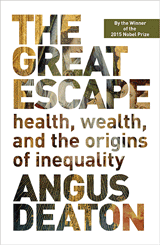
The Great Escape: Health, Wealth, and the Origins of Inequality

Angus Deaton, Winner of the 2015 Nobel Prize in Economics
bookjacket
The world is a better place than it used to be. People are healthier, wealthier, and live longer. Yet the escapes from destitution by so many has left gaping inequalities between people and nations. In The Great Escape, Angus Deaton--one of the foremost experts on economic development and on poverty--tells the remarkable story of how, beginning 250 years ago, some parts of the world experienced sustained progress, opening up gaps and setting the stage for today's disproportionately unequal world. Deaton takes an in-depth look at the historical and ongoing patterns behind the health and wealth of nations, and addresses what needs to be done to help those left behind.


Deaton describes vast innovations and wrenching setbacks: the successes of antibiotics, pest control, vaccinations, and clean water on the one hand, and disastrous famines and the HIV/AIDS epidemic on the other. He examines the United States, a nation that has prospered but is today experiencing slower growth and increasing inequality. He also considers how economic growth in India and China has improved the lives of more than a billion people. Deaton argues that international aid has been ineffective and even harmful. He suggests alternative efforts--including reforming incentives to drug companies and lifting trade restrictions--that will allow the developing world to bring about its own Great Escape.


Demonstrating how changes in health and living standards have transformed our lives, The Great Escape is a powerful guide to addressing the well-being of all nations.


Angus Deaton, winner of the 2015 Nobel Prize in economics, is the Dwight D. Eisenhower Professor of Economics and International Affairs in the Woodrow Wilson School of Public and International Affairs and the Economics Department at Princeton University. His many books include The Analysis of Household Surveys and Economics and Consumer Behavior. He is a past president of the American Economic Association.

Reviews:
"If you want to learn about why human welfare overall has gone up so much over time, you should read The Great Escape: Health, Wealth, and the Origins of Inequality."--Bill Gates

"[O]ne of the most succinct guides to conditions in today's world. . . . The story Deaton tells--the most inspiring human story of all--should give all of us reason for optimism, so long as we are willing to listen to its moral."--David Leonhardt, New York Times Book Review

"[A]n illuminating and inspiring history of how mankind's longevity and prosperity have soared to breathtaking heights in modern times. . . . [Deaton's] book gives a stirring overview of the economic progress and medical milestones that, starting with the Industrial Revolution and accelerating after World War II, have caused life expectancies to soar."--Fred Andrews, New York Times
"[A]n engaging and sure-footed guide to the 'endless dance between progress and inequality . . .'"--Martha C. Nussbaum, New Republic

"Is the world becoming a fairer as well as a richer place? Few economists are better equipped to answer this question than Angus Deaton of Princeton University, who has thought hard about measuring international well-being and is not afraid to roam through history. Refreshingly, Mr Deaton also reaches beyond a purely economic narrative to encompass often neglected dimensions of progress such as better health. . . . [T]he theme requires a big canvas and bold brushwork, and Mr Deaton capably offers both."--Economist

"[E]loquently written and deeply researched. . . . For those interested in world poverty, it is unquestionably the most important book on development assistance to appear in a long time."--Kenneth Rogoff, Project Syndicate


Table of Contents:
Preface ix
Introduction: What This Book Is About 1
1 The Wellbeing of the World 23
PART I LIFE AND DEATH
2 From Prehistory to 1945 59
3 Escaping Death in the Tropics 101
4 Health in the Modern World 126
PART II MONEY
5 Material Wellbeing in the United States 167
6 Globalization and the Greatest Escape 218
PART III HELP
7 How to Help Those Left Behind 267
Postscript: What Comes Next? 325
Notes 331
Index 351


http://press.princeton.edu/titles/10054.html

Monday, February 16, 2015

'50 Ways to Live the Good Life'


  • Publisher: HarperCollins Publishers
  • Pub. Date: December 2006
With her 25th book, lifestyle philosopher Alexandra Stoddard offers simple steps for taking charge of your life--your way. In brief essays filled with useful examples and optimism, she reveals 50 choices you can make to live joyfully in pursuit of what is true, good, and beautiful. Her essays help us trust ourselves ("Intuition is your guiding light"), stay steady in a storm ("Your choices count most in a crisis"), embrace the new ("Accept opportunity"), address unfinished business ("Have as few regrets as possible"), surround ourselves with delights ("Redefine what is beautiful"), and remember to have fun ("Cheap thrills are thrilling").

As a pioneering writer and lecturer on personal happiness for the past twenty years, Alexandra has inspired millions to break the "rules" and pursue fulfillment. Now, as scientists have begun to discover the benefits of living a happy life, Alexandra provides practical ways to live happily every day. She puts us in charge of our choices, reminding us that we always have a choice about what we think, feel, and do. When we are true to ourselves, we can fly above stress and conflict, contented and confident that we are the right path.

Every choice you make is an opportunity to delight in life. You Are Your Choices offers insight and companionship each step of the way.

Deborah Bigelow - Library Journal

Stoddard's (Living a Beautiful Life) guide, which invites readers to live a good, beautiful, and true life, fits right in with people's desire to live life differently in the new year. In 50 short essays, Stoddard incorporates the thoughts of great philosophers and leaders into commonsense ideas for daily application. She invites readers to embrace variety, e.g., by tasting a new flavor of ice cream or learning to identify constellations. Similarly, she encourages the celebration of simple rituals by using a special bar of soap or a beautiful towel for hand washing. Everyone will undoubtedly find something of value in this gem of a book for most public libraries.

Biography

Alexandra Stoddard is the author of more than twenty-five books and is a sought-after speaker on the art of living well. Through her lectures, articles, media appearances, and books such as Choosing Happiness, Things I Want My Daughters to Know, You Are Your Choices, and many more, she has inspired people around the world to pursue more fulfilling lives. She and her husband, Peter Megargee Brown, live in Stonington Village, Connecticut.

Table of Contents

An Invitation 1
Every Day, Commit Yourself to Experiencing the Good Life 4
Be True to All Your Choices 9
Be Responsible-Say No 12
Stand On Your Own Two Feet 15
Information Is Not Inspiration 19
Take Satisfaction in Doing the Right Thing 22
Go After What You Love 25
Have Realistic Expectations 29
Live from the Inside Out 33
Celebrate Simple Ceremonies 36
Reevaluate Your Priorities Regularly 43
Have as Few Regrets as Possible 48
Leave the Safe Harbor 52
Who Knows, It Might Be Good 57
Redefine What Is Beautiful 61
The Power of Flowers 67
Share the Beauty 72
Live with the Objects You Love 75
Why Not Be Comfortable? 80
Maintain Balance Through Your Choices 84
Cultivate Good Energy 87
Cheap Thrills Are Thrilling 91
You Own Your Self 95
Stop Complaining 98
Accept Responsibility 101
Be Aware 104
Your Choices Count Most in a Crisis 107
Faster Isn't Better 109
Reach Out-Literally 113
Privacy Please 116
A Free Day for You 119
Good Design Matters 122
Enough Is Enough 125
Give Yourself Time 130
Get Going 134
Embrace Variety 138
Move On 143
Walk Away 147
See the Big in the Little 150
Surround Yourself with People You Trust 154
Intuition Is Your Guiding Light 157
Never Say Never 160
Understand the Law of Cause and Effect 162
Choose Love for Yourself and Others 165
Do More Things That Make You Happy 168
Trust Your Subjective Well-Being 171
Avoid Perfection in Pursuit of Excellence 176
Get Organized 181
Why Not Now? 186
Wise Choices, Yes, and Good Luck 190
.
Source: Barnes and Noble
.

Wednesday, January 21, 2015

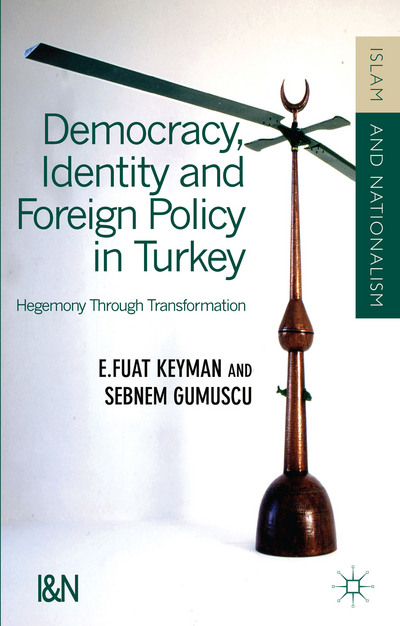
Democracy, Identity and Foreign Policy in Turkey

Democracy, Identity and Foreign Policy in Turkey


E.Fuat Keyman, Sabancı University
Şebnem Gümüşçü, Middlebury College 

Palgrave Macmillan, 2014


The recent history of Turkey is dominated by the country's transformation into a modern democracy. Over the past few years Turkey has been increasingly recognised as a nation of economic, political and cultural significance as well as being a vital political connection between Europe and the Middle East. In this compelling volume, Professor Keyman and Dr. Gumüsçu put democratisation in Turkey under the microscope with an especial focus on recent transformations under the Justice and Development Party (AKP). Accordingly, it explores to what extent Turkey's transformation under the AKP has led to democratic consolidation as well as asking if there is a disconnect between economic, cultural, and urban transformation, on the one hand, and democratic consolidation on the other? Furthermore, this book also takes the opportunity to explore several issues that have a direct effect on the consolidation of Turkish democracy such as globalization, foreign policy activism, the kurdish question, religious governance and civil society. By critically analyzing the dialectic between domestic transformations and global/regional dynamics, the book also discusses the ways in which Turkish transformation is affected by the Arab uprisings as well as how Turkey may inspire these countries.


Table of Contents

1. Introduction

2. Turkey's Transformation


3. Constructing Hegemony: the AKP Rule


4. AKP's Hegemony and Democratic Consolidation


5. Turkey's Proactive Foreign Policy under the AKP


6. Turkish Foreign Policy in the aftermath of the Arab Uprisings


7. The AKP, Arab Uprisings and the Kurdish Question


8. Secularism, Democracy and Identity


9. Civil Society and Democratic Consolidation


10. Conclusion: Turkey at the Crossroads: Democratization through the Strong EU Anchor


Sunday, November 02, 2014

Shifting Sands: The United States in the Middle East


Joel S. Migdal
Columbia University Press 2014

Joel S. Migdal revisits the approach U.S. officials have adopted toward the Middle East since World War II, which paid scant attention to tectonic shifts in the region. After the war, the United States did not restrict its strategic model to the Middle East. Beginning with Harry S. Truman, American presidents applied a uniform strategy rooted in the country’s Cold War experience in Europe to regions across the globe, designed to project America into nearly every corner of the world while limiting costs and overreach. 

The approach was simple: find a local power that could play Great Britain’s role in Europe after the war, sharing the burden of exercising power, and establish a security alliance along the lines of NATO. Yet regional changes following the creation of Israel, the Free Officers Coup in Egypt, the rise of Arab nationalism from 1948 to 1952, and, later, the Iranian Revolution and the Egypt-Israel peace treaty in 1979 complicated this project. Migdal shows how insufficient attention to these key transformations led to a series of missteps and misconceptions in the twentieth century. With the Arab uprisings of 2009 through 2011 prompting another major shift, Migdal sees an opportunity for the United States to deploy a new, more workable strategy, and he concludes with a plan for gaining a stable foothold in the region.


Joel S. Migdal is the Robert F. Philip Professor of International Studies at the Henry M. Jackson School of International Studies, University of Washington, and has been writing about the Middle East and state-society relations worldwide for more than forty years. Among his books are The Palestinian People (with Baruch Kimmerling), Through the Lens of IsraelStrong Societies and Weak States, and State-in-Society.


Monday, October 27, 2014

The Arab Uprisings Explained


Edited by Marc Lynch
Columbia University Press 2014 

Why did Tunisian protests following the self-immolation of Mohammed Bouazizi lead to a massive wave of uprisings across the entire Arab world? Who participated in those protests, and what did they hope to achieve? Why did some leaders fall in the face of popular mobilization while others found ways to survive? And what have been the lasting results of the contentious politics of 2011 and 2012? The Arab uprisings pose stark challenges to the political science of the Middle East, which for decades had focused upon the resilience of entrenched authoritarianism, the relative weakness of civil society, and what seemed to be the largely contained diffusion of new norms and ideas through new information technologies.

In this volume, leading scholars in the field take a sharp look at the causes, dynamics, and effects of the Arab uprisings. Compiled by one of the foremost experts on Middle East politics and society, The Arab Uprisings Explained offers a fresh rethinking of established theories and presents a new framework through which scholars and general readers can better grasp the fast-developing events remaking the region. These essays not only advance the study of political science in the Middle East but also integrate the subject seamlessly into the wider political science literature. Deeply committed to the study of this region and working out the kinks of the discipline, the contributors to this volume help scholars and policymakers across the world approach this unprecedented historical period smartly and effectively.

Friday, September 26, 2014

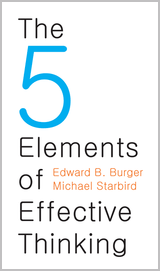
The 5 Elements of Effective Thinking

bookjacket
Princeton University Press, 2012

Winner of the 2013 Silver Medal in Self-Help, Independent Publisher Book Awards


The 5 Elements of Effective Thinking presents practical, lively, and inspiring ways for you to become more successful through better thinking. The idea is simple: You can learn how to think far better by adopting specific strategies. Brilliant people aren't a special breed--they just use their minds differently. By using the straightforward and thought-provoking techniques in The 5 Elements of Effective Thinking, you will regularly find imaginative solutions to difficult challenges, and you will discover new ways of looking at your world and yourself--revealing previously hidden opportunities.

The book offers real-life stories, explicit action items, and concrete methods that allow you to attain a deeper understanding of any issue, exploit the power of failure as a step toward success, develop a habit of creating probing questions, see the world of ideas as an ever-flowing stream of thought, and embrace the uplifting reality that we are all capable of change. No matter who you are, the practical mind-sets introduced in the book will empower you to realize any goal in a more creative, intelligent, and effective manner. Filled with engaging examples that unlock truths about thinking in every walk of life, The 5 Elements of Effective Thinking is written for all who want to reach their fullest potential--including students, parents, teachers, businesspeople, professionals, athletes, artists, leaders, and lifelong learners.

Whenever you are stuck, need a new idea, or want to learn and grow, The 5 Elements of Effective Thinking will inspire and guide you on your way.

To share thinking stories, go to: http://5elementsofthinking.wordpress.com

Edward B. Burger is the president of Southwestern University, and an educational and business consultant. Formerly he was a professor at Williams College and a vice provost at Baylor University. He has authored or coauthored more than sixty-five articles, books, and video series; delivered over five hundred addresses and workshops throughout the world; and made more than fifty radio and television appearances. His teaching and scholarly writing have earned him many national honors and the largest teaching award given in the English-speaking world. Michael Starbird is University Distinguished Teaching Professor at The University of Texas at Austin and an educational and business consultant. His numerous books, lectures, workshops, and video courses have reached large national audiences of students, teachers, businesspeople, and lifelong learners. His success at teaching people to think has been recognized by more than fifteen awards, including the highest national teaching award in his field as well as statewide and university-wide honors selected from all disciplines.

Reviews:
"What do earth, fire, air, and water have to do with effective thinking? Everything, according to mathematics professors Edward B. Burger and Michael Starbird. In The 5 Elements of Effective Thinking, the authors draw on these metaphor-laden elements from the natural world to demonstrate how to ask better questions, take calculated risks, learn from mistakes, and, ultimately, transform ourselves into more engaged and thoughtful citizens of the world. . . . The 5 Elements of Effective Thinking is a useful guide for anyone interested in tackling difficult subject matter, particularly in the classroom. The book also could serve as a solid supplementary text in courses on critical thinking."--Jennifer Moore, ForeWord Reviews

"If you remember being told by your teachers to think harder and having no idea how, The 5 Elements of Effective Thinking should help. . . . This is a snappy, illuminating read that should appeal to anyone who has ever dreamed of being a genius and is willing to strive, step by step, to become one."--David Wilson, South China Morning Post

"Thinking is good, enthuses this book by two distinguished teachers of mathematics. You might think you're being creative or having intuitions or conducting a romance or whatever, but it's all thinking, right? And you can learn to think better! So you can, and the advice herein, which includes many practical tenets of 'critical thinking', will surely be useful to many a schoolchild or business leader."--Steven Poole, Guardian (U.K.)


Monday, August 11, 2014

International Orders in the Early Modern World

International Orders in the Early Modern World

Before the Rise of the West

Edited by Shogo SuzukiYongjin ZhangJoel Quirk

Routledge – 2014 – 20 pages

This book examines the historical interactions of the West and non-Western world, and investigates whether or not the exclusive adoption of Western-oriented ‘international norms’ is the prerequisite for the construction of international order.
This book sets out to challenge the Eurocentric foundations of modern International Relations scholarship by examining international relations in the early modern era, when European primacy had yet to develop in many parts of the globe. Through a series of regional case studies on East Asia, the Middle East, Africa and Latin America, and Russia written by leading specialists of their field, this book explores patterns of cross-cultural exchange and civilizational encounters, placing particular emphasis upon historical contexts. The chapters of this book document and analyse a series of regional international orders that were primarily defined by local interests, agendas and institutions, with European interlopers often playing a secondary role. These perspectives emphasize the central role of non-European agency in shaping global history, and stand in stark contrast to conventional narratives revolving around the ‘Rise of the West’, which tend to be based upon a stylized contrast between a dynamic ‘West’ and a passive and static ‘East’.
Focusing on a crucial period of global history that has been neglected in the field of International Relations, International Orders in the Early Modern World will be interest to students and scholars of international relations, international relations theory, international history, early modern history and sociology.
REVIEWS
"An outstanding volume of non-Eurocentric historical-sociological essays that advances an extremely powerful critique of the English School’s commitment to what I call the ‘Eurocentric big bang theory of world politics’ – that the big bang of modernity exploded autonomously within Europe and that thereafter European ‘civilization’ expanded outwards in a non-problematic way to remake the world in its own image – by deploying the antidote of bringing Eastern agency back into the story of the long-term development of world politics." - John M. Hobson, Professor of Politics and International Relations, University of Sheffield, UK.
"Perhaps ‘1648 and all that’ fundamentally distorts our understanding of the history of international relations. By rediscovering early modern and non-western international orders, this expert team sets out a challenge to IR scholarship. It is especially welcome and important in making sense of the profound changes currently underway." - Ian Clark, E. H. Carr Professor of International Politics, Aberystwyth University
"Maps centered on the South Pole are amusing, but international relations books centered on the non-Western world are essential. From its origins, international relations theory has been a Western enterprise with other parts of the world largely ignored or analyzed through parochial and often inappropriate conceptions. Suzuki, Zhang, Quirk and their collaborators turn the tables and offer perspectives on Europe from East Asia, the Middle East, Africa and Latin America, and generally at a time when European interlopers were unable to impose their preferences on these cultures. They effectively demonstrate the importance of non-Western cultures and their ideas in shaping global history." - Richard Ned Lebow, Professor of International Political Theory, King's College London, UK
CONTENTS
Introduction Shogo Suzuki, Yongjin Zhang and Joel Quirk 1. Europeans and the Steppe: Russian lands under the Mongol Rule Iver B. Neumann 2. Europe, Islam and Pax Ottomana, 1453-1774 Ayla Göl 3. Curious and Exotic Encounters: Europeans as Supplicants in the Chinese Imperium, 1513-1793 Yongjin Zhang 4. Europe at the Periphery of the Japanese World Order Shogo Suzuki 5. A Corrupt International Society: How Britain Was Duped into its First Indian Conquest Darshan Vigneswaran 6. International Relations in the Americas during the Long Eighteenth Century, 1663-1820 Charles Jones 7. Europeans, Africans and the Atlantic World, c1450-1850 Joel Quirk and David Richardson Conclusion: Eurocentrism, World History, Meta-narratives and the meeting of international societies Richard Little
AUTHORS
Shogo Suzuki is Senior Lecturer in the Department of Politics at University of Manchester, UK.
Yongjin Zhang is Professor of International Politics at Bristol University, UK.
Joel Quirk is Senior Lecturer in the Department of Political Studies at the University of the Witwatersrand, South Africa.


Monday, June 16, 2014

International Relations since 1945

John Kent

East, West, North, South: International Relations since 1945 (7th edition) By: Geir Lundestad London: Sage Publications Ltd, 2014


The latest edition of this work has added more material, albeit primarily of a factually descriptive nature, to cover events after 1986, which was when the first edition concluded. Some alterations have also been made to the sections and the order in which they appear, although much of the overall structure is unchanged. The demand for new editions of the book bears witness to the continuing strength of Cold War orthodoxy about US policy, often dressed up as post-revisionism or linked to Soviet and Eastern bloc archives. The book has, however, always contained flashes of useful and interesting interpretations, which brighten up the more traditional and sometimes highly dubious assumptions that still dominate this latest edition.
Thus ,while some of the initial concepts and coverage have clear and valid attractions, by linking a number of global regions and phenomena, which are not always tackled in a work of this kind, reservations remain. There is a significant concentration on East-West relations in the period up to the early 1960s (118 pages out of the first 236 for under twenty years), as compared to the same amount for the period covering the next fifty years. Despite the justifiable merits of parts of the earlier editions on arms and US relations with Western Europe after the 1950s, there is a strong sense of regret that the ‘new’ of this edition does not apply to a wider range of issues and interpretations, which challenge some conventional interpretations. Unfortunately the post-revisionist Cold War focus, initially on Europe, still creates the feel that the geographic extensions involved in decolonisation, and issues of non-European and non-North American importance never assume an equal role in the analysis. This is despite the addition of a largely new chapter on the Rise of East Asia (Chap. 11), extending the earlier, now somewhat questionable interpretation of the Cold War beginning in Europe and becoming global.
Some of the strengths and weaknesses from the earlier editions are extended and developed into the period from 1986-2013. The use of online resources, especially the World Development Report, is particularly important and provides a different tool for general assessments of economic and social developments. The Stockholm International Peace Research Institute is used in a similar way for a valuable history of the arms race. The end of the Cold War receives a separate added chapter, although Gorbachev’s unilateral concessions on arms are included in the extended arms race chapter. The reluctance to distinguish between the separate, if connected, hot war and Cold War requirements was a feature of the first edition and remains so. One result is that the myth that NATO was formed because of the immediate Soviet military threat, as opposed to the ideological threat inherent in the influence of Soviet communism, is also maintained. Interestingly the Lisbon force goals of 1952 are still portrayed as embodying the reality of defending Western Europe with conventional forces. Actually the ninety-two divisions deemed necessary would, if they were raised, also have involved the destruction of any prospect of a stable peacetime economy. The British military were keen to produce the ‘I told you so’ card after Lisbon since, for the first three years after the shift in US global strategy (and indeed before), they had been telling the Americans that Europe could not be defended with conventional forces. And the ‘stop lines’ had only ever been devised for political reasons, not the military need to defend Western Europe. There is also no overall attempt to examine the ways in which military strategy was connected to, or disconnected from, foreign policy; nor to define propaganda, covert operations, or psychological warfare as important components of the early Cold War. Furthermore, in this edition, there is no sign of any influence from newer historians on both sides of the Atlantic, who have been writing with a focus on the US and without the language skills to access the new sources being revealed behind the former Iron Curtain (for example: Kenneth Osgood, Scott Lucas, Greg Mitrovich, Jonathan Haslam; and on the topic of decolonisation: Steve Ashton, Sarah Stockwell, Larry Butler, Ronald Hyam, Tony Stockwell).
The sense of a small amount of new wine in old bottles is reinforced by the short bibliographies, now included at the end of each chapter rather than in bibliographical sections at the end of the book. A large amount of recommended material is between thirty and forty years old, and outweighs some of the more recent works, which are all the more neglected if they undermine the already received and widely accepted wisdom. In the decolonisation section this is particularly noticeable, with six books noted from the 1960s and 1970s, four from the 1980s, and only four more from the 1990s onwards. Nothing is produced in the recommended reading on the French Empire by French historians, or on the Portuguese Empire arising from the growing interest of Portuguese historians. Nor is the multi-volumed forty-book series of the British Documents of the End of Empire Project, with their hundreds of page introductions mentioned, despite having begun twenty-five years ago. Neither here, nor in the literature related to the chapter on the global Cold War conflict, does the Non-Aligned World of the 1960s significantly feature. The important book, authored by the less well known Robert Rakove (2013), on Kennedy’s and Johnson’s different policies towards the non-aligned world, and which would have added significance for a work with a title of East, West, North, South, is also not mentioned.
The chapter on the economic relations between North and South has been extended both through chronological coverage and by transferring the theories of development and underdevelopment into the new chapter on economic relations between North and South (Chap. 13). As with revisionism, orthodoxy, and post-revisionism, there is a similar general interpretative framework provided through which economic development is discussed. In the case of Chapters 13 and 14, liberalism and structuralism provide the core framework of analysis, although the weaknesses of structuralism, as evidenced by events in the 1990s, are more noticeable than the problems of liberalism and the Washington Consensus, as laid bare by the 2007-08 crisis of deregulated financial capitalism.
There is an additional, more interesting, and completely new chapter on Globalisation and Fragmentation (Chap. 15), even if the questions arising from it are less troublesome for the liberal democratic capitalist order than those raised by the recent financial crisis, or Thomas Piketty’s (2014) analysis of capitalism and the data he uses to show when and how, in the last three centurie,s greater inequalities of wealth have been created or reduced. This is achieved by examining data from the 18th century onwards from the US, France, Great Britain, Japan, Canada, Spain, Argentina, Switzerland, India, Portugal, and China, showing wealth levels generated by earned income (wages salaries and wage related income) and that from capital (rents, dividends, capital gains, profits, and royalties). Thus, the economic reasons why historical periods produced or reduced greater inequality between states and individuals can be economically tested for the first time (if not perfectly) without any focus on theoretical modelling on Marxist or neo-liberal lines. Hence, some of the current theoretical assumptions can be fundamentally challenged empirically and some of their ideological fallacies exposed.
The conclusion of this new edition is also an interesting updated section looking to the future through patterns of broad developments and some intriguing possibilities, such as the impact of the checks on US global dominance by numerous regional powers. In a sense, once the orthodox post-revisionism has been superseded, this is a book characterised by possibilities, which epitomise both its strengths and its weaknesses. In what is essentially a demanding task, inevitably open to particular criticisms, the broad patterns of change during this period have been clearly identified, but once they are related to more specific events in reality, while there are many questions and possibilities identified and noted here, they are not always fully resolved. Interesting patterns in the book tend to run into the sands of the myriad alternative possibilities that are thrown up when they confront the uniqueness of particular events. These patterns include the growing links between the US and Western Europe in the immediate years after World War II, which have been confounded by the specific circumstances required to defend Western Europe; the general changes brought about in the Middle East by the Arab Spring, which have produced different outcomes in different countries as ‘local circumstances and US policies varied considerably from country to country’ (p.134). There is thus a sense of regret that more has not been done by the author to try and tie the broader patterns of these periods of history more firmly and critically to their historical specificities.
References
Rakove, R.B. (2013), Kennedy, Johnson and the Non-Aligned World. Cambridge, Cambridge University Press.
Pikkety, T. (2014), Capital in the twenty first century. USA, The Belknap Press of Harvard University Press.
Wednesday, April 23, 2014

The Prospects for Arab Democracy

Book_3D_-_Understanding_Tahrir_Square_small_cropped_transparent
Stephen Grand
Brookings Insitution Press, 2014

Amid the current turmoil in the Middle East, Understanding Tahrir Square sounds a rare optimistic note. Surveying countries in other parts of the world during their transitions to democracy, author Stephen Grand argues that the long-term prospects in many parts of the Arab world are actually quite positive. If the current polarization and political violence in the region can be overcome, democracy will eventually take root. The key to this change will likely be ordinary citizens—foremost among them the young protestors of the Arab Spring who have filled the region's public spaces—most famously, Egypt's Tahrir Square.

The book puts the Arab Spring in comparative perspective. It reveals how globalization and other changes are upending the expectations of citizens everywhere about the relationship between citizen and state. Separate chapters examine the experiences of countries in the former Eastern bloc, in the Muslim-majority states of Asia, in Latin America, and in Sub-Saharan Africa during the recent Third Wave of democratization. What these cases show is that, at the end of the day, democracy requires democrats.


Many complex factors go into making a democracy successful, such as the caliber of its political leaders, the quality of its constitution, and the design of its political institutions. But unless there is clear public demand for new institutions to function as intended, political leaders are unlikely to abide by the limits those institutions impose. If American policymakers want to support the brave activists struggling to bring democracy to the Arab world, helping them cultivate an effective political constituency for democracy —in essence, growing the Tahrir Square base —should be the lodestar of U.S. assistance.


  • 185 KB
  • 34 KB


  • Advance Praise for Understanding Tahrir Square


    "Judicious and far-ranging examination of how the experience of democratization from Central and Eastern Europe to Latin America, Asia, and Africa can help inform our understanding of the challenges and opportunities facing contemporary movements in the Middle East. A timely and practical guide for democracy activists as well as policymakers who want to support their aspirations."
    —James B. Steinberg, Dean, The Maxwell School of Citizenship and Public Affairs, Syracuse University, and former Deputy Secretary of State
    "With rigor and clarity Grand assembles an enormous amount of insight and information about democratic transitions from around the world and highlights important possible applications of this comparative experience to the daunting challenges that democracy faces in the Arab world."
    —Thomas Carothers, Carnegie Endowment for International Peace
    "Understanding Tahrir Square is not just a name of a book. It is a long-forgotten fantasy, a desperate wish, and a dilemma more complicated than a daytime soap opera. So, if you really have a weird urge to still try to understand Tahrir Square, get an 8-ball, or better, try your luck with this book."


    —Bassem Youssef, Host, Al Bernameg (“The Jon Stewart of Egypt”)

    Related Posts with Thumbnails

    Düşünce Kahvesi

    Photography

    Photography
    dpchallenge.com

    NYT: Travel and Cities

    H-Net Academic Announcements - All