Showing posts with label foreign policy. Show all posts
Showing posts with label foreign policy. Show all posts
Monday, August 17, 2015
Summer Readings
Our Universities: The Outrageous Reality, Andrew Delbanco
Public Research Universities: Why They Matter, AAAS
The Pope and the Planet, Bill McKibben
What Is Wrong with the West’s Economies?, Edmund S. Phelps
The Mystery of ISIS, NYRB
China: The Superpower of Mr. Xi, NYRB
Dual Enrollment: Is High School the Future of Higher Education?, AHA Forum
What Does It Mean to Think Historically?, Thomas Andrews and Flannery Burke
How Long to the PhD?, Robert B. Townsend
How Do We Learn from History?, James J. Sheehan
After Waterloo, Marco D`eramo
The Failure of the EU’s Technocrats, AI
Escaping the Civil War Trap in the Middle East, K. M. Pollack and B. F. Walter


Wednesday, January 21, 2015
Democracy, Identity and Foreign Policy in Turkey
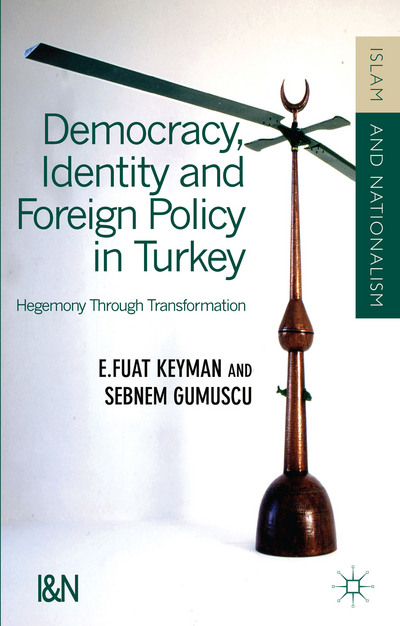
E.Fuat Keyman, Sabancı University
Şebnem Gümüşçü, Middlebury College
Palgrave Macmillan, 2014
The recent history of Turkey is dominated by the country's transformation into a modern democracy. Over the past few years Turkey has been increasingly recognised as a nation of economic, political and cultural significance as well as being a vital political connection between Europe and the Middle East. In this compelling volume, Professor Keyman and Dr. Gumüsçu put democratisation in Turkey under the microscope with an especial focus on recent transformations under the Justice and Development Party (AKP). Accordingly, it explores to what extent Turkey's transformation under the AKP has led to democratic consolidation as well as asking if there is a disconnect between economic, cultural, and urban transformation, on the one hand, and democratic consolidation on the other? Furthermore, this book also takes the opportunity to explore several issues that have a direct effect on the consolidation of Turkish democracy such as globalization, foreign policy activism, the kurdish question, religious governance and civil society. By critically analyzing the dialectic between domestic transformations and global/regional dynamics, the book also discusses the ways in which Turkish transformation is affected by the Arab uprisings as well as how Turkey may inspire these countries.
Table of Contents
1. Introduction
2. Turkey's Transformation
3. Constructing Hegemony: the AKP Rule
4. AKP's Hegemony and Democratic Consolidation
5. Turkey's Proactive Foreign Policy under the AKP
6. Turkish Foreign Policy in the aftermath of the Arab Uprisings
7. The AKP, Arab Uprisings and the Kurdish Question
8. Secularism, Democracy and Identity
9. Civil Society and Democratic Consolidation
10. Conclusion: Turkey at the Crossroads: Democratization through the Strong EU Anchor
Sunday, November 02, 2014
Shifting Sands: The United States in the Middle East
Joel S. Migdal
Columbia University Press 2014
Joel S. Migdal revisits the approach U.S. officials have adopted toward the Middle East since World War II, which paid scant attention to tectonic shifts in the region. After the war, the United States did not restrict its strategic model to the Middle East. Beginning with Harry S. Truman, American presidents applied a uniform strategy rooted in the country’s Cold War experience in Europe to regions across the globe, designed to project America into nearly every corner of the world while limiting costs and overreach.
The approach was simple: find a local power that could play Great Britain’s role in Europe after the war, sharing the burden of exercising power, and establish a security alliance along the lines of NATO. Yet regional changes following the creation of Israel, the Free Officers Coup in Egypt, the rise of Arab nationalism from 1948 to 1952, and, later, the Iranian Revolution and the Egypt-Israel peace treaty in 1979 complicated this project. Migdal shows how insufficient attention to these key transformations led to a series of missteps and misconceptions in the twentieth century. With the Arab uprisings of 2009 through 2011 prompting another major shift, Migdal sees an opportunity for the United States to deploy a new, more workable strategy, and he concludes with a plan for gaining a stable foothold in the region.
Joel S. Migdal is the Robert F. Philip Professor of International Studies at the Henry M. Jackson School of International Studies, University of Washington, and has been writing about the Middle East and state-society relations worldwide for more than forty years. Among his books are The Palestinian People (with Baruch Kimmerling), Through the Lens of Israel, Strong Societies and Weak States, and State-in-Society.
Friday, May 09, 2014
Interview with IR Scholar Nicholas Onuf
May 9, 2014
The interview was conducted by Rachel Denison. She is Deputy Features Editor at E-IR, and has a Masters degree in International Relations from the University of Sussex.
The interview was conducted by Rachel Denison. She is Deputy Features Editor at E-IR, and has a Masters degree in International Relations from the University of Sussex.
Nicholas Greenwood Onuf is renowned as one of the founders of constructivism in International Relations. He is also known for his important contributions to International Legal Theory, International History, and Social Theory. Onuf’s most famous work is arguably World of Our Making: Rules and Rule in Social Theory and International Relations (published in 1989), which should be on every IR student’s must-read list. His recent publications include Nations, Markets, and War: Modern History and the American Civil War (2006, co-authored with his brother Peter Onuf) and International Legal Theory: Essays and Engagements, 1966-2006 (2008). Onuf is currently Professor Emeritus of International Relations at Florida International University and is on the editorial boards of International Political Sociology, Cooperation and Conflict, and Contexto Internacional. Professor Onuf received his PhD in International Studies at John Hopkins University, and has also taught at Georgetown University, American University, Princeton, Columbia, University of Southern California, Pontifícia Universidade Católica do Rio de Janeiro, and Kyung Hee University in Korea.
In this interview, Professor Onuf discusses the professionalization of scholarship in IR and the effects this has had on the field in the US and globally; the influence that constructivism and World of Our Making has had on social theory; the transformations he has noticed in International Law Theory; and his top ten tips for flourishing in academia.
Where do you see the most exciting research/debates happening in contemporary IR?
I am not sure I see any exciting debates at this moment. I am not even sure we ever had a debate in the usual sense of the term. There have been moments better characterized as a parting of the ways. I like to think I participated in one in the late 1980s. Since then, well, these ‘ways’ have grown further and further apart. If such partings are generational (as I think they are), then we should now be seeing another such moment. If we do not (and I do not), then it is because IR has lost all coherence as a field—there is nothing left to render apart. Not that this distresses me. At the last parting, I suggested that we should think of international relations as a species of social relations and abandon IR theory for social theory.
What are the most important/interesting areas of IR Theory that are underdeveloped or understudied at the moment? Where is there most need and scope for new thinking?
As I just intimated, I do not believe IR theory can be made interesting. The question is, what area in social theory, broadly conceived, could help us—everyone interested in what we still call international relations—do our thing. Inasmuch as we in IR have rummaged around in social theory pretty superficially (and I count myself here), there is no area that could not be put to better use. That said, I am myself most interested in cognitive, evolutionary, and moral psychology these days. Mostly because I like to read around, and this stuff keeps me thinking.
How has the way you understand the world changed over time, and what (or who) prompted the most significant shifts in your thinking?
I take this question—the way I understand the world—to concern the philosophical assumptions informing my scholarship. For the first 15 or 20 years of my scholarly career, I was a philosophical ignoramus. Still am, of course, though I can say that I have plunged into several philosophical seas and not drowned. I started off as an unthinking, and therefore utterly conventional, philosophical realist. Doubts came with exposure to postmodern and radical feminist theorizing, and theorists, in the early 1980s. Reading Wittgenstein pushed me into the linguistic turn and Oxford-style ordinary language philosophy helped me rethink the links between speech, rules, and rule, and thus the premises of much of social theory. I do not recall when I first dug into Kant’s First Critique, but I have never recovered from the experience—I still think of myself as a thoroughgoing philosophical idealist, not at all discomforted by the material appearance of the world. Around 1990, I took the better part of a sabbatical leave to read Aristotle from front to back, with cascading effects on my scholarship.
Having taught and spoken on IR theory all around the world, how would you say IR is studied and understood as a discipline in the US versus the UK/Europe, or indeed in South America or Asia?
I resist calling IR a discipline for reasons that should be obvious from my reply to the first two questions. Educated as I was in the US, I have always thought of it as a field of study in the discipline of political science, and I always took seriously the presumption that it was a field sufficiently at odds with the rest of political science to warrant excursions into other disciplines. In my case, this was history from the beginning (later reinforced by working with a brilliant historian who happens to be my brother). I also worked extensively in international law, but this was complicated by the vocational thrust of legal education in the US. Yet another complication is the vocational orientation of the so-called professional schools of international affairs, in which I taught for many years. Here again, disciplined scholarship and, especially, theory take a back seat to practical training and ‘real-world experience.’
Now, I think it is an open question as to whether IR is understood as a discipline in the rest of the world. There are, of course, the trappings of a discipline now almost everywhere: journals and professional associations specifically devoted to IR, not to mention clannish behavior. The big difference between the US and elsewhere is the lack of separate IR departments in the US and their proliferation in many other countries. This is a large result of the globalization of IR, while political science has always been and will always be country-specific for obvious reasons.
So let me shift the terms of discussion here just a little bit. What I saw happening in the US over the last five decades is the professionalization of scholarship (and more generally the professionalization of the professions). This was the deep issue in the so-called second debate: disciplined, highly trained US scholars, committed to rigorous positivist science, lording over English gentleman-scholars as dabblers. As a wealthy country, the US could afford the big science model of the scholarly profession, and reaps significant rewards in doing so—all this contributed to the imposition of set standards for scholarly performance, the normalization of scholarly practices, and the hegemonial presumption that everyone else in the world should and eventually would do things our way.
It is no surprise that some scholars in the US resented this development and there is less discipline than demanded, but professionalization won out domestically and has made great inroads in the rest of the world (just consider the RAE process in the UK and the English School today). Combined with so many other facets of US hegemony, the globalization/professionalization of IR in accordance with the big science model has also been a source of resistance, which I see (and sympathize with) whenever I am abroad. I also see a significant improvement in standards for scholarship. Even if higher standards are a consequence of US hegemonial discipline, as I think they are, they are nevertheless to be welcomed.
What did you feel was missing from IR theory, with Realism and Liberalism as the main schools of thought, that you felt a new school of thought—Constructivism—was needed? What blanks do you feel it fills in in our understanding of International Relations?
At the time I wrote World of Our Making, most of us in the US took realism to be the field’s frame of reference—indeed the umbrella theory that gave IR its coherence. Liberalism was on the outs, along with international law and institutions; realism had combined with a commitment to positivist science in deciding what counted as a contribution to knowledge. I did not feel a new approach was needed or, for that matter, that liberalism needed to be resuscitated. There are no ‘blanks’—the very term implies a philosophical/social theoretic stance contrary to the one that I have already sketched.
As I said in response to question 3, I had come increasingly to feel that a bottom-up revolution was needed. I also thought that a background in international legal theory gave me (and my friend Fritz Kratochwil) something distinctive and important to contribute to the cause. Constructivism’s subsequent erection as IR’s third pillar—in the US, no less—signaled the end of the uprising, the banishment of post-positivist, feminist, and critical renegades, and the normalization of IR as social science. As I suggested in my response to the last question, normalization and professionalization are hegemonial practices fueling the US vs. rest of the world dynamic. The question takes for granted that constructivism has been normalized. To the extent this is so, it is less by discipline than exclusion. That I, as a would-be revolutionary, should be among those who are effectively excluded is no great surprise.
What implications do you think that your book World of Our Making has had on the study of IR?
World of Our Making gives IR scholars an opportunity (incentive, excuse) to look beyond the world of states and their relations and ask how it, or any ‘world,’ has come to be what it is as a social arrangement, how people engage in world-making and to what effect, and how these two processes are, as we say perhaps too glibly, co-constitutive. The book also gives scholars good reasons to consider speaking as doing, rules as indispensable to social life, and rule, not anarchy, as the abiding condition of world politics.
I would say that constructivism thus conceived asks too much in a world where scholars have become ever more specialized in their interests and procedures. For that reason, it gets honorable mention when it gets any acknowledgment at all. Various people have gone ahead and worked on performative speech, rules in practice, and much else that I brought to attention, though often enough without realizing that I had already dealt with these matters. Few indeed have followed my initiatives with respect to rule and exploitation in world politics, even though there is much discussion of hegemony and hierarchy.
If identity and interests are a pre-given as constructivism argues, how would you argue that this framework can be used to help academics and students of IR understand and analyse current affairs, e.g. the crisis in Syria or in the Ukraine?
I would never say that identity and interests are pre-given. In my opinion, anyone who does say this does not have even the remotest idea what it means to talk about social construction. As a general proposition, ongoing processes of identity- and interest-formation give us little help in understanding crises in world politics. The converse proposition is, however, another matter: What is the impact of crises on processes of identity- and interest-formation? When, for example, Stefano Guzzini talks about identity-triggers, I think he is on to something.
In International Legal Theory, you outline the key developments and problems in the field of International Law. What do you feel the most transformative have been and how have they affected the study and practice of International Law? Since its publication in 2008, are there any problems or developments that you wish you could address?
When I first started working in international legal theory, I saw three large issues needing further work. I used to think of them as the three S’s: the sources of international law, subjects of international law, and sanctions in international law. I wrote a great deal about the first, and some about the third, and very little about the second. I had my reasons at the time, but, looking back, I should probably have concentrated on the second, which has proven to be transformative. Instead I became increasingly interested in the properties of (legal) rules as instruments of social control, and this converged with a longstanding interest in world-order thinking and duly eventuated in my work on conditions of rule, to which I alluded earlier.
International Legal Theory marked my exit from active scholarship in/on international law. By happenstance, my departure coincided with a spirited revival of theoretical work among international lawyers, and something of a rapprochement between IL and IR. I have no regrets about bowing out when I did, because so many people today are working on the three S’s in blissful ignorance of what I and others had written about decades earlier. The one exception is the discussion of ‘the fragmentation of international law’ as a reaction to accelerating functional differentiation in global administrative practice. Unlike me, Kratochwil has continued to engage international legal theory; his forthcoming book, The Status of Law in World Society, has far more to say about this development and its implications than I could possibly hope to.
What is the most important advice you could give to young scholars of International Relations?
As an old dog, I routinely dispense advice to young scholars whom I know well enough to think that my advice fits their circumstances. Rather than trying to guess what, in general, constitutes the most important advice I can give, let me list a few things. Ten, actually—ten rules for flourishing as a scholar in IR:
1) Preparing at length for classes does not make you a better teacher. Insofar as it dampens spontaneity, students will think you are boring; this will undercut the self-confidence you thought your lengthy preparations had purchased for you. And, of course, it steals valuable time from your scholarship.
2) Writing is a craft; writing well takes most of us a great deal of work. The usual practice is to think of a problem or issue, formulate a project, do ‘research,’ and then write it up. Bad idea. Keep writing at every stage, even if, in the end, you throw out most of what you have written. Writing makes the problem clearer, points up what more you need to do in the way of research, and, most of all, keeps your writing skills well-honed.
3) Don’t send sloppy, badly crafted papers out for review. As a frequent referee, I see them all too often. Many referees will punish you, not always consciously, for doing so, even if they think you are on to something. Once you think you have a well-crafted piece of work, do send it out, because most referees and editors take their duties seriously and will give you valuable feedback.
4) Be cautious about taking on collaborative projects. We all know that scholarship is a lonely occupation. Collaboration reduces the loneliness quotient and can result in better work than any of the collaborators could have produced on their own. It can also result in a piece of work that no one is entirely happy with. Sometimes collaboration causes damaging tension and bad feelings because of temperamental differences, greater or lesser commitment to the project, and perceived inequities in the distribution of work. All that said, collaborating with my brother on two book projects was hugely rewarding. That it might have been hugely risky never occurred to us.
5) Be even more cautious in participating in symposium projects. Their thematic foci may not match your interests very well; they tend to be superficially refereed and thus are not taken seriously; they also tend to disappear quickly from view. There are exceptions—symposia that mark major developments in the field—but you’ll have a pretty good idea if a particular symposium project has that potential. As a senior scholar, I contribute to symposia because it is fun to do projects with friends and I can afford the luxury. Most of all, avoid editing symposium volumes. This involves collaboration under the most difficult conditions. It is extraordinarily time consuming. Wrangling recalcitrant contributors is too often a thankless and disheartening responsibility.
6) Do not take on too many projects at one time. You will spread yourself too thin, miss deadlines, and make it all the more likely that you will succumb to the 90% rule—you run out of steam when any given project is 90% done and only needs some fine-tuning to be sent off. You will end up with a drawer full of nearly done projects that you have progressively lost interest in and will therefore never finish.
7) Dissertations are apprentice projects, immediately recognizable as such. Turning a dissertation into a book is probably the smart thing to do, but it will often take longer than writing the dissertation did. For most of us, it takes five years to write a good book; World of Our Making took me ten years. Whether you have that much time, institutionally speaking, is another matter.
8) Read every day. When I get up in the morning (early) and get my coffee, I read for 45 minutes. In my case, it has always been something that I do not have to read for whatever I am doing at the time. While this has broadened me immeasurably, for many scholars, a fixed time for reading is an opportunity—perhaps the only opportunity—to keep up on the literature in the field.
9) Whether to jump on a trend in the field’s scholarship, try anticipating a trend, come late to a trend but treat it critically, jump around from thing to thing, or plug away at something few others seem to be interested in is a tricky question, having much to do with temperament. It requires you to ask yourself how ambitious you are, how much you need validation from others, how long you can stayed focused on one thing, et cetera.
10) On the assumption that you are smarter than most people (or you would not be a scholar), seek out people whom you know to be smarter than you in various obvious ways. On the one hand, the more of these people you know, the less intimidating you will find them, and the more you will learn from them. On the other hand, knowing really smart people will remind you of your own limitations and help you be less arrogant. Arrogance is, of course, a constant hazard in our line of work. I like to think that hanging out with people who are smarter than I am has been the key to my own success as a scholar. Some of them have been my students. (I could name names, but it would not be appropriate here.) As for making me less arrogant as a human being, anything I might venture to say about that can only sound—what is the right word?—arrogant.
Friday, April 04, 2014
Good-Bye Hegemony!: Power and Influence in the Global System
Simon Reich & Richard Ned Lebow
Princeton University Press, 2014


Many policymakers, journalists, and scholars insist that U.S. hegemony is essential for warding off global chaos. Good-Bye Hegemony! argues that hegemony is a fiction propagated to support a large defense establishment, justify American claims to world leadership, and buttress the self-esteem of voters. It is also contrary to American interests and the global order. Simon Reich and Richard Ned Lebow argue that hegemony should instead find expression in agenda setting, economic custodianship, and the sponsorship of global initiatives. Today, these functions are diffused through the system, with European countries, China, and lesser powers making important contributions. In contrast, the United States has often been a source of political and economic instability.
Rejecting the focus on power common to American realists and liberals, the authors offer a novel analysis of influence. In the process, they differentiate influence from power and power from material resources. Their analysis shows why the United States, the greatest power the world has ever seen, is increasingly incapable of translating its power into influence. Reich and Lebow use their analysis to formulate a more realistic place for America in world affairs.
Simon Reich is professor of global affairs and political science at Rutgers University, Newark. Richard Ned Lebow is professor of international political theory at King's College London and the James O. Freedman Presidential Professor of Government Emeritus at Dartmouth College.
"Mounting a frontal challenge to reigning theories in international relations and the conventional wisdom regarding the place of the United States in the international system, Good-Bye Hegemony! shows that the country stopped acting like a hegemon a long time ago. This accessible and engaging work will spark interesting and useful discussions in international relations and comparative foreign policy."--Jeffrey Anderson, Georgetown University
"It seems that only yesterday 'American empire' was a hot topic, but Reich and Lebow demonstrate that even U.S. hegemony was a short-lived post-World War II phenomenon. Though the United States maintains enormous military and economic capabilities, its actual influence and legitimacy are seriously limited in today's multipower world. The authors' argument--that the United States is most effective when emphasizing persuasion and sponsorship--will be central to future policy debates."--Yale H. Ferguson, Rutgers University
"In this thought-provoking and sobering narrative, Reich and Lebow take direct aim at the international relations establishment, arguing for the limits of material power and the importance of legitimacy in gauging America's global influence."--James Goldgeier, American University
"This book's main arguments against hegemonic theory are strong and necessary: the hegemonic period was not as great as rose-colored remembrances portray, the United States was not as benevolent a hegemon as often claimed, and hegemony did not last as long as often depicted. The book makes a forceful statement and should be part of the debate."--Bruce W. Jentleson, Duke University
"This beautifully provocative book turns the mainstream debate on the global power shift upside down. Reconceptualizing the relationship between power and influence, it refutes the widespread view that the United States must remain the world's hegemon and provides the blueprint for a more cooperative U.S. foreign policy. A must-read for all who care about the world's future."--Harald Mueller, executive director of the Peace Research Institute, Frankfurt
List of Tables ix
Preface xi
Chapter 1 The Wall Has Fallen 1
Chapter 2 Power and Influence in the Global System 15
Chapter 3 Europe and Agenda Setting 51
Chapter 4 China and Custodial Economic Management 83
Chapter 5 America and Security Sponsorship 131
Chapter 6 The Future of International Relations 171
Index 185
Wednesday, December 25, 2013
Interview with IR Professor James Fearon
e-International Relations on December 16, 2013
James D. Fearon is Geballe Professor in the School of Humanities and Sciences at Stanford University and a Senior Fellow in Stanford’s Freeman-Spogli Institute for International Studies. He is a member of the National Academy of Sciences, the American Academy of Arts and Sciences, and a program member of the Institutions, Organizations, and Growth group of the Canadian Institute for Advanced Research. Fearon’s research has focused on the causes and correlates of interstate war, civil war, and ethnic conflict. He has also published on positive theories of democracy, the problem of intervention in “failed” states, and on how states signal intentions in militarized interstate disputes.
In this interview, Professor Fearon discusses responses to the civil war in Syria and offers his thoughts on the passing of Ken Waltz and the academic study of civil wars.
In this interview, Professor Fearon discusses responses to the civil war in Syria and offers his thoughts on the passing of Ken Waltz and the academic study of civil wars.
—
Kenneth Waltz sadly passed away recently. What impact did Prof. Waltz’s writings and teaching have on your intellectual development?
I hadn’t majored in Political Science as an undergraduate, and was pretty clueless about the field when I started as a grad student at Berkeley. There were a couple of things I read in my first year that essentially decided my path of study, and Waltz’s Theory of International Politics was one of them. I found his writing and style of thinking really compelling.
I’m not sure I have this exactly right, but I think Ken was on leave for my first year and didn’t teach the IR theory seminar my second year. In any event I had essentially no interactions with him, except through reading his work, till my third year, when I TAed for his course on U.S. defense policy. I asked him if he would chair my dissertation committee because what I wanted to do was somewhat closer to his interests and general analytical style than Ernst Haas’. Haas was the other senior IR scholar at Berkeley at the time and I had had a lot more courses and other interactions with him to that point. I thought Haas was tremendous, but he had his own thing and a dissertation using game theoretic methods to analyze how and when interstate disputes escalate or don’t escalate to war was not close enough.
At least in my case, Ken was a fairly hands-off dissertation adviser, which suited me fine. He had certain things he was very insistent on, such as the distinction between deterrence and defense, or being very careful about how nuclear weapons change things in interstate crises. Otherwise he let me develop the dissertation as I saw fit. At that time he was pretty supportive of the attempt to apply game theoretic thinking to those problems — I recall him noting more than once that he had read Von Neumann and Morgenstern’s Theory of Games and Economic Behavior in the 1950s and thought there were valuable insights in it that he drew on for his first book. But there was ambivalence as well. Certainly by his later years he seemed to have decided that all those quantitative and formal approaches weren’t really necessary. He appreciated and encouraged the more historical parts of my dissertation, to be sure.
Ken had an unusual intellectual style, a style that has become even more unusual as time has passed. He chose very big questions, and would go at them in a slow, careful, deliberate manner. He didn’t spin off ideas left and right, or bounce between them, or publish lots of articles on one thing and then another. Because his writing is often highly condensed, students and people in the IR field often underestimate the strength of his positions. So interactions with him frequently would have the quality of Ken explaining why you needed to go back and think about his arguments again. In my experience this is usually right. If you think Waltz is just plain mistaken about this or that, you usually do need to go back and think about it some more. Of course, there are lots of things I disagree with him about, or think he didn’t get quite right, but as a general rule of thumb, if you think he’s wrong about something it’s a good idea to go back and make sure you really understand what he is saying and the full set of arguments for the position.
The civil war in Syria has become a hotly debated topic, particularly the issue of whether a military intervention should be implemented. Do you feel that this would be an effective way to resolve the crisis?
At this point, a massive military intervention is probably the only effective way to end the war, but that doesn’t mean this would be the right thing to do. First off, such an intervention would be over the strong objections of Russia, Iran, and other states, thus escalating interstate conflict, with a number of possible bad downstream consequences. Second, such an intervention would be highly costly, since the interveners would surely face — and further stimulate — protracted violent opposition from Islamist insurgents even if intervention overcame the Assad regime and its international supporters. Third, and probably most important, even if an intervention could depose the Assad regime and end the current war, the third parties would then be responsible for creating a stable political order that would allow them to depart without a return to war. We appear to have no idea how to do this. So, no, I don’t think a major military intervention (going to war against the Assad regime) would be a good approach to ending the war in Syria.
Throughout the nineties, politicians and the international media argued that many of the civil wars that emerged around the globe were caused by ancient ethnic hatreds. These explanations were falsified by scholars, yet this template of understanding is still highly popular with politicians and the media. Why do you think that this is the case and do you feel that adopting this ancient ethnic hatreds narrative can have negative political consequences?
Well, depending on what we count as “ancient,” I’m not sure I’d say this sort of explanation is always wrong, or wrong in all cases. There is a lot of variation here. There certainly are some conflicts where there is a long history of intense animosity between members of the ethnic groups in question, and where it is plausible that past episodes of violence created cultural memes that get recycled in new contexts, or that may increase the odds of violence by making it more mutually expected. Or where intense dislike of the other group just disposes people to be more accepting or supportive of politicians who are advocating for ethnic cleansing.
But of course there are many other ethnic conflicts where there really isn’t much history of past violence between the groups, or it doesn’t go back very far. David Laitin and I have recently been doing some research on long-run persistence of armed conflict in particular places around the world. One of the “side” findings that I think is interesting is this: There are remarkably few instances where members of two ethnic groups who fought on opposite sides of a Correlates-of-War-coded conflict post-1945 also fought on opposite sides of a COW-coded conflict before 1945. (These include interstate, civil, colonial, and what COW calls “non-state” wars.) Now, these are relatively high-level conflicts, due to the COW criteria, so I’m sure that if you considered lower-level conflicts you will find more cases of repeated fighting between members of different ethnic groups that go back 100 or 200 years (although it should be stressed that when you look at conflicts in the 19th century and earlier, “ethnic conflict” was often not how the leaders thought about what they were doing). But still, I was struck by how few — like three or four — such cases appear at the COW-war level.
Why are “ancient hatreds” stories so popular in the media? I don’t know, I could only speculate. “History repeats itself” is a common explanatory trope for journalists in general. And since it is typically assumed that ethnic groups are age-old things — indeed this is practically built into the concept, even though it is usually factually wrong — perhaps it seems natural to people that therefore ethnic conflicts must be ancient. And of course labelling a conflict as “ethnic” can be a way of marking it as atavistic and thus not something we can do much about.
Can incorrectly explaining a conflict as a product of ancient hatreds have negative political consequences? Perhaps your question was inspired by the famous example of President Clinton supposedly being strongly influenced against intervention in the Balkans by Robert Kaplan’s bookBalkan Ghosts. This is usually exhibit A here. It’s hard to gauge how important such thinking is case to case. Usually there are other, probably more decisive political or military considerations against intervention, so the ancient-hatreds story may just be cover. Probably in general the more dangerous negative political consequence is when some members of a group themselves come to subscribe to a factually inaccurate nationalist narrative that puts great stress on a history of conflict with other, presumed-to-be inferior groups.
A common criticism from constructivists of the rationalist approach to ethnic conflict is that it overlooks the significance of cultural factors, particularly the propagation of ethnic myths justifying hostility and dominance by political elites, in explaining the outbreak of violence. Do you feel that this criticism is fair?
I have no interest in defending or advocating for a “rationalist approach” to ethnic conflict, or international relations, or any broad domain of politics. The field of IR seems almost absurdly prone to meta-level arguments over this or that approach, and I don’t want to contribute to that.
But so as not to seem like I’m completely avoiding the question: I have a hard time making sense of an opposition between “rationality” and “culture.” The opposition between “rational” and “irrational” can make more sense, where the former is a normative standard that defines what “irrational” action would be in some context.
As I mentioned in some responses above, I think that ethnic myths that justify hostility and dominance by political elites can certainly be an important factor in explaining ethnic violence in some cases. When the argument is that elites are deliberately using these myths for their own political advantage, this often gets classed as a “rationalist” story, for whatever little that’s worth.
In some cases where civil wars have broken out they have been characterized by civilian targeting, atrocities and, in some instances, genocide. Do you think that rational actor models are sufficient in explaining occurrences like genocide in civil wars?
Again, I couldn’t care less whether rational actor models are sufficient for this purpose (I’m also not sure what “sufficient” can mean for explananda like this one). I think that explaining civilian targeting in civil war is an important research objective, and am happy to get insights from whatever approaches produce them.
The study of ‘ethnic conflict’ has grown significantly in the past two decades. Which new studies on this subject have you found the most interesting?
I actually haven’t been working on ethnic conflict and ethnic violence much recently, so I don’t feel well qualified to answer. I’ve been reading James Scott’s The Art of Not Being Governed, which is not exactly new and not exactly on “ethnic conflict,” but nonetheless extremely interesting on how to think about the formation of ethnicities and conflictual relationships among them in Asia.
There is a wave of interesting research in political economy going on, mainly by economists like Nathan Nunn, Hans-Joachim Voth, Daron Acemoglu, James Robinson, Melissa Dell, and others, including a lot of new PhDs. This research agenda takes a long view and tends to find striking and sometimes surprising continuities of political and economic institutions, or long-lasting impacts of particular historical events. Some of the work has looked at historical persistence of armed conflict (not typically “ethnic conflict” per se), but not much of it. As I mentioned, this is an area where Laitin and I are doing some data collection.
What key advice would you give to scholars who are just starting their careers and want to focus their research on civil wars?
If a grad student were to come to my office and ask this question, in so many words, I would ask him or her what it is about civil wars that interests them, and if there is some particular conflict or set of conflicts that has inspired the interest. Then we would have a conversation the point of which would be to draw out this interest and develop ideas about how to pursue it in light of the questions posed and answers found by the most relevant existing literatures. So, basically, I don’t have a good generic answer to the question “how to focus in new research on civil war?” It’s a big topic and there are a lot of interesting angles worth pursuing.
—
This interview was conducted by Al McKay. Al is an Editor-at-large of e-IR.
Friday, November 29, 2013
International Relations since 1945
The seventh edition of Geir Lundestad’s classic overview of the history and key developments of international politics in the post-war era continues in the clear, accessible and authoritative vein of previous editions. The book provides an engaging narrative of all the significant events since 1945 and equips you with the knowledge and skills with which to approach contemporary issues in international politics.
- an account of the world as it has evolved up to 1945
- an updated section on Barack Obama and the Greater Middle East, with a new discussion on the events surrounding the Arab Spring
- a new section on population, gender and the environment
- essential updates on superpowers, state and non-state actors, and global governance
- a new conclusion considering the future of the international system
This fully revised new edition now includes:
Complete with annotated further reading lists accompanying each chapter, the book skilfully guides you through all the important events that have shaped the international system since 1945.
East, West, North, South remains essential, accessible reading for all students of international relations, world politics and international history.
Table of Contents
| The New World | |
| The Cold War in Europe, 1945–1949 | |
| The Cold War Becomes Global, 1945–1962 | |
| Detente Between East and West, 1962–1975 | |
| Renewed Tension Between East and West, 1975–1984 | |
| The End of the Cold War, 1984–1990 | |
| Major Powers and Local Conflicts after the Cold War, 1990–2013 | |
| The Arms Race, 1945–2013 | |
| The United States and Western Europe, 1945–2013 | |
| The Soviet Union/Russia and the (formerly) Communist Countries, 1945–2013 | |
| The Rise of East Asia | |
| Decolonization | |
| Economic Relations Between North and South, 1945–2013 | |
| Two Theories on Development and Under-development | |
| Globalization and Fragmentation | |
| Conclusion: The Future |
Wednesday, June 05, 2013
Interview with IR scholar Prof. Chris Brown

E-IR Website
Chris Brown is a prominent international political theorist who contributes to debates on issues of global justice, human rights, and humanitarian intervention. If you have ever taken a class in international politics and theory, then you are likely familiar with his books International Relations in Political Thought: Texts from the Greeks to the First World War coauthored with Terry Nardin and N. J. Rengger, and Understanding International Relations, written with Kirsten Ainley. Other recent books include Practical Judgement in International Political Theory and Sovereignty, Rights and Justice. He is Professor of International Relations at the London School of Economics and contributes to LSE’s British Politics and Policy blog.
Professor Brown answers reader questions about the theory-practice divide, non-Western political theory, the ongoing crisis in Syria, and challenges to the Responsibility to Protect doctrine (R2P).
—
Where do you see the most exciting research/debates happening in contemporary IR?
I think there are lots of areas where things are happening. One of the things that has interested me the most has been the of revival of realism in recent years, both classical realism, but also the work of Bernard Williams (eg In the Beginning was the Deed, 2009) and Raymond Geuss (eg Philosophy and Real Politics, 2008) the ‘new political realism’, as it’s sometimes called. The idea is that too much contemporary IPT [International Political Theory] is essentially liberal moralizing, arguing that politics are secondary to morals, whereas what Williams was arguing, and Geuss argues, is for the autonomy of the political. So I think that’s an interesting agenda.
The ‘practice agenda’ is also very interesting. But there are also a lot of things going on in IPE [International Political Economy], and global environment studies, which I don’t know enough about, but think if I did know enough about them they would be extremely interesting.
What are the most important/interesting areas of IR theory that are underdeveloped today or under studied at the moment? Where is there most need and scope for new thinking?
I think partly the answer I already gave is relevant. People think they understood realism and its implications, and now they’re realizing that maybe they don’t. It seems strange to think of realism as an underdeveloped area, but I think in some respects it is. The serious thinking about this is a more recent phenomenon than one might expect. But the same is true of the ‘practice turn’.
There’s another area that I think is underdeveloped, although I get in trouble for saying this, and that’s the whole area of foreign policy analysis. It seems to me policy analysis is very important. I think theory and practice have got divorced in ways that are undesirable. And to some extent, the analysis of foreign policy is part of that. Another aspect of this is covered in a piece I’m writing for the European Journal of International Relations; one of the arguments I make in that article is that there is a need for critical problem solving. You are probably familiar with the distinction between problem solving theory and critical theory, that’s found in Robert Cox- he set this out 30 or so years ago- and he argued that critical theory challenges the roots and the way questions are set up. Problem solving is just what it sounds like, it’s solving problems that other people have given to you. What I want to argue is that we need more problem solving theory, but we need problem solving theory that’s critical in another sense, that is oriented towards the less advantaged in society globally. So generally, one of the things I try to argue in the paper for the EJIR is that figures like John Ikenberry, John Mearsheimer and Joseph Nye are actually problem solving-oriented academics, and they do very good work, but their concept of the problem is very much, ‘how do we manage power from the point of view of the powerful.’ What I’m saying is, I’d like to see more work done on problems, but not the problems the powerful have, the problems that the weak have.
How has the way you understand the world changed over time, and what (or who) prompted the most significant shifts in your thinking?
I think the biggest shift that has taken place in my thinking over the past 30 years is that I’m a lot less tolerant of relativist ideas, and multiculturalist ideas than I used to be. And that’s something that when you say it, it induces shock and horror sometimes. 25 years ago, I was writing material that, if it wasn’t poststructuralist, was at least ‘fellow traveling’ with the poststructuralists, arguing essentially anti-foundationalist ideas, arguing that the Western liberal tradition was just one tradition among other traditions, and so on. In a way, I think I was in bad faith over a lot of that. I believed that liberalism would always be there, and so one can afford to attack it. The events of the last 20 years have shown that that’s really not the case, that a lot of the traditional liberal values of freedom and tolerance are seriously under attack and need to be defended. So I’ve become a defender of the Enlightenment project in a way that I wasn’t maybe 30 years ago- that’s a big shift. I’m not sure that any one particular individual has been significant in the process though- lots of individuals have been.
What is the most important advice you could give to young scholars of IR?
If one’s thinking in terms of an academic career, make sure that you know what you’re letting yourself in for. I think an academic career has become much more difficult than it used to be, that the demands on young scholars are much more than they were. So you have to be reallycommitted. Whenever students come to me and say they want to do a PhD I try to discourage them, I tell them- look, it’s awful, the money is bad, you’re going to have four years and you’ll be miserable for most of it-don’t do it unless you’re really committed to a particular topic. The thing that’s got to drive you is that you’ve go to be absolutely fascinated. Don’t drift into it. Make sure that that’s what the driver is, because that’s the thing that will carry you through. And I think that’s true for any area of scholarship nowadays.
How do you understand non-Western political theories in relation to IR theory?
I think this is a fascinating question. At a personal level, I wish I understood more non-Western theories. Some of the work that’s done on non-Western theories seems to me to not be terribly good- I mean, one finds that some quite traditional Western ideas are being fed back from non-Western societies, so it’s a kind of mirror effect- it looks as if it’s coming out of China, but it’s actually coming out of the United States, being mirrored back to the United States. On the other hand- and I’m using China as an example- there are a lot of very serious scholars working on classical Chinese political thought and its implications for the developing state system. It’s a tricky task because Chinese thought is based around the idea of harmony and all under heaven being under one rule, and so there isn’t really a great deal of material as I understand it on international systems, the idea of divided sovereignty, or indeed the ideas of sovereignty at all- it looks like a Western import. So I’m waiting- I do read a lot of the Chinese scholars, not in Chinese unfortunately, but many of them are translated to English. So far, I’m not finding stuff there that looks enormously original, but I’m still looking and I think it has got to be out there. There are other traditions as well- India I think is fascinating. India did have international systems for long periods, there ought to be authors out there with something to say. The only author that anyone ever talks about in the West is Kautilya, a classical Indian thinker. There have got to be others, and his thinking has got to be more sophisticated than we used to think it was. So I’m happily enthusiastic about the idea of non-Western IR theory, but I’m waiting for it, waiting for the books that present an alternative.
One thing that one can’t get around, and I don’t think that one is being imperialist in saying this, is that the current world order was created out of the European world order. So there’s a sense in which the dominance of European/North American thinking about International Relations isn’tsimply a product of power- it may be a product of power, but at first remove, if you see what I mean. The Europeans created the current world, as a result of which their ideas are the ones that are most obviously available for understanding how this world works. But this could change. The only really important non-Western idea in International Relations I think of the past 50 years came out of Latin America, and that was theDependency argument of Gunder Frank and similar figures. The problem is that it was wrong, so you have a non-Western vision of the world that didn’t hold up. So we’re still waiting.
In a lecture given to the British International Studies Association in 2005, you suggested that in the past 3 decades or so, IR theory in the UK has become more professionalized and sophisticated even as it has become less connected to the rest of the IR discourse. Is that still the case, and if so, is it a concern? How should theory and empirical studies meet?
Smashing question. Yes, I think it’s so. That’s the first bit- I don’t think anything has seriously changed. I’ve been reading material by some of the Americans on this, particularly Mearsheimer and Walt, and Ken Waltz thought the same thing. They argue that in America, theory is undervalued, and what is valued is empirical research, large-n quantitative studies- Political Science with a capital s: scientific technology, theory testing, that sort of quantitative work. In Britain I think it’s exactly reversed- that kind of quantitative work is being done, and it’s being done more than it used to be, but it’s still a minority practice. Within the British scene, theory is more highly valued than it is within the United States, and in a way, there’s been a kind of division of intellectual labor- economists could explain this in terms of theories of comparative advantage- British political theory has a comparative advantage over a lot of American theory, I think, whereas American applied research has a big comparative advantage over British. British graduate education is much less oriented towards quantitative techniques, the money is not there for large-N quantitative studies a lot of the time. So there’s been a kind of divide between the two countries, and I think the British profession is more theory-oriented, and within the British profession it is theory that has more prestige probably than other areas: if you’re working simply in empirical work it is somewhat more difficult to get the recognition that theorists get. So yes, I think that has happened, and it is continuing. And I don’t think it’s a good thing- we need more work on the theory-practice join. I think we need more theoretically-informed empirical work, much more. And a different kind of theoretically-informed empirical work. It gets back to my point about critical problem solving as opposed to just problem solving.
Do you have any suggestions for how the theory-practice divide might be bridged?
You know, I just said that it hasn’t changed, but it may be changing, I think there might be more people interested in this- the practice turn in theory has pushed people back more into empirics. And I think the kind of divide that Mearsheimer and Walt talk about is not as serious here. In the States it really is- we’re all remembering Ken Waltz at this moment of course because of his recent death- I was at the conference at Aberystwyth for the 30th anniversary of Theory of International Politics, and I remember him and John Mearsheimer talking about the complete absence of new theoretical thinking. Mearsheimer, who is a very significant figure at the University of Chicago, said that he couldn’t appoint good theorists- it wasn’t just his kind of theory that was missing, there just weren’t that many people doing formal theory either. PhD students in the United States are encouraged to do large-n quantitative studies. That’s how you get a doctorate: you pick your little hypothesis and test it, you don’t go from the big theoretical picture. I don’t think it’s quite as bad in this country, there are still theory PhDs being turned out- I’ve supervised some very good ones in recent years, and so have other people in my department. So I think that maybe it will change over time but I think that we’ve got a different problem in Britain than in America. Of course I say that, but it’s really a united discipline because of the intersections between the two, so it’s difficult to talk about them as being separate now.
Are the recent conflicts and interventions in the Middle East and West Africa raising new questions and challenges for theorists of humanitarian intervention – or are they confirming existing thinking?
R2P is an interest of mine, and I think the message from Libya has been very instructive on what the limits of R2P actually are. So I think we’re learning something from that. Syria is teaching us what we should know anyway, which is that caution is always required, and that we have to be very careful what we’re doing. But I think as you say- you mention four cases there, Libya, Syria, Ivory Coast, and Mali- one of the striking things is how different they all are. Generalizing on humanitarian intervention can be very difficult to do. The Libyan case and the Syrian case look as though they have certain similarities, because they both come out of the Arab spring, but they’re very, very different. Assad’s place within Syrian society is very different from Gaddafi’s within Libyan society. In a way, what these cases illustrate is the point I was making earlier about theory and practice: we need to approach these problems from the basis of knowledge about the individual countries; big-picture knowledge about humanitarian intervention doesn’t actually help much if you’re deciding what to do about Syria. What you want to know about Syria is, who is supporting Assad, who is opposing Assad, what is the geopolitical balance, what would happen if we did X- these are empirical questions, they’re not big stories about humanitarian intervention.
What kinds of things should states look at when they are deciding whether or not to intervene in cases like Syria?
The most basic thing is don’t make things worse. The key is, can we act in these circumstances in ways where we’re pretty confident that our intervention will improve the situation on the ground for the people who live in the area. I think on the whole it did for Libya, even given all of the problems there. The Gaddafi regime was threatening mass murder in Benghazi, and one of the things that was unusual about Gaddafi was that he did threaten his own population in this way. Governments quite often harm their populations, but they very rarely announce their intention to do so quite so vigorously. It’s difficult to ignore when someone’s saying, ‘we’re coming in and killing all the rats and cockroaches,’ in circumstances where you can do something. So I think you just have to find out what the situation is on the ground- can you actually improve things by intervening, or will you actually just heighten or make the war worse. And do you have a sense of what kind of outcome you’d like to see, and whether you’ll be able to produce it. That, I think, has become the problem in Syria. Conceivably, if support had been given very early on to the Free Syrian Army, that might’ve been a good thing to do, but now we’ve got to a point where the Syrian opposition seem to be composed of groups we don’t necessarily want to support, and we don’t want to support Assad either. So there’s a sense in which trying to broker a deal is probably the best thing we can do. I think Obama’s got it right on this. He’s keeping out of it and attempting to work with the Russians on some kind of solution, and I think that’s the right way to go.
You have argued that humanitarian “interventions involve the exercise of power.” In a situation like the on-going crisis in Syria, what kinds of power and interest calculations will states like the US, Russia, and Turkey make?
As to the first point, this is one of the things that is so obvious that people forget it at times, that intervention is always an act of power. Powerful countries intervene in weak countries, it’s never the other way around. Because that is so obvious, people put it on one side in a box and they don’t think about it. But if you exercise superior power in that way, then you have to be very careful that you’re not engaging in bullying- you have to be very careful that you’re sure of your case before you get involved.
What are the considerations? Well I think the considerations are: is it in the national interest, what are our national interests in these circumstances. One of our interests ought to be- what are the interests of the people in the country concerned, so I think it’s reasonable enough that the world is very concerned about the fate of the Syrian people. But you’ve also got to think about your own position on that. You’ve got to look at the balance of forces within the country; how your action, if you did act, would be received; what the implications would be; and what kind of actions would be needed. That is one of the features of the Syrian case that is different from the Libyan case: in the Libyan case, the Libyan air force was pretty much a joke. Producing a no fly zone took about an hour, it was one night’s work with cruise missiles to take out their anti-aircraft capability. It’s not like that in Syria: Syria has a very effective anti-aircraft capability, they’ve got a lot of mobile missiles, they’ve got a lot of modern fighter jets. Basically they have been preparing for a potential war with Israel for a long time so they’ve got a lot of very good kit there. That doesn’t mean you couldn’t do it, but it wouldn’t be easy, and that has to enter into the calculations. A medium-term campaign to establish air superiority could be a very damaging process, a lot of people would get killed, a lot of civilians. And it would be very difficult to do this without Turkey, but if Turkey gets involved, then that threatens to really become a major regional conflict, to pull in Iraq, Iran, other countries in the region- Israel is a possibility as well. So I think these are the kind of considerations that have to be taken on board. It would be nice to sit down and say, what is the best thing we could do for the Syrian people, but one has to think about all these other factors, partly because they will affect the Syrian people as much as they affect other countries. I mean, if this turns into an even worse war than it is at the moment then even more Syrians will be killed than have been already.
Given the lessons that states and international organizations are presumably learning from recent interventions and crises, what kinds of lessons do you think will be drawn for the development of R2P?
I find that R2P is in a confusing state at the moment, because on the one hand, the language of the Responsibility to Protect has been mainstreamed into the UN system: it’s now the way that the UN talks about these issues, it’s the way that the Secretary General talks about them. So it has been adopted in that way. At the same time, the underlying problems with R2P haven’t been solved. Ultimately R2P tries to depoliticize the act of intervention, and that depoliticization has failed. There isn’t a consensus on the Security Council on these issues, Russia and China think about these things very differently than the way the Western powers think about them, and even amongst themselves, Britain and France think about these things somewhat differently than the United States does. The developing world on the whole, the global South, hasn’t accepted the R2P premise, they haven’t accepted that this is something different from humanitarian intervention. The language has driven out other ways of talking about intervention, but the politics of it is still really not established. So I think we’re just going to have to watch and learn, as it were, as other crises come up. Gradually the language and the practice will come together, either by R2P being changed quite dramatically, or by peoples’ attitudes being changed. At the moment I think it’s still very much in flux. Immediately after the Libyan intervention, people were saying that R2P has now come of age. But I think the Syrian case shows that that simply isn’t true, and the subsequent problems in Libya forced people to reassess whether this was really a great success in the first place. Now people think that it might have been a success but it’s really 60/40, whereas it looked much more clear cut originally. So I think the jury’s still out on R2P, and will be for some time.
—
This interview was conducted by Alex Stark. Alex is Features Editor and a director of e-IR’s editorial board. She is currently studying for an MSc International Relations (Research) at the London School of Economics.
Subscribe to:
Posts (Atom)


Photography

dpchallenge.com