Showing posts with label thinking. Show all posts

Friday, September 26, 2014

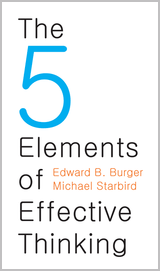
The 5 Elements of Effective Thinking

bookjacket
Princeton University Press, 2012

Winner of the 2013 Silver Medal in Self-Help, Independent Publisher Book Awards


The 5 Elements of Effective Thinking presents practical, lively, and inspiring ways for you to become more successful through better thinking. The idea is simple: You can learn how to think far better by adopting specific strategies. Brilliant people aren't a special breed--they just use their minds differently. By using the straightforward and thought-provoking techniques in The 5 Elements of Effective Thinking, you will regularly find imaginative solutions to difficult challenges, and you will discover new ways of looking at your world and yourself--revealing previously hidden opportunities.

The book offers real-life stories, explicit action items, and concrete methods that allow you to attain a deeper understanding of any issue, exploit the power of failure as a step toward success, develop a habit of creating probing questions, see the world of ideas as an ever-flowing stream of thought, and embrace the uplifting reality that we are all capable of change. No matter who you are, the practical mind-sets introduced in the book will empower you to realize any goal in a more creative, intelligent, and effective manner. Filled with engaging examples that unlock truths about thinking in every walk of life, The 5 Elements of Effective Thinking is written for all who want to reach their fullest potential--including students, parents, teachers, businesspeople, professionals, athletes, artists, leaders, and lifelong learners.

Whenever you are stuck, need a new idea, or want to learn and grow, The 5 Elements of Effective Thinking will inspire and guide you on your way.

To share thinking stories, go to: http://5elementsofthinking.wordpress.com

Edward B. Burger is the president of Southwestern University, and an educational and business consultant. Formerly he was a professor at Williams College and a vice provost at Baylor University. He has authored or coauthored more than sixty-five articles, books, and video series; delivered over five hundred addresses and workshops throughout the world; and made more than fifty radio and television appearances. His teaching and scholarly writing have earned him many national honors and the largest teaching award given in the English-speaking world. Michael Starbird is University Distinguished Teaching Professor at The University of Texas at Austin and an educational and business consultant. His numerous books, lectures, workshops, and video courses have reached large national audiences of students, teachers, businesspeople, and lifelong learners. His success at teaching people to think has been recognized by more than fifteen awards, including the highest national teaching award in his field as well as statewide and university-wide honors selected from all disciplines.

Reviews:
"What do earth, fire, air, and water have to do with effective thinking? Everything, according to mathematics professors Edward B. Burger and Michael Starbird. In The 5 Elements of Effective Thinking, the authors draw on these metaphor-laden elements from the natural world to demonstrate how to ask better questions, take calculated risks, learn from mistakes, and, ultimately, transform ourselves into more engaged and thoughtful citizens of the world. . . . The 5 Elements of Effective Thinking is a useful guide for anyone interested in tackling difficult subject matter, particularly in the classroom. The book also could serve as a solid supplementary text in courses on critical thinking."--Jennifer Moore, ForeWord Reviews

"If you remember being told by your teachers to think harder and having no idea how, The 5 Elements of Effective Thinking should help. . . . This is a snappy, illuminating read that should appeal to anyone who has ever dreamed of being a genius and is willing to strive, step by step, to become one."--David Wilson, South China Morning Post

"Thinking is good, enthuses this book by two distinguished teachers of mathematics. You might think you're being creative or having intuitions or conducting a romance or whatever, but it's all thinking, right? And you can learn to think better! So you can, and the advice herein, which includes many practical tenets of 'critical thinking', will surely be useful to many a schoolchild or business leader."--Steven Poole, Guardian (U.K.)


Wednesday, January 16, 2013

Can non-Europeans think?


Hamid Dabashi, Columbia University


In a lovely little panegyric for the distinguished European philosopher Slavoj Zizek, published recently on Al Jazeera, we read:
There are many important and active philosophers today: Judith Butler in the United States, Simon Critchley in England, Victoria Camps in Spain, Jean-Luc Nancy in France, Chantal Mouffe in Belgium, Gianni Vattimo in Italy, Peter Sloterdijk in Germany and in Slovenia, Slavoj Zizek, not to mention others working in Brazil, Australia and China.
What immediately strikes the reader when seeing this opening paragraph is the unabashedly European character and disposition of the thing the author calls "philosophy today" - thus laying a claim on both the subject and time that is peculiar and in fact an exclusive property of Europe.

Even Judith Butler who is cited as an example from the United States is decidedly a product of European philosophical genealogy, thinking somewhere between Derrida and Foucault, brought to bear on our understanding of gender and sexuality.

To be sure, China and Brazil (and Australia, which is also a European extension) are cited as the location of other philosophers worthy of the designation, but none of them evidently merits a specific name to be sitting next to these eminent European philosophers.

The question of course is not the globality of philosophical visions that all these prominent European (and by extension certain American) philosophers indeed share and from which people from the deepest corners of Africa to the remotest villages of India, China, Latin America, and the Arab and Muslim world ("deep and far", that is, from a fictive European centre) can indeed learn and better understand their lives.
That goes without saying, for without that confidence and self-consciousness these philosophers and the philosophical traditions they represent can scarce lay any universal claim on our epistemic credulities, nor would they be able to put pen to paper or finger to keyboard and write a sentence.

Thinkers outside Europe 
These are indeed not only eminent philosophers, but the philosophy they practice has the globality of certain degrees of self-conscious confidence without which no thinking can presume universality.

The question is rather something else: What about other thinkers who operate outside this European philosophical pedigree, whether they practice their thinking in the European languages they have colonially inherited or else in their own mother tongues - in Asia, in Africa, in Latin America, thinkers that have actually earned the dignity of a name, and perhaps even the pedigree of a "public intellectual" not too dissimilar to Hannah Arendt, Jean-Paul Sartre, and Michel Foucault that in this piece on Al Jazeera are offered as predecessors of Zizek?

"Why is European philosophy 'philosophy', but African philosophy 'ethnophilosophy'?"
What about thinkers outside the purview of these European philosophers; how are we to name and designate and honour and learn from them with the epithet of "public intellectual" in the age of globalised media?

Do the constellation of thinkers from South Asia, exemplified by leading figures like Ashis Nandy, Partha Chatterjee, Gayatri Spivak, Ranajit Guha, Sudipta Kaviraj, Dipesh Chakrabarty, Homi Bhabha, or Akeel Bilgrami, come together to form a nucleus of thinking that is conscious of itself? Would that constellation perhaps merit the word "thinking" in a manner that would qualify one of them - as a South Asian - to the term "philosopher" or "public intellectuals"?

Are they "South Asian thinkers" or "thinkers", the way these European thinkers are? Why is it that if Mozart sneezes it is "music" (and I am quite sure the great genius even sneezed melodiously) but the most sophisticated Indian music ragas are the subject of "ethnomusicology"?

Is that "ethnos" not also applicable to the philosophical thinking that Indian philosophers practice - so much so that their thinking is more the subject of Western European and North American anthropological fieldwork and investigation?

We can turn around and look at Africa. What about thinkers like Henry Odera Oruka, Ngugi wa Thiong'o, Wole Soyinka, Chinua Achebe, Okot p'Bitek, Taban Lo Liyong, Achille Mbembe, Emmanuel Chukwudi Eze, Souleymane Bachir Diagne, V.Y. Mudimbe: Would they qualify for the term "philosopher" or "public intellectuals" perhaps, or is that also "ethnophilosophy"?

Why is European philosophy "philosophy", but African philosophy ethnophilosophy, the way Indian music is ethnomusic - an ethnographic logic that is based on the very same reasoning that if you were to go to the New York Museum of Natural History (popularised in Shawn Levy's Night at the Museum [2006]), you only see animals and non-white peoples and their cultures featured inside glass cages, but no cage is in sight for white people and their cultures - they just get to stroll through the isles and enjoy the power and ability of looking at taxidermic Yaks, cave dwellers, elephants, Eskimos, buffalo, Native Americans, etc, all in a single winding row.

The same ethnographic gaze is evident in the encounter with the intellectual disposition of the Arab or Muslim world: Azmi Bishara, Sadeq Jalal Al-Azm, Fawwaz Traboulsi, Abdallah Laroui, Michel Kilo, Abdolkarim Soroush. The list of prominent thinkers and is endless.

In Japan, Kojan Karatani, in Cuba, Roberto Fernandez Retamar, or even in the United States people like Cornel West, whose thinking is not entirely in the European continental tradition - what about them? Where do they fit in? Can they think - is what they do also thinking, philosophical, pertinent, perhaps, or is that also suitable for ethnographic examinations?

The question of Eurocentricism is now entirely blase. Of course Europeans are Eurocentric and see the world from their vantage point, and why should they not? They are the inheritors of multiple (now defunct) empires and they still carry within them the phantom hubris of those empires and they think their particular philosophy is "philosophy" and their particular thinking is "thinking", and everything else is - as the great European philosopher Immanuel Levinas was wont of saying - "dancing".

The question is rather the manner in which non-European thinking can reach self-consciousness and evident universality, not at the cost of whatever European philosophers may think of themselves for the world at large, but for the purpose of offering alternative (complementary or contradictory) visions of reality more rooted in the lived experiences of people in Africa, in Asia, in Latin America - counties and climes once under the spell of the thing that calls itself "the West" but happily no more.

The trajectory of contemporary thinking around the globe is not spontaneously conditioned in our own immediate time and disparate locations, but has a much deeper and wider spectrum that goes back to earlier generations of thinkers ranging from José Marti to Jamal al-Din al-Afghani, to Aime Cesaire, W.E.B. DuBois, Liang Qichao, Frantz Fanon, Rabindranath Tagore, Mahatma Gandhi, etc.

So the question remains why not the dignity of "philosophy" and whence the anthropological curiosity of "ethnophilosophy"?

Let's seek the answer from Europe itself - but from the subaltern of Europe.

'The Intellectuals as a Cosmopolitan Stratum'
In his Prison Notebooks, Antonio Gramsci has a short discussion about Kant's famous phrase in Groundwork of the Metaphysics of Morals (1785) that is quite critical in our understanding of what it takes for a philosopher to become universally self-conscious, to think of himself as the measure and yardstick of globality. Gramsci's stipulation is critical here - and here is how he begins:
Kant's maxim "act in such a way that your conduct can become a norm for all men in similar conditions" is less simple and obvious than it appears at first sight. What is meant by 'similar conditions'?
To be sure, and as Quintin Hoare and Geoffrey Nowell Smith (the editors and translators of the English translation of Gramsci's Prison Notebooks) note, Gramsci here in fact misquotes Kant, and that "similar conditions" does not appear in the original text, where the German philosopher says: "I am never to act otherwise than so that I could also will that my maxim should become a universal law." This principle, called "the categorical imperative", is in fact the very foundation of Kantian ethics.

So where Kant says "universal law", Gramsci says, "a norm for all men", and then he adds an additional "similar conditions", which is not in the German original.

"The world at large, and the Arab and Muslim world in particular, is going through world historic changes - these changes have produced thinkers, poets, artists, and public intellectuals at the centre of their moral and politcial imagination."
That misquoting is quite critical here. Gramsci's conclusion is that the reason Kant can say what he says and offer his own behaviour as measure of universal ethics is that "Kant's maxim presupposes a single culture, a single religion, a 'world-wide' conformism... Kant's maxim is connected with his time, with the cosmopolitan enlightenment and the critical conception of the author. In brief, it is linked to the philosophy of the intellectuals as a cosmopolitan stratum".

What in effect Gramsci discovers, as a southern Italian suffering in the dungeons of European fascism, is what in Brooklyn we call chutzpah, to think yourself the centre of universe, a self-assuredness that gives the philosopher that certain panache and authority to think in absolutists and grand narrative terms.
Therefore the agent is the bearer of the "similar conditions" and indeed their creator. That is, he "must" act according to a "model" which he would like to see diffused among all mankind, according to a type of civilisation for whose coming he is working-or for whose preservation he is "resisting" the forces that threaten its disintegration.
It is precisely that self-confidence, that self-consciousness, that audacity to think yourself the agent of history that enables a thinker to think his particular thinking is "Thinking" in universal terms, and his philosophy "Philosophy" and his city square "The Public Space", and thus he a globally recognised Public Intellectual.

There is thus a direct and unmitigated structural link between an empire, or an imperial frame of reference, and the presumed universality of a thinker thinking in the bosoms of that empire.

As all other people, Europeans are perfectly entitled to their own self-centrism.

The imperial hubris that once enabled that Eurocentricism and still produces the infomercials of the sort we read in Al Jazeera for Zizek are the phantom memories of the time that "the West" had assured confidence and a sense of its own universalism and globality, or as Gramsci put it, "to a type of civilisation for whose coming he is working".

But that globality is no more - people from every clime and continent are up and about claiming their own cosmopolitan worldliness and with it their innate ability to think beyond the confinements of that Eurocentricism, which to be sure is still entitled to its phantom pleasures of thinking itself the centre of the universe. The Gramscian superimposed "similar conditions" are now emerging in multiple cites of the liberated humanity.

The world at large, and the Arab and Muslim world in particular, is going through world historic changes - these changes have produced thinkers, poets, artists, and public intellectuals at the centre of their moral and politcial imagination - all thinking and acting in terms at once domestic to their immediate geography and yet global in its consequences.

Compared to those liberating tsunamis now turning the world upside down, cliche-ridden assumption about Europe and its increasingly provincialised philosophical pedigree is a tempest in the cup. Reduced to its own fair share of the humanity at large, and like all other continents and climes, Europe has much to teach the world, but now on a far more leveled and democratic playing field, where its philosophy is European philosophy not "Philosophy", its music European music not "Music", and no infomercial would be necessary to sell its public intellectuals as "Public Intellectuals".

Hamid Dabashi is the Hagop Kevorkian Professor of Iranian Studies and Comparative Literature at Columbia University in New York. Among his most recent books is The World of Persian Literary Humanism (2012).

The views expressed in this article are the author's own and do not necessarily reflect Al Jazeera's editorial policy.
Friday, February 24, 2012

Famous Quotes by Goethe (313 Quotations)

Famous Quotes by Johann Wolfgang Von Goethe (313 Quotations)
1749-1832, German Poet, Dramatist, Novelist

Quote Bullet

A clever man commits no minor blunders.
Johann Wolfgang Von Goethe - [Mistakes]

Quote Bullet

A collections of anecdotes and maxims is the greatest of treasures for the man of the world, for he knows how to intersperse conversation with the former in fit places, and to recollect the latter on proper occasions.
Johann Wolfgang Von Goethe - [Proverbs]

Quote Bullet

A creation of importance can only be produced when its author isolates himself, it is a child of solitude.
Johann Wolfgang Von Goethe - [Creativity]

Quote Bullet

A distracted existence leads us to no goal.
Johann Wolfgang Von Goethe - [Goals]

Quote Bullet

A great revolution is never the fault of the people, but of the government.
Johann Wolfgang Von Goethe - [Revolutions and Revolutionaries]

Quote Bullet

A great scholar is seldom a great philosopher.
Johann Wolfgang Von Goethe - [Scholars and Scholarship]

Quote Bullet

A judge who cannot punish, in the end associates themselves with the criminal.
Johann Wolfgang Von Goethe - [Justice]

Quote Bullet

A person can stand almost anything except a succession of ordinary days.
Johann Wolfgang Von Goethe - [Retirement]

Quote Bullet

A person hears only what they understand.
Johann Wolfgang Von Goethe - [Listening]

Quote Bullet

A person is never happy till their vague strivings has itself marked out its proper limitations.
Johann Wolfgang Von Goethe - [Happiness]

Quote Bullet

A person places themselves on a level with the ones they praise.
Johann Wolfgang Von Goethe - [Self-esteem]

Quote Bullet

A purpose you impart is no longer your own.
Johann Wolfgang Von Goethe - [Purpose]

Quote Bullet

A really great talent finds its happiness in execution.
Johann Wolfgang Von Goethe - [Talent]

Quote Bullet

A useless life is an early death.
Johann Wolfgang Von Goethe - [Death and Dying]

Quote Bullet

Age does not make us childish, as some say; it finds us true children.
Johann Wolfgang Von Goethe - [Age and Aging]

Quote Bullet

All that is noble is in itself of a quiet nature, and appears to sleep until it is aroused and summoned forth by contrast.
Johann Wolfgang Von Goethe - [Aristocracy]

Quote Bullet

All the knowledge I possess everyone else can acquire, but my heart is all my own.
Johann Wolfgang Von Goethe - [Emotions]

Quote Bullet

All truly wise thoughts have been thoughts already thousands of times; but to make them truly ours, we must think them over again honestly, till they take root in our personal experience.
Johann Wolfgang Von Goethe - [Thoughts and Thinking]

Quote Bullet

Ambition and love are the wings to great deeds.
Johann Wolfgang Von Goethe - [Deeds and Good Deeds]

Quote Bullet

Anecdotes and maxims are rich treasures to the man of the world, for he knows how to introduce the former at fit place in conversation.
Johann Wolfgang Von Goethe - [Quotations]


Quote Bullet

Art is long, life short, judgment difficult, opportunity transient.
Johann Wolfgang Von Goethe - [Arts and Artists]

Quote Bullet

As soon as you trust yourself, you will know how to live.
Johann Wolfgang Von Goethe - [Trust]

Quote Bullet

Austere perseverance, hash and continuous... rarely fails of its purpose, for its silent power grows irresistible greater with time.
Johann Wolfgang Von Goethe - [Perseverance]

Quote Bullet

Be above it! Make the world serve your purpose, but do not serve it.
Johann Wolfgang Von Goethe - [Purpose]

Quote Bullet

Be generous with kindly words, especially about those who are absent.
Johann Wolfgang Von Goethe - [Words]

Quote Bullet

Be he a king or a peasant, he is happiest who finds peace at home.
Johann Wolfgang Von Goethe - [Home]

Quote Bullet

Beauty is a manifestation of secret natural laws, which otherwise would have been hidden from us forever.
Johann Wolfgang Von Goethe - [Beauty]

Quote Bullet

Beauty is a primeval phenomenon, which itself never makes its appearance, but the reflection of which is visible in a thousand different utterances of the creative mind, and is as various as nature herself.
Johann Wolfgang Von Goethe - [Beauty]

Quote Bullet

Beauty is everywhere a welcome guest.
Johann Wolfgang Von Goethe - [Beauty]

Quote Bullet

Before you can do something you must first be something.
Johann Wolfgang Von Goethe - [Action]

Quote Bullet

Behavior is the mirror in which everyone shows their image
Johann Wolfgang Von Goethe - [Behavior]

Quote Bullet

By seeking and blundering we learn.
Johann Wolfgang Von Goethe - [Research]

Quote Bullet

Certain defects are necessary for the existence of individuality.
Johann Wolfgang Von Goethe - [Faults]

Quote Bullet

Certain flaws are necessary for the whole. It would seem strange if old friends lacked certain quirks.
Johann Wolfgang Von Goethe - [Flaws]

Quote Bullet

Character develops itself in the stream of life.
Johann Wolfgang Von Goethe - [Character]

Quote Bullet

Character is formed in the stormy billows of the world.
Johann Wolfgang Von Goethe - [Character]

Quote Bullet

Character, in great and little things, means carrying through what you feel able to do.
Johann Wolfgang Von Goethe - [Character]

Quote Bullet

Clever people are always the best conversations lexicon.
Johann Wolfgang Von Goethe - [Intelligence and Intellectuals]

Quote Bullet

Common sense is the genius of humanity.
Johann Wolfgang Von Goethe - [Common Sense]

Quote Bullet

Correction does much, but encouragement does more. Encouragement after censure is as the sun after a shower.
Johann Wolfgang Von Goethe - [Encouragement]

Quote Bullet

Courage and modesty are the most unequivocal of virtues, for they are of a kind that hypocrisy cannot imitate; they too have this quality in common, that they are expressed by the same color.
Johann Wolfgang Von Goethe - [Courage]

Quote Bullet

Daring ideas are like chessmen moved forward. They may be beaten, but they may start a winning game.
Johann Wolfgang Von Goethe - [Ideas]

Quote Bullet

Death is a commingling of eternity with time; in the death of a good man, eternity is seen looking through time.
Johann Wolfgang Von Goethe - [Death and Dying]

Quote Bullet

Deeply earnest and thoughtful people stand on shaky footing with the public.
Johann Wolfgang Von Goethe - [Public]

Quote Bullet

Deny yourself! You must deny yourself! That is the song that never ends.
Johann Wolfgang Von Goethe - [Denial]

Quote Bullet

Difficulties increase the nearer we approach the goal.
Johann Wolfgang Von Goethe - [Goals]

Quote Bullet

Do not give in too much to feelings. A overly sensitive heart is an unhappy possession on this shaky earth.
Johann Wolfgang Von Goethe - [Feelings]

Quote Bullet

Don't dissipate your powers; strive to concentrate them. Genius thinks it can do whatever it sees others doing, but it will surely repent of every ill-judged outlay.
Johann Wolfgang Von Goethe - [Focus]

Quote Bullet

Doubt can only be removed by action.
Johann Wolfgang Von Goethe - [Doubt]

Quote Bullet

Dream no small dreams for they have no power to move the hearts of men.
Johann Wolfgang Von Goethe - [Dreams]

Quote Bullet

Enjoy what thou has inherited from thy sires if thou wouldn't really possess it. What we employ and use is never an oppressive burden; what the moment brings forth, that only can it profit by.
Johann Wolfgang Von Goethe - [Enjoyment]

Quote Bullet

Every author in some degree portrays himself in his works, even if it be against his will.
Johann Wolfgang Von Goethe - [Writers and Writing]

Quote Bullet

Every man has enough power left to carry out that of which he is convinced.
Johann Wolfgang Von Goethe - [Power]

Quote Bullet

Every offense is avenged on earth.
Johann Wolfgang Von Goethe - [Justice]

Quote Bullet

Every person above the ordinary has a certain mission that they are called to fulfill.
Johann Wolfgang Von Goethe - [Purpose]

Quote Bullet

Every situation, every moment -- is of infinite worth; for it is the representative of a whole eternity.
Johann Wolfgang Von Goethe - [Eternity]

Quote Bullet

Every spoken word arouses our self-will.
Johann Wolfgang Von Goethe - [Words]

Quote Bullet

Everybody wants to be somebody; nobody wants to grow.
Johann Wolfgang Von Goethe - [Change]

Quote Bullet

Everything has been thought of before, but the problem is to think of it again.
Johann Wolfgang Von Goethe - [Quotations]

Quote Bullet

Everything in the world may be endured except continual prosperity.
Johann Wolfgang Von Goethe - [Prosperity]

Quotations 1 to 60 of 313


Next Last
Related Posts with Thumbnails

Düşünce Kahvesi

Photography

Photography
dpchallenge.com

NYT: Travel and Cities

H-Net Academic Announcements - All