Showing posts with label turkey. Show all posts

Wednesday, January 21, 2015

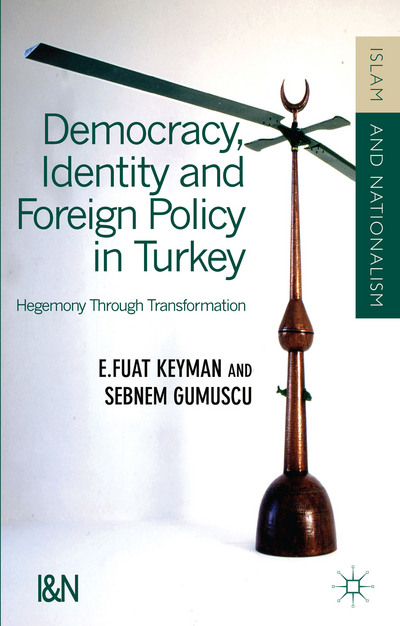
Democracy, Identity and Foreign Policy in Turkey

Democracy, Identity and Foreign Policy in Turkey


E.Fuat Keyman, Sabancı University
Şebnem Gümüşçü, Middlebury College 

Palgrave Macmillan, 2014


The recent history of Turkey is dominated by the country's transformation into a modern democracy. Over the past few years Turkey has been increasingly recognised as a nation of economic, political and cultural significance as well as being a vital political connection between Europe and the Middle East. In this compelling volume, Professor Keyman and Dr. Gumüsçu put democratisation in Turkey under the microscope with an especial focus on recent transformations under the Justice and Development Party (AKP). Accordingly, it explores to what extent Turkey's transformation under the AKP has led to democratic consolidation as well as asking if there is a disconnect between economic, cultural, and urban transformation, on the one hand, and democratic consolidation on the other? Furthermore, this book also takes the opportunity to explore several issues that have a direct effect on the consolidation of Turkish democracy such as globalization, foreign policy activism, the kurdish question, religious governance and civil society. By critically analyzing the dialectic between domestic transformations and global/regional dynamics, the book also discusses the ways in which Turkish transformation is affected by the Arab uprisings as well as how Turkey may inspire these countries.


Table of Contents

1. Introduction

2. Turkey's Transformation


3. Constructing Hegemony: the AKP Rule


4. AKP's Hegemony and Democratic Consolidation


5. Turkey's Proactive Foreign Policy under the AKP


6. Turkish Foreign Policy in the aftermath of the Arab Uprisings


7. The AKP, Arab Uprisings and the Kurdish Question


8. Secularism, Democracy and Identity


9. Civil Society and Democratic Consolidation


10. Conclusion: Turkey at the Crossroads: Democratization through the Strong EU Anchor


Friday, October 25, 2013

Rethinking the Kurdish question in Turkey

E. Fuat Keyman, Sabancı University (Istanbul)
www.resetdoc.org It is not possible to make Turkish modernity multicultural, Turkish democracy consolidated, Turkish economy sustainable, Turkish society a society of living together; and Turkish foreign policy proactive, multidimensional, and effective, without resolving the Kurdish question. In this paper; I will suggest that the democratic solution to the Kurdish question lies in; (a) a critical analysis of state-centric Turkish modernity and its recent crisis, as the Kurdish identity has always been constructed as the Other of Turkish national identity; and (b) an attempt aiming at a democratic reconstruction of the political in Turkey, which sees a multicultural and differentiated understanding of constitutional citizenship as a constitutive norm of “living together in diversity”. By doing so, it would be possible to seek a feasible and effective solution to the Kurdish question not in “ethnic terms,” but by exploring possible ways of “articulating identity-claims to citizenship rights with an emphasis on the practice of democracy”.Antonio Gramsci's famous statement that “the old is dying and the new cannot be born: in this interregnum a great variety of morbid symptoms appear,” though penned as early as the 1930s, captures and expresses eloquently the transformative and ambivalent nature of the world in which we live.[1] One of the sites at which such transformation and ambivalence has occurred is that of “the political” where particularistic identity claims have begun to increasingly dictate the mode of articulation of political practices and ideological/discursive forms in national and global relations. This politics has a name: the politics of identity. Debates over multiculturalism and Islamophobia in the West and North America, the rise of religious fundamentalism and meta-racism, and the dissemination of ethnic conflicts in various places in the world, to name a few, constitute different manifestations of the politics of identity. Identity politics could constitute a ground for what William Connolly calls “the ethos of pluralization” as the ineradicable dimension of democracy.[2] Yet it is through political claims to identity that the (communitarian) attempts at renouncing a democratic vision of society operate and assume self-referential legitimacy, as in the cases of ethno-nationalism, meta-racism and religious fundamentalism.Turkey would not constitute an exception in this sense, and this paper attempts to analyze critically the identity politics in Turkey by focusing on what has come to be known as “the Kurdish question”. Since the 1980s, Turkish politics has increasingly been marked by the tension between the universal and the particular, where at stake is the clash between the secular national identity as the bearer of cultural homogenization and the revitalization of the language of difference through the resurgence of Islam, the reemergence of Kurdish nationalism in organized form, the non-Muslim minority question, the Headscarf Affair, and the sexual question. Despite significant differences among them, all these movements directly challenge the unifying discourse of Turkish national identity on the basis of which secularist and state-centric Turkish modernity reproduces itself.Of these movements, the “Kurdish question” has been most politically troublesome and challenging. The Kurdish question has placed ethnicity at the center of Turkish politics, while also causing a very bloody and violent ethnic conflict, or “low-intensity war” between government forces and the PKK (the Kurdish Workers Party); a war that has left almost 40,000 people dead; more than 1,000,000 people displaced; and a society highly polarized, intolerant, and facing a serious risk of segregation. The Kurdish question has involved not only a growing Kurdish ethnic assertiveness in the form of identity politics which claims for the “recognition” of difference, but also and more importantly and devastatingly “a campaign of violence” and terrorist activities of the PKK.[3] Thus, the demand for recognition has gone hand in hand with violence and terror, making it almost impossible to separate discursively and politically the politics of identity from that of war. As Cizre correctly puts it, “The harshness of the present armed conflict between the state security forces and the Kurdish Workers Party (PKK) reinforces the belief that Kurdish nationalism is not a simple expression of discontent, but a movement that demands changing the boundaries of the Turkish entity”.[4] In fact, today, it is not possible to make Turkish modernity multicultural, Turkish democracy consolidated, Turkish economy sustainable, Turkish society a society of living together; and Turkish foreign policy proactive, multidimensional, and effective, without solving, or at least disarming, the Kurdish question.Despite the recent efforts and calls for its democratic solution based on deliberation and democracy, the embeddedness of identity claims into violent ethnic conflict has also rendered impossible a critical and problem-solving analysis of the Kurdish question. Instead it has become an effective heuristic device for Turkish and Kurdish nationalist discourses to establish themselves as hegemonic in the political arena. These seemingly antagonistic nationalist discourses have acted in a strikingly similar fashion; both have securitized the Kurdish question, established a sharp disconnect between security and liberty, as well as security and democracy, and in doing so, privileged the former as the foundational ground on which the question is supposed to be dealt with. Rather than theoretical efforts aiming at providing an historical and critical analysis of the Kurdish question, it is the securitization of the political and societal polarizations that have dictated the way in which the question has been framed and dealt with. Thus, the Kurdish question has been used and abused by both the state-centric Turkish nationalism and Kurdish ethno-nationalism, in their seemingly antagonistic, yet politically and epistemologically almost identical modes of discourse and practice.In recent years, especially since 2000, Turkey has been undergoing a significant transformation process whose manifestations have been felt in politics, economy, culture, and foreign policy. Yet, the Kurdish question has remained hostage to violence and terror, and has sunk more and more into the grip of securitization and ethno-nationalism. In this era, Turkey has been governed by a strong majority government formed by the AK Party (the Justice and Development Party) It has begun its full accession negotiations with the European Union, and has become one of the key regional and global actors of globalization in the areas of security and economy. It has also achieved economic dynamism even at a time when the global economy has been confronted by severe crises. Moreover, Turkey has initiated what has come to be known as “the democratic opening” with the intention of introducing a reform package in the areas of minority rights and freedoms concerning education, broadcasting, organization and expression of cultural difference; has started the state-based negotiations with the PKK for the disarmament of the Kurdish question, while the pro-Kurdish party the BDP (the Peace and Democracy Party) has increased its power and influence in the 12 June 2011 national elections by obtaining 36 independent MPs. Yet, these changes unfortunately did not rescue the Kurdish question from violence, terror, and ethno-nationalism. Today, while Turkey’s active globalization and Europeanization are increasing its global visibility, it continues to suffer inside from the on-going low-intensity war between the Turkish state and the PKK; from the growing risk of becoming an ethnically-divided, polarized, and conflict-prone society; as well as from the endurance of the dominance of the language of security and conflict over democracy and liberty....Full-text available at:http://www.resetdoc.org/story/00000022304

Friday, March 15, 2013

After Defeat: How the East Learned to Live with the West


Washington and Lee University
News and Media, 2011

After growing up in Turkey and then studying international relations in the United States, Ayşe Zarakol realized there was something missing from the literature on international relations. "It had almost nothing to say about the constant struggle with identity issues in countries such as Turkey that I heard on almost a daily basis," she said.

In her first book, "After Defeat: How the East Learned to Live with the West" (Cambridge University Press, February 2011), Zarakol used history, social theory and political theory as well as the field of international relations to make the point that international identity matters to countries.

Zarakol, assistant professor of politics at Washington and Lee University, said that American scholars have tended to focus on the argument that material resources and weapons determine international relations. "I want to draw attention to what may just be the most glaring oversight in mainstream international relations - the lack of attention given to the social nature of the modern international system and its cultural and historical origins," she said.

She explained that international norms about states, and people in those states, have been operating since the 19th century when Europe was at its most racist and imperialistic. "The book is not a manifesto against Western civilization. The norms have changed over time and become more pluralistic, and that's to the credit of the international system. But we need to acknowledge that these norms have Western origins. Most countries in the world did not share that heritage when they joined the international system and had to adapt to a culture that was foreign to them."

The international norms stigmatized countries for being non-Western, and for not being sufficiently modern, developed, industrialized, secular, Christian or democratic. Zarakol argued that stigma has the same effect on states that it has on individuals. "We know that social stratification persists in domestic systems even in the face of legal equality, and we know how much of an obstacle social inequality may be for individuals to fully exercise their autonomy - how is that lesson so easily forgotten in international relations?" she asked.

Zarakol examined Turkey after World War I, Japan after World War II and Russia after the end of the Cold War, to show how they adapted to Western norms by integrating into the international system after losing to Western powers.

"These types of Eastern countries, which used to be powerful and were not colonized by the West, tend to be especially preoccupied by status concerns, and this drives their foreign policy and sometimes their domestic behavior," she said.

Zarakol pointed out that once you start seeing yourself in a comparative light you have basically two choices, just as a stigmatized person in domestic society has - you can embrace the norms and try to assimilate or you can reject them. But both strategies lead to reinforcing the norms.

"If the stigmatized outsider attempts to become ‘normal' through assimilation, he confirms the definition of himself as not ‘normal.' If he argues against the ‘normal' view by pointing out that there are other experiences which that ‘normal' view does not account for, he draws attention to the ‘abnormality,'" she said. "The only way out of the impasse is to make no choice at all and resign oneself to living in a condition of ambivalence."

Zarakol said that what people want most of all is to matter, and that what keeps their faith in the system is the hope that they will matter some day, even if they do not matter today.

"I think there needs to be a better understanding of how social hierarchies in the international system have affected people's lives in the last century," she said. "Because I think the 20th century was a time of promise, in the sense that if a country acted in a certain way it would move up both the material and social hierarchy. But that hasn't really been the case for many countries and I think that's a big problem in international relations. There is little recognition that lack of upward mobility is shaping the motivations of people around the world and creates resentment."

She also pointed out that the scholarly discipline of international relations has barely begun to accept that such social inequalities between countries even exist.

Citing the examples of Japan and Turkey, which have pursued Western-friendly policies in order to gain recognition, Zarakol said that neither country has been able to find a secure place in the international order. "For example, despite its great success and being a member of the G8, Japan is not a rule maker. It doesn't set the agenda in the international system."

I think there may be a limit to how long the majority of the world's population will tolerate living under an international system whose rules they have very little input in, and one in which even the most successful outsiders are never accorded the full respect that their material success entitles them to."

Zarakol added that, for the most part, the field of international relations deems the dilemmas of these countries as irrelevant to modern-day politics. "Not only is this problematic from a social science perspective, but it is also dangerous from a policy-making angle," she said. "Simply put, we need a meritocratic international system, instead of one that is only described as such."


"After Defeat: How the East Learned to Live with the West" is available on Amazon or from the Cambridge University Press.


REVIEW

"A highly sophisticated and impressive book that provides an important contribution to the role of identity in International Relations. By focusing on three key ‘interstitial' states-Japan, Russia and Turkey -which have been located on the ‘inferior' side of the ‘established-outsider' organizing principle of international society, Ayse Zarakol advances a novel understanding of International Relations that goes beyond extant constructivist and English School theories." - John M. Hobson, University of Sheffield


Wednesday, November 21, 2012

Turkey and Its Neighbors: Foreign Relations in Transition


"A well-informed and timely addition to scholarship on this important topic."—Paul Kubicek, Oakland University

"Refreshing.... Advances the debate about and enhances our understanding of this important country’s foreign policy."—Malik Mufti, Tufts University

DESCRIPTION

Recent years have seen dramatic changes in the nature, direction, and impact of Turkey's foreign relations in its neighborhood—a region that encompasses Europe, the Middle East, the Black and Caspian seas, and the Caucasus. The authors of this original collection explore those changes, the causes behind them, and their impact on Turkey's ties with its traditional allies in the West.

ABOUT THE AUTHOR

Ronald H. Linden is professor of political science at the University of Pittsburgh. Ahmet O. Evin is founding dean of the Faculty of Arts and Social Sciences at Sabanci University. Kemal Kirişci is professor of international relations at Boğaziçi University. Thomas Straubhaar is professor of economics at the University of Hamburg. Nathalie Tocciis senior fellow at the Istituto Affari Internazionali. Juliette Tolay is a doctoral candidate in political science and international relations at the University of Delaware. Joshua W. Walker is assistant professor of international studies at the University of Richmond.

CONTENTS

  • Foreword—Stephen F. Szabo.
  • Understanding Turkey’s Relations with Its Neighbors—J. Tolay and R.H. Linden.
  • Reclaiming Turkey’s Imperial Past—J.W. Walker.
  • From Confrontation to Engagement: Turkey and the Middle East—N. Tocci and J.W. Walker.
  • Battles, Barrels, and Belonging: Turkey and Its Black Sea Neighbors—R.H. Linden.
  • Energy and Turkey’s Neighborhood: Post-Soviet Transformation and Transatlantic Interests—A.O. Evin.
  • Coming and Going: Migration and Changes in Turkish Foreign Policy—J. Tolay.
  • Democracy Diffusion: The Turkish Experience—K. Kirişci.
  • Turkey as an Economic Neighbor—T. Straubhaar.
  • Turkey as a Transatlantic Neighbor—N. Tocci.
  • Turkey and Its Neighborhood: Past, Present, and Future—the Authors.


Wednesday, September 12, 2012

Multiple Paths to Modernity

RESET DOC
September 2012

Each cultural and denominational tradition, including Islam and other religions, is susceptible to lead to an internal elaboration of its own democratic and pluralist approach to modernity. Four leading scholars explain how and why this happens.

Monday, November 14, 2011

Revisiting the Turkish Politics after the June 2011 Elections

ÜMİT CİZRE
Istanbul Şehir University
Insight Turkey 13, 4 (2011)
pp.83-105

....

Conclusion: Summer 2011 as a Point of No Return to Status Quo Ante

In its first two terms in office, the AK Party government felt the pressure of a number of socio-political cracks in the country, the republican dogmas of the secular elite, the interventionist mentality of the military, the suspicions of intellectuals, the zigzagging support for the government in the business, and the increasingly vocal renunciations on its reformist political agenda. In the still-developing post-election era, there is a more heightened public awareness, critique and anticipation regarding the fundamental issues waiting to be resolved, not in the ways they were managed ad hoc in the past but in sync with emerging new realities. This fact alone points to a need for all actors, including the opposition forces in the country, to adopt a fresh perspective in assessing and restructuring the major fault lines in Turkey. The impending sense of unfinished business on the part of the AK Party government also gives hope that in the new agenda for change the reform priority of the next four years will not be politics-as-usual.

The opposition is also at a crossroads: to only make leadership changes (like the CHP) while everything else stays the same does not play in the streets. In fact, together with the trigger-happy instigators of the conflict that keeps flaring up in the southeast even when there is a truce, superficial changes and rhetoric work the other way in terms of creating urgency and intensity for wishing to see “something radically different” in place of familiar faces, repetitive rhetoric, business-as-usual attitudes and clichéd ideas. New realizations, aspirations, and trends in the country also stem from Turkey’s new found ambition to project Turkish power across its borders for regional stability and as a credible example of democracy for Egypt, Tunisia, Syria and Libya. To be congruent with that image, the need for a political shake-up that would transform societal and political realities and the remnants of the old order seems to be more intense and urgent.

Those opposition actors which collude with old power centers, be they leftwing, right-wing, secular, or Turkish/Kurdish nationalists, stand in sharp contrast to the vitality, urgency and inventiveness of the new popular critique of the past. They also impose limitations on the transformative role the AK Party can play in the next four years. The actors of the ancien regime are seriously in need of a shake-up to question their heritage, intellectual preparedness and responsibility in making a New Deal.


Full-text of the article, available at:


Monday, April 18, 2011

Secularism: America, France and Turkey in Comparative Perspective

Ahmet T. Kuru, San Diego State University
Cambridge University Press, 2009


Why do secular states pursue different policies toward religion? This book provides a generalizable argument about the impact of ideological struggles on the public policy making process, as well as a state-religion regimes index of 197 countries. More specifically, it analyzes why American state policies are largely tolerant of religion, whereas French and Turkish policies generally prohibit its public visibility, as seen in their bans on Muslim headscarves. In the United States, the dominant ideology is "passive secularism," which requires the state to play a passive role, by allowing public visibility of religion. Dominant ideology in France and Turkey is "assertive secularism," which demands that the state play an assertive role in excluding religion from the public sphere. Passive and assertive secularism became dominant in these cases through certain historical processes, particularly the presence or absence of an ancien régime based on the marriage between monarchy and hegemonic religion during state-building periods.


Excerpt


Table of Contents

1. Analyzing secularism: history, ideology, and policy

Part I. The United States:
2. Passive secularism and the Christian right's challenge (1981–2008)
3. Religious diversity and the evolution of passive secularism (1776–1981)

Part II. France:
4. Assertive secularism and the multiculturalist challenge (1989–2008)
5. The war of two Frances and the rise of assertive secularism (1789–1989)

Part III. Turkey:
6. Assertive secularism and the Islamic challenge (1997–2008)
7. Westernization and the emergence of assertive secularism (1826–1997)


Reviews

"Professor Kuru's authoritative study, written with remarkable precision, asks taboo-breaking questions and provides iconoclastic responses to them in strict accordance with the maxim facta non verba. First, it shatters the deeply internalized myth that Turkish laïcité is unquestionably sui generis and thus cannot be compared with any other case. Second, it rebuffs the widely accepted premise that Islam and secularism are inherently incompatible, and that assertive secularism would therefore be the only working model for Muslim societies. Third, it clearly shows that in its application of assertive secularism Turkey has gone far beyond its historical model, the French laïcité of the Third Republic. This exemplary piece of scholarship further offers invaluable insight into the present-day tug-of-war over secularism in Turkey." - M. Şükrü Hanioğlu, Princeton University

"Kuru's work speaks to a wide audience. Substantively, it explains both the formation and policy consequences of various forms of secularism, which should interest scholars and students of a wide array of subjects. With a precise analytical framework and engaging historical narrative, it introduces the relevance of ideology to the study of religion and politics. It also combines deductive theory witha rich empirical analysis that is sensitive to the historical context. This book deserves high praise for managing to cross so many boundaries in such a sophisticated manner." - Middle East Policy

"...Kuru demonstrates that much can be gleaned from further study of these three constitutionally secular cases. Secularism and State Policies Towards Religion sets a new standard for such studies and should be required reading for anyone interested in the relationship between religion and state.... While Kuru focuses on three states, his theoretical framework is potentially applicable to a wider range of states. I believe the significance of this contribution will be seen in future studies of the role of religion in government policy in which I expect this book to become a required citation." - Jonathan Fox, Bar Ilan University, Journal for the Scientific Study of Religion

"Kuru's... book is original, scholarly, and wide-ranging, lifting the account of the relationship between religion and politics in Turkey out of the normal single-country context or the simpler comparison with other Muslim societies. Readers whose main interest in the Turkish or Muslim context may be inclined to skip the chapters on the United States and France, but by doing so they will miss an important part of the book which should be illuminating reading for anyone concerned with the role of religion in modern democracies." - William Hale, School of Oriental and African Studies, Middle East Journal

"I recommend this book highly to anyone interested in church-state issues, or in the comparative study of religion and politics. Students of American politics could learn from the book as well, since it puts contemporary US church-state debates in a broader context." - Clyde Wilcox, Georgetown University, Journal of Church and State
"Professor Kuru's book is, no doubt, a major contribution to the international literature on the subject, as well as being a much-needed scholarly contribution to the current debates in Turkey, which often presents a picture of a dialogue of the deaf." Ergun Özbudun, Bilkent University, Insight Turkey

"Relying on an extensive list of legal and political documents, interviews with political elites, and existing research sources.... Kuru has produced an impressive body of research. He has shown effectively that ideology can shape preferences and frame debates.... Secularism and State Policies toward Religion helps us understand both the origins and consequences of the variety of secular states and the policies that result." - Roger Finke, Penn State University, Contemporary Sociology

"Secularism and State Policies toward Religion is a very well-written, well-organized, well-argued and easy-to-read book on an important and difficult topic: it is a comparative in-depth analysis of three different regimes of secularism." - Menderes Çınar, Başkent University, New Perspectives on Turkey

"Kuru's book is a priceless contribution to the cutting-edge debate on state–religion interaction... [It] is the best comparative book that has been published recently on contested state attitudes and policies toward religion... The book succeeds in incorporating an extremely nuanced understanding of each of the three cases without losing terminological clarity, analytical consistency, and theoretical depth." - Berna Turam, Northeastern University, International Journal of Middle East Studies


Friday, February 25, 2011

Turkey: A Democratic Superpower in the Middle East

New Perspectives Quarterly, Fall 2010
Reza Aslan is the author of No god but God: The Origins, Evolution and Future of Islam.

Istanbul—A political party espousing a commitment to what it calls “Islamic moral values” has brought Turkey closer to a full-fledged democracy than it has ever been.

Last week, 30 years after a military coup overturned the democratically elected government of Suleyman Demirel, Turks voted overwhelmingly for constitutional changes pushed through by the moderate Islamists of Prime Minister Recep Tayyip Erdogan’s Justice and Development Party (known by its Turkish initials AKP).

The reforms strengthen the rights of women, children and the handicapped, provide greater freedoms for Turkey’s Christian and Kurdish minorities (both of whom have been repeatedly persecuted and marginalized by previous governments), relax Turkey’s restrictive labor laws, curtail the role of the military in political affairs and allow for the creation of more democratic institutions throughout the country. More crucially, the reforms reorganize the structure of the court system, providing greater legal protections for ordinary citizens while stripping the military of its immunity against prosecution in civilian courts.

Opponents in the constitutional referendum argued that it ceded too much power to the president and parliament, particularly when it comes to appointing judges. Yet such arguments failed to persuade voters, nearly 60 percent of whom voted for the package of reforms that the AKP presented as a necessary step toward Turkey’s membership in the European Union. (Interestingly, even as enthusiasm for EU membership has deteriorated in Turkey—support has dropped to 54 percent from 68 percent in 2005—the economic and political changes have proved so popular that they seem no longer to be dependent on what Europe wants from Turkey, but on what Turks want for themselves.)

Since coming to power in 2002, the AKP, which models itself on Europe’s conservative Christian Democratic parties, has steadily chipped away at the military’s self-ascribed role as the protector of Turkish democracy. Instead, the AKP has provided Turks with a model of governance that reflects a commitment to constitutional democracy and the rule of law, but without the need to forcibly repress the country’s religious identity.

Not only has Turkey become a freer, more liberal, more inclusive and more democratic country under the AKP, it has also become a more dominant global power and has experienced an unprecedented period of economic growth. Indeed, the Turkish economy has come out of the global recession stronger than ever, posting a 10.3 percent growth in GDP in the second quarter of this year. That makes Turkey the third-fastest-growing economy in the world behind Singapore and Taiwan.

And yet the AKP continues to face the same tired rhetoric from Turkey’s main opposition parties that it is undermining the “secular foundations” of the state by, for example, allowing girls to go to school while wearing a simple scarf over their hair.

One hears similar criticisms in the United States, where there has been a lot of hand-wringing lately over Turkey’s increasingly assertive foreign policy, its deepening ties with Iran, Syria and Iraq, and its overt criticism of Israel’s treatment of the Palestinians. Some have even suggested that Turkey, the only Muslim member of NATO, is turning away from its strategic alliance with the West and instead building an “Islamic axis” against America’s interests in the region.

This is nonsense. It is not Islam that drives the AKP’s foreign or domestic policy but rather its economic and national security interests. If Turkey has been focusing its diplomatic efforts on the Middle East, Central Asia and the Persian Gulf, it is because that is where its economic growth is coming from, not from Europe or the US.

Further, Turkey’s more robust foreign policy and its attempts to insert itself as a mediator in the region’s conflicts are the result of its revived sense of national confidence. Turkey is no longer willing to be subordinate to the US but insists on being treated as an ally and equal, with its own proposals and policies for dealing with the region’s problems.

That is a good thing, because Turkey’s interests in the region—whether regarding a two-state solution to the Israeli-Palestinian conflict, or building stability in Iraq and Afghanistan, or keeping Iran from developing nuclear weapons—align with those of the US In fact, it is no exaggeration to say that Turkey is now America’s most important strategic ally in the Middle East.

More significantly, Turkey has provided the peoples of the Middle East with a more authentic example of Islamic governance than one finds in the secular dictatorships of Egypt, Jordan and Syria or the religious authoritarianism of Iran and Saudi Arabia. The AKP has proved that there need not be any contradictions between Islam and democracy, that a party committed to Islamic values can be equally committed to human rights, constitutionalism, pluralism and the rule of law. And with the passage of the constitutional reforms, Turkey took another step toward solidifying its position as the new superpower of the Middle East: the shining model of what a modern, Muslim-majority democracy can achieve if given the opportunity.


Friday, February 11, 2011

The Fading Dream of Europe in Turkey

Orhan Pamuk

In the schoolbooks I read as a child in the 1950s and 1960s, Europe was a rosy land of legend. While forging his new republic from the ruins of the Ottoman Empire, which had been crushed and fragmented in World War I, Mustafa Kemal Atatürk fought against the Greek army, but with the support of his own army he later introduced a slew of social and cultural modernization reforms that were not anti- but pro-Western. It was to legitimize these reforms, which helped to strengthen the new Turkish state’s new elites (and were the subject of continuous debate in Turkey over the next eighty years), that we were called upon to embrace and even imitate a rosy-pink—occidentalist—European dream.

The schoolbooks of my childhood were texts designed to teach us why a line was to be drawn between the state and religion, why it had been necessary to shut down the lodges of the dervishes, or why we’d had to abandon the Arab alphabet for the Latin. But they were also overflowing with questions that aimed to unlock the secret of Europe’s great power and success. “Describe the aims and outcomes of the Renaissance,” the middle school history teacher would ask in his exam. “If it turned out we were sitting on as much oil as the Arabs, would we then be as rich and modern as Europeans?” my more naive classmates at the lycée would say. In my first year at university, whenever my classmates came across such questions in class, they would fret over why “we never had an enlightenment.” The fourteenth-century Arab thinker Ibn Khaldun said that civilizations in decline were able to keep from disintegrating by imitating their victors. Because Turks were never colonized by a world power, “worshiping Europe” or “imitating the West” has never carried the damning, humiliating overtones described by Frantz Fanon, V.S. Naipaul, or Edward Said. To look to Europe has been seen as a historical imperative or even a technical question of adaptation.

But this rose-colored dream of Europe, once so powerful that even our most anti-Western thinkers and politicians secretly believed in it, has now faded. This may be because Turkey is no longer as poor as it once was. Or it could be because it is no longer a peasant society ruled by its army, but a dynamic nation with a strong civil society of its own. And in recent years, there has of course been the slowing down of talks between Turkey and the European Union, with no resolution in sight. Neither in Europe nor in Turkey is there a realistic hope that Turkey will join the EU in the near future. But to admit to having lost this hope would be as crushing as to see relations with Europe break down entirely. So no one has the heart even to utter the words.

That Turkey and other non-Western countries are disenchanted with Europe is something I know from my own travels and conversations. A major cause of the strain in relations between Turkey and the EU was most certainly the alliance that included a sector of the Turkish army, leading media groups, and nationalist political parties, all combining in a successful campaign to sabotage negotiations over entry into the EU. The same alliance was responsible for the prosecutions launched against me and many writers, the shooting of others, and the killing of missionaries and Christian clerics.

There are also the emotional responses whose significance can best be explained by the example of relations with France. Over the past century, successive generations of the Turkish elite have faithfully taken France as their model, drawing on its understanding of secularism and following its lead on education, literature, and art. So to have France emerge over the past five years as the country most vehemently opposed to the idea of Turkey in Europe has been heartbreaking and disillusioning. It is, however, Europe’s involvement in the war in Iraq that has caused the keenest disappointment in non-Western countries, and in Turkey, real anger. The world watched Europe being tricked by Bush into joining this illegitimate and cruel war, while showing immense readiness to be tricked.

When looking at the landscape of Europe from Istanbul or beyond, the first thing one sees is that Europe generally (like the European Union) is confused about its internal problems. It is clear that the peoples of Europe have a lot less experience than Americans when it comes to living with those whose religion, skin color, or cultural identity are different from their own, and that many of them do not warm to the prospect: this resistance to outsiders makes Europe’s internal problems all the more intractable. The recent discussions in Germany on integration and multiculturalism—particularly its large Turkish minority—are a case in point.

As the economic crisis deepens and spreads, Europe may be able, by turning in on itself, to postpone its struggle to preserve the culture of the “bourgeois” in Flaubert’s sense of the word, but that will not solve the problem. When I look at Istanbul, which becomes a little more complex and cosmopolitan with every passing year and now attracts immigrants from all over Asia and Africa, I have no trouble concluding that the poor, unemployed, and undefended of Asia and Africa who are looking for new places to live and work cannot be kept out of Europe indefinitely. Higher walls, tougher visa restrictions, and ships patrolling borders in increasing numbers will only postpone the day of reckoning. Worst of all, anti-immigration politics, policies, and prejudices are already destroying the core values that made Europe what it was.

In the Turkish schoolbooks of my childhood there was no discussion of democracy or women’s rights, but on the packets of Gauloises that French intellectuals and artists smoked (or so we thought) were printed the words “liberté, égalité, fraternité” and these were much in circulation. “Fraternité” came to stand for the spirit of solidarity and resistance promoted by movements of the left. But callousness toward the sufferings of immigrants and minorities, and the castigation of Asians, Africans, and Muslims now leading difficult lives in the peripheries of Europe—even holding them solely responsible for their woes—are not “brotherhood.”

One can understand how many Europeans might suffer anxiety and even panic as they seek to preserve Europe’s great cultural traditions, profit from the riches it covets in the non-Western world, and retain the advantages gained over so many centuries of class conflict, colonialism, and internecine war. But if Europe is to protect itself, would it be better for it to turn inward, or should it perhaps remember its fundamental values, which once made it the center of gravity for all the world’s intellectuals?


—Translated from the Turkish by Maureen Freely

Monday, November 01, 2010

Religion and Work Ethic Values: The Case of Turkey

THE INFLUENCE OF RELIGION OVER WORK ETHIC VALUES:
The Case of Islam and Turkish SME Owner-Managers

Selçuk Uygur, Phd Thesis, 2009
Brunel University, London


Abstract:
The aim of this thesis is to explore the influence of religion on the work ethic values of small and medium-sized enterprise (SME) owner-managers in Turkey. The emergence of religious/pious business people in Turkey has been regarded as a phenomenon. This research pays special attention to the religious transformation and secularism in Turkey. It is based on semi-structured qualitative interviews with 32 Turkish SME owner-managers. The sample of the study has been divided into two groups: The practicing Muslim Turkish managers (the religious group), and non/less practicing Muslim Turkish managers (the secular group).


Discourse analysis of the qualitative data, first, clarifies where to seek the religious influence on business activities. It indicates that the influence of religion should be sought within individuals‘ conduct/manner of living leading the moral values and the mentalities of the business people, rather than seeking cause and affect relationship. The contemporary Islamic interpretation in Turkey, as it is called Turkish/Anatolian interpretation of Islam, is found to re-shape the existing teachings of the religion and reproduce the religious structure through the practices. In this respect, five distinguishing characteristics emerged as signs of the religious influence behind the pious business people‘s actions: Hard work as an Islamic duty, good will (intention), responsibility, bounty/benevolence and the balance/equilibrium in one‘s life. It is also observed that the new Islamic discourse in Turkey provides moral energy exclusively for the religious business people in terms of influencing and encouraging entrepreneurial activities.


Meanwhile, the study demonstrates that the work ethic values of the religious Turkish SME owner-managers have been evolving to be more rational and professional, especially after the 1980s liberal economy. This transformation has been evaluated within the concept of secularisation.


Concluding Remarks
It could be concluded that Turkey has entered a healthier modernization process which seems as a road of no return by making the peace between Islam and modernity. It seems that after more than a century of soul-searching‘ has settled upon the idea of re-producing traditional values within the contemporary framework. In the context of this research, the newly emergent business class appears as the carrier of this transformation process. In particular, it has been observed that Turkey‘s new entrepreneurs have been re-shaping their mentalities towards business activities and re-producing the existing work-related values and ethics. Max Weber regards this ethical transformation (Protestantization) as the fundamental prerequisite of an extensive development process, and calls it the spirit‘ of Western capitalism. In this respect, Turkey has been experiencing a similar process in the context of Islam. In terms of being worldly, the secularization of Islam is attempting to provide its own view on several aspects of modern life, including business ethics.


The findings of this research give the impression that Islam, in a Turkish context, has considerable potential to contribute new angles to the modern capitalist system. This moderate view of Islam, which does not contradict with free market or liberal economy, seems to have promising views on business ethics beyond the Western perspective. In a way, it can potentially create new views of capitalism.


Overall, the assimilation of liberal values and being articulated to the modern world makes us optimistic about the future of Turkey. Regardless of the level of religiousness, this tendency seems to be shared by the majority of the society. This study regards secularization of Islam as the catalyst of this broad tendency. In this respect, the new‘ work ethic, which is re-producing the tradition based on a rational way of thinking, could play a vital role in creating a strong enterprise culture in Turkey. Additionally, it can be claimed that this development will make Turkey‘s hand stronger in the EU accession process.


Full-text of the PhD Thesis (pdf, 257 pages) is available at:


Friday, July 09, 2010

Turkey: what axis shift?

Mensur Akgün
Kultur University, Istanbul
Le Monde Diplomatique
July 9, 2010


Turkey has been charged with changing axis for a while, but the question is, whose axis is shifting? Turkey’s confidence is rising as it gains in respect due to its recent initiatives. Only in foreign policy is there really a change of direction: it is apparent that Turkey, from now on, will act more autonomously. If necessary, it will define its interests separately from its traditional allies. Turkey will be less open than it was in the past to unilateral requests from the European Union and US. In short, Turkey will not now do whatever it’s asked to do.

That has to do with the changing dynamics of international politics rather than any animosity to the West. It is time to recall a basic, perhaps banal, fact of global politics: the cold war ended 20 years ago and the nature of Turkey’s role as alliance partner has clearly changed.

Those who accuse Turkey of changing axis confuse the transformation of global politics with that of values and (ideological) trends. And this is where the question of axis shift is perceived as a threat and there is a ringing of alarm bells. But Turkey is simply continuing the broad trends and values begun in 1839 during the period of the Tanzimat reforms.

There is no doubt that Turkey is in transition: problems are on the way to being resolved. Turkey is reconciling itself with its history, albeit slowly, and a process of normalisation is underway, particularly with our neighbours — including Armenia. The country is also democratising and human rights are respected more. That doesn’t mean everything is perfect. But the general direction is towards a more democratised and pluralist Turkey in domestic and external politics.

Does proposing democratisation as a remedy for the Kurdish problem signify an axis change? Or taking steps to normalise relations with Armenia, or paying an official visit to Northern Iraq to end the traditional enmity with Kurdistan? Or supporting a resolution of the Cyprus problem on the basis of UN parameters, or making proposals to solve problems in the Aegean? You may answer that Turkey has shifted axis by deepening its relations with the Middle East and Arab world. But you could say the same of France: President Sarkozy has been trying to solve Syria’s problems with Israel even though France is thousands of miles from these countries.

Why shouldn’t Turkey play a positive role in resolving the troubles in our own neighbourhood, the Middle East, and develop relations and earn money from trade, tourism and investment with these countries with which we have close cultural and historical ties?

Some in Turkey echo the charge of axis shift. Could this be somehow related to the inferiority complex that we feel vis-à-vis the West, as if the ‘western-ness’ of our literati could be called into question by our good relations with the East. Such fears create obstacles for those interested in understanding the real transformation taking place in Turkey.

Some still believe the Justice and Development (AK) Party and its so-called hidden Islamist agenda is estranging us from the EU and transforming Turkey into an Islamic country. Others, particularly those looking at Turkey from the outside, are concerned whey they see it make insightful points, even though in an imperfect and sometimes incorrect style. May be they are worried that Turkey is acting in line with the principles of the UN Charter, the Nuclear Nonproliferation Treaty, Geneva Convention and human rights documents. Rather than changing axis, Turkey is becoming more "western" with each passing day. The only difference is its rising confidence, the appropriate policies that it pursues, and increased respect it is winning for its initiatives. So whose axis is shifting? The answer, unfortunately, is Europe’s, particularly the European Union. The EU is moving away from its own values, and sacrificing its basic principles because of unfounded fears, and forgetting its promises when it comes to Turkey.

Twenty years after the end of the cold war, with the transformation of world politics, Turkey is becoming more aware of its potential as a force for stability and peace in its own region, and an actor to be reckoned with in world politics. I can understand that makes some people uneasy, but I believe those who are interested in expanding zones of stability and resolving problems through peaceful means should recognise that Turkey has a vision that the our region needs.


Friday, February 12, 2010

Towards Democratic Civilian-Military Relations in Turkey


BOMBS target the faithful in Istanbul’s busiest mosques; a Turkish air force jet is shot down over the Aegean, provoking a war with Greece. Chaos descends over Turkey. The army steps in, overthrows the mildly Islamist Justice and Development (AK) Party that has governed Turkey since 2002, and takes control.

This plan, codenamed “Sledgehammer” and hidden among 5,000 pages of army documents, was exposed in January by a small independent newspaper, Taraf. It caused a storm. The army said it was just a “simulation exercise”. How, thundered General Ilker Basbug, the chief of the general staff, could Turkish soldiers, who charge into battle crying “Allah, Allah”, bomb a mosque? It is a question which civilian and military prosecutors are now attempting to answer.

“Sledgehammer” is only the latest in a string of alleged coup plots to have been exposed in recent years. That helps explain why, on February 4th, Turkey’s government scrapped the controversial security and public order (“Emasya”) protocol, which lets the army choose to take charge in the provinces when law and order breaks down. Critics argued that Emasya’s real purpose was to provide the legal framework for a future coup.

The army’s image has been badly tarnished and its role is now being questioned. Is its influence fading irreversibly as Turkey becomes a fully fledged Western democracy? Or is this just the latest twist in the long battle between the elite, made up of generals and an old guard used to monopolising wealth and power, against a rising class of overtly pious Anatolians, symbolised by the AK government?

The answers matter, and not just to the Turks. Turkey is a strategic pivot between Europe and the Middle East. It has a large and growing population of 72m people. It is poised to become a main transit route for oil and gas from the east. It has NATO’s second-largest army, after America’s. And it is a rare example of a secular democracy in a mainly Muslim country, closely watched by other democracies, such as Pakistan and Indonesia, where the army is strong.

Herein lies the conundrum. The Turkish army has long been seen as the guarantor of the secular republic founded 86 years ago by Kemal Ataturk. For all its recent troubles, it remains the country’s most trusted and popular institution (although its ratings are slipping to unprecedented lows). Yet the generals’ persistent meddling in politics and the red lines they seem to draw around some of the thorniest subjects—such as Cyprus or the Kurds—are among the biggest obstacles to Turkey becoming a full democracy. Turkey’s constitution was drafted by the army 30 years ago; it urgently needs a rewrite. And the issues on which the army is most recalcitrant are precisely those that most bedevil Turkey’s chances of joining the European Union.

A parallel state
The army has staged three coups since 1960, when it hanged the country’s first freely elected prime minister, Adnan Menderes, established the National Security Council and set up its own courts. “They created a parallel state,” explains Umit Kardas, a former military prosecutor. The generals cemented their power after the 1980 coup by pushing through an authoritarian constitution that remains in force.

In 1997 the generals toppled the country’s first Islamist-led government, on the dubious ground that it was seeking to introduce sharia law. This “post-modern coup” came after a sustained campaign orchestrated by the generals and their friends in the media and business. In 2007 they threatened to intervene again, this time through a web posting on the defence staff’s website objecting to Abdullah Gul, then Turkey’s foreign minister, becoming the country’s president. They were unhappy that Mr Gul’s wife chose to wear a headscarf, which is banned in state institutions as a symbol of Islamic fundamentalism.

This “e-coup” proved a huge miscalculation. Recep Tayyip Erdogan, the prime minister, called a snap election, AK won a second term with a greater share of the vote (47%), and Mr Gul duly became president. “The army tried to dictate its will and the people said no—and what’s happened since shows that the army is losing its power,” notes an EU diplomat in Ankara.

Undeterred, in 2008 the generals tacitly backed the country’s chief prosecutor, Abdurrahman Yalcinkaya, when he tried to persuade the constitutional court to ban the AK party on the flimsy charge that it was seeking to reverse secular rule. The constitutional court ruled against the ban, though by a whisker.

Since then, the government has been fighting back. Over the past two years the public has been bombarded with revelations of the army’s alleged skulduggery. Scores of officers, including retired generals, have been interrogated or arrested in connection with the so-called Ergenekon case, named after an alleged shadowy network of rogue security officers, academics, journalists and businessmen. Prosecutors accuse the network of planning to foment chaos through a series of bloody provocations, thus justifying a coup against AK. But the evidence has not always been convincing, and some innocent people have been caught up; many have been detained for months without charge.

The generals insist that Ergenekon is part of a smear campaign led by Fethullah Gulen, a moderate Islamic cleric who heads Turkey’s richest and most influential Islamic brotherhood. This movement, which abhors violence and embraces capitalism, is acknowledged to have kept Turkish Islam tame. But the generals believe Mr Gulen and his followers are steering Turkey towards Islamic rule. One of the army’s alleged coup plots involved the planting of weapons in the homes of Gulenists in an attempt to discredit them.

It is not just coup-mongering that is blighting the army’s image. A recent string of bloody attacks by the separatist Kurdistan Workers’ Party (PKK) has raised questions about the army’s prowess in the field. These grew louder when Taraf published documents purporting to show that the army had advance warning of a PKK attack carried out in 2007 on Daglica, a remote outpost on Turkey’s border with Iraq. The revelations provoked an outcry, and previously taboo questions about Turkey’s military activities are now being asked. Ali Bayramoglu, a liberal academic, notes: “Until recently, losing a son in service of the country was a badge of honour. But for the first time the Turkish people are openly questioning the merits of the war.”

Ergenekon and Daglica have sapped the army’s prestige. But it is EU-oriented reforms that are nibbling at its power. This may explain why the generals, although paying lip service to the goal of joining the EU, are in fact rather ambivalent about it.

Suits v uniforms
The reforms began in earnest in 2002, when AK formed Turkey’s first single-party government in 17 years. In January 2004 the National Security Council, through which the generals used to impose their views, was shrunk to an advisory body. In one of its boldest moves, the AK government passed a constitutional amendment last year paving the way for officers to be tried in civilian courts.

The generals may be down, but they are by no means out. The civilian-trials amendment was struck down by the constitutional court in January. To say that the army’s power is declining indicates “a comfortable assumption of linear progress, where democracy and the politicians are gaining ground,” comments William Hale, a British analyst; that is not entirely accurate, he says.

In truth the army is strong whenever the civilian government is weak, or when danger threatens. Many people worry that tensions between Turks and Kurds could escalate into the kind of unrest that might justify a fresh army intervention. And there is another catch. The army’s own internal-service law allows it to intervene in defence of secularism and “the indivisible unity of the state” when these are perceived to be at risk—from Kurdish separatists, for example. Although General Basbug endorsed the scrapping of Emasya, he has made it clear that this last safeguard must remain untouched. EU demands that the generals should be answerable to the defence ministry, rather than the other way round, have yet to be met. “Let them subordinate the army to the ministry of sports if they want,” scoffs Armagan Kuloglu, a retired general. “The army will still do what it needs to do.” Lale Kemal, a military analyst, says that “until the constitution is replaced, civilian control over the army is a pipe-dream.” Mr Erdogan has vowed to replace the constitution, but he is widely suspected of cutting deals with the generals behind the scenes.

Quarrels between Turkey’s soldiers and its civilian rulers are nothing new. In 1908 the “Young Turks” mounted the first successful modern coup when they overthrew the tyrannical Sultan Abdulhamid II. The army was hailed then as a force for modernisation. It also offered a leg-up for the rural masses to climb the social ladder.

But it was not until Ataturk rescued Turkey from dismemberment at the hands of the western Allies after the first world war that the army was put on a pedestal. Millions of Turks believe that, had it not been for Ataturk and the army, there would be no Turkey today. Such feelings are cemented during the 15 months of military service that are mandatory for all Turkish men. The army also owes its popularity to an education system which decrees that “Every Turk is born a soldier”.

For millions of secular Turks the army remains the sole guarantor of their freewheeling lifestyle. The main opposition Republican People’s Party (CHP), founded by Ataturk, should be in the vanguard of pro-EU changes. Yet it has opposed many of them, even though it is EU membership, not the army, that offers the best shield against radical Islam.

With no credible rivals in sight, the AK party may well win a third term in 2012. This could give freer rein to what critics call Mr Erdogan’s tilt towards authoritarianism. His attacks against opposition newspapers and his reluctance to change laws that keep smaller (ie, Kurdish) parties out of parliament have reinforced this image. “One might feel better about the military’s loss of power if Turkey had a balanced political system with the possibility of alternance of government,” says Eric Edelman, a former American ambassador to Turkey.

Unlike the crooked politicians who have long mismanaged the country, “the Turkish army doesn’t represent narrow interests,” argues Mesut Yegen, a sociologist at Ankara’s Middle East Technical University. “It draws its legitimacy from the people. It is truly a national force.” This may explain why Turkey’s generals have always handed power back to civilians after their coups. Yet for all its talk of being of the people, “the army believes that it knows what is best for them,” says Mr Kardas. Cloistered in their barracks, clubs and holiday camps, soldiers are often out of touch. “We lived in a surreal world where officers who wanted to get promoted had to drink wine and dance the waltz,” says Senol Ozbek, a retired lieutenant-colonel.

A very modern general
If Turkey’s army is beginning to lose its addiction to political meddling, it is in part thanks to the efforts of the man at the top. General Basbug, who won a reputation for toughness in the early 1990s during the height of the Kurdish insurgency in south-east Turkey, is as strict a secularist as any. But he is well aware that the army’s perceived aversion to Islam has contributed to its sagging popularity.

The general has a more enlightened understanding of the army’s role than did some of his predecessors. According to Mr Edelman, General Basbug’s experiences as a cadet during the 1960 coup convinced him that there was no place for the army in Turkish politics. His name has never been linked to any alleged coup-plotters. He says he is determined to weed them out. Now some of his soldiers seem to be catching the bug; they are said to be behind many of the alleged coup plots that have been leaked. “Some are out to get their peers, some are Gulenists, but many are idealists who believe the army should keep out of politics,” says Mehmet Baransu, the Taraf journalist who broke the Sledgehammer story.

Such attitudes are spreading throughout Turkey, helped by the forces of globalisation and the internet in a country where half the population is below the age of 29. Every Tuesday night millions of Turks tune in to watch a new mini-series called “Would This Heart Forget You”. Were it not for the romantic plots, the programme might be mistaken for a documentary on the army’s abuses during the 1980 coup. Recent episodes showed torture scenes in the notorious prison at Diyarbakir. “The soldiers would stick truncheons up our anuses, urinate on us and force us to eat dead rats,” says Salih Sezgin, a former inmate. Until recently such a series could not have been aired.

Back in 1909, Ataturk delivered a speech to his fellow Young Turks. “Our colleagues in the army should no longer dabble in politics,” he said. “They should direct all their efforts to strengthening the army instead.” Over 100 years later, the message may at last be getting through.
.
Related Posts with Thumbnails

Düşünce Kahvesi

Photography

Photography
dpchallenge.com

NYT: Travel and Cities

H-Net Academic Announcements - All