Showing posts with label sufism. Show all posts

Sunday, May 30, 2010

If It Is Not Too Dark


If It Is Not Too Dark

Go for a walk, if it is not too dark.
Get some fresh air, try to smile.
Say something kind
To a safe-looking stranger, if one happens by.

Always exercise your heart's knowing.

You might as well attempt something real
Along this path:

Take your spouse or lover into your arms
The way you did when you first met.
Let tenderness pour from your eyes
The way the Sun gazes warmly on the earth.

Play a game with some children.
Extend yourself to a friend.
Sing a few ribald songs to your pets and plants -
Why not let them get drunk and wild!

Let's toast
Every rung we've climbed on Evolution's ladder.
Whisper, "I love you! I love you!"
To the whole mad world.

Let's stop reading about God -
We will never understand Him.

Jump to your feet, wave your fists,
Threaten and warn the whole Universe

That your heart can no longer live
Without real love!

~ Hafiz ~


(I Heard God Laughing - Renderings of Hafiz by Daniel Ladinsky)

.
http://www.panhala.net/Archive/If_It_Is_Not_Too_Dark.html

Monday, May 25, 2009

"In truth, everyone is a shadow of the Beloved"

.


ONE WHISPER OF THE BELOVED

Lovers share a sacred decree -
to seek the Beloved.
They roll head over heels,
rushing toward the Beautiful One
like a torrent of water.

In truth, everyone is a shadow of the Beloved -
Our seeking is His seeking,
Our words are His words.

At times we flow toward the Beloved
like a dancing stream.
At times we are still water
held in His pitcher.
At times we boil in a pot
turning to vapor -
that is the job of the Beloved.

He breathes into my ear
until my soul
takes on His fragrance.
He is the soul of my soul -
How can I escape?
But why would any soul in this world
want to escape from the Beloved?

He will melt your pride
making you thin as a strand of hair,
Yet do not trade, even for both worlds,
One strand of His hair.

We search for Him here and there
while looking right at Him.
Sitting by His side we ask,
"O Beloved, where is the Beloved?"

Enough with such questions! -
Let silence take you to the core of life.

All your talk is worthless
When compared to one whisper
of the Beloved.

Mevlana Rumi
http://www.allspirit.co.uk/rumi5.html
.
Index of Rumi Poems
.

Monday, January 26, 2009

Sema: Human Being in the Universal Movement

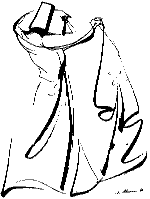
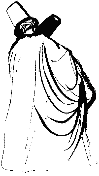
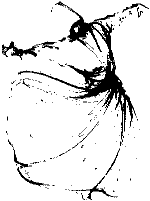
Text by Dr. Celaleddin Celebi, illustrations by Ingrid Schaar «Dr. Celebi's other writings»

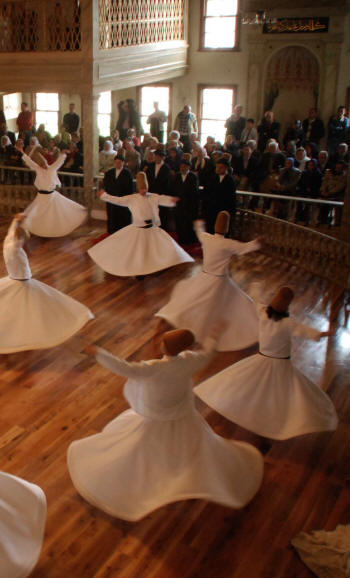
Whirling Dervishes in front of Mevlana's Mausoleum Sema is part of the inspiration of Mevlana Celaleddin-i Rumi (1207- 1273) as well as of Turkish custom, history, beliefs and culture.

From a scientific viewpoint we witness that contemporary science definitely confirms that the fundamental condition of our existence is to revolve. There is no object, no being which does not revolve and the shared similarity among beings is the revolution of the electrons, protons and neutrons in the atoms, which constitute the structure of each of them. As a consequence of this similarity, everything revolves and man carries on his live, his very existence by means of the revolution in the atoms, structural stones of his body, by the revolution of his blood, by his coming from the earth and return to it, by his revolving with earth itself.

Whirling Dervishes doing SemaHowever, all of these are natural, unconscious revolutions. But man is the possessor of a mind and intelligence which distinguishes him from and makes him superior to other beings. Thus the "whirling dervish" or Semazen causes the mind to participate in the shared similarity and revolution of all other beings… Otherwise, the Sema ceremony represents a mystical journey of man's spiritual ascent through mind and love to "Perfect." Turning towards the truth, his growth through love, desert his ego, find the truth and arrive to the "Perfect," then he return from this spiritual journey as a man who reached maturity and a greater perfection, so as to love and to be of service to the whole of creation, to all creatures without discrimination of believes, races, classes and nations.

nat-serif #8.gif (2958 bytes)Sema consists of seven parts.

The first part
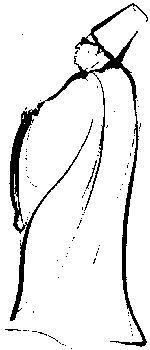
The dervish with his headdress (his ego's tombstone), his white skirt (his ego's shroud) is by removing his black cloak spiritually born to the truth, he journeys and advances there. At the onset and each stop of the Sema, holding his arms crosswise he represent the number one, and testifies to God's unity. While whirling his arms are open, his right hand directed to the skies ready to receive God's beneficence, looking to his left hand turned toward the earth, he turn from right to left around the heart. This is his way of conveying God's spiritual gift to the people upon whom he looks with the eyes of God. Revolving around the heart, from right to left, he embraces all the mankind, all the creation with affection and love… It starts with an eulogy "Nat-I Serif" to the Prophet, who represents love, and all Prophets before him. To praise them is praising God, who created all of them.
kudum #6.gif (3179 bytes)

The second part is a drum voice,
symbolizing God order to the Creation: "Be."

ney #7.gif (2255 bytes)The third part is an instrumental improvisation "taksim" with a reed "ney." It represents the first breath which gives life to everything. The Divine Breath.

The fourth part is the "dervishes" greetings to each other and their thrice repeated circular walk "Devr-i Veled," with the accompaniment of a music called "peshrev." It symbolize the salutation of soul to soul concealed by shapes and bodies.

The fifth part is the Sema (whirling). It consists of four salutes or "Selam"s. At the end of each as in the onset, the dervish testifies by his appearance to God's unity.

  • The first salute is man's birth to truth by feeling and mind. His complete conception of the existence of God as Creator and his state of creature.
  • The second salute expresses the rapture of man witnessing the splendor of creation, in front of God's greatness and omnipotence.
  • The third salute is the transformation of rapture into love and thereby the sacrifice of mind to love. It is a complete submission, it is annihilation of self with in the loved one, it is unity. This state of ecstasy is the highest grade in Buddhism, defined as "Nirvana" and in Islam "Fenafillah." However, the highest rank in Islam is the rank of the Prophet, he is called God's servant first and his messenger afterwards. The aim of Sema is not unbroken ecstasy and loss of conscious thought. At the termination of this salute, he approves again by his appearance, arms crosswise the Unity of God, consciously and feelingly.
  • The forth salute Just as the Prophet ascends till the "Throne" and then returns to his task on earth, the whirling dervish reaching the state of "Fenafillah," return to his task in creation, to his state of subservience following the termination of his spiritual journey and his ascent. He is a servant of God, of his Books, of his Prophets and all his creation.
hirka cikar #9.gif (3094 bytes)

First Salute

kiss hand #5.gif (3485 bytes)

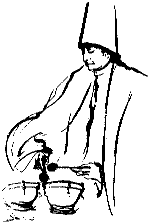
Kiss of hand
Permission to whirl (dance)

Second Salute

whirl #4.gif (2770 bytes)

Third Salute - Whirling

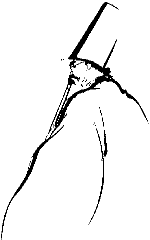
meditation #2.gif (1831 bytes)

At the sixth part Sema ends with a reading of the Quran and specially of the verse from sura Bakara 2, verse 115, "Unto God belong the East and the West, and whither over ye turn, you are faced with Him. He is All-Embracing, All-Knowing."

The seventh part is a prayer for the repose of the souls of all Prophets and all believers.

Monday, December 01, 2008

The Meaning of Love


The Meaning of Love

Both light and shadow
are the dance of Love.

Love has no cause;
it is the astrolabe of God's secrets.

Lover and Loving are inseparable
and timeless.

Although I may try to describe Love
when I experience it I am speechless.

Although I may try to write about Love
I am rendered helpless;
my pen breaks and the paper slips away
at the ineffable place
where Lover, Loving and Loved are one.

Every moment is made glorious
by the light of Love.

Rumi
http://www.poetseers.org/the_poetseers/love/17/


When the Rose is gone

When the rose is gone and the garden faded
you will no longer hear the nightingale's song.
The Beloved is all; the lover just a veil.
The Beloved is living; the lover a dead thing.
If love withholds its strengthening care,
the lover is left like a bird without care,
the lover is left like a bird without wings.
How will I be awake and aware
if the light of the Beloved is absent?
Love wills that this Word be brought forth

Rumi
http://www.poetseers.org/the_poetseers/love/5


Love

Are you fleeing from Love because of a single humiliation?
What do you know of Love except the name?
Love has a hundred forms of pride and disdain,
and is gained by a hundred means of persuasion.
Since Love is loyal, it purchases one who is loyal:
it has no interest in a disloyal companion.
The human being resembles a tree; its root is a covenant with God:
that root must be cherished with all one's might.
A weak covenant is a rotten root, without grace or fruit.
Though the boughs and leaves of the date palm are green,
greenness brings no benefit if the root is corrupt.
If a branch is without green leaves, yet has a good root,
a hundred leaves will put forth their hands in the end.

Rumi
http://www.poetseers.org/the_poetseers/love/10
.

Friday, March 28, 2008

Pearls of Wisdom (VII) / Mevlana Rumi

The Rumi: The Card and Book Pack by Eryk Hanut, Michele Wetherbee, Michele Wetherbee, Michele Wetherbee (Tuttle Publishing, 2006).
.
Synopsis (Barnes & Noble)
Thirteenth-century Persian poet Rumi remains one of the world's most popular mystics and poets; his fans include PBS' Bill Moyers, among others. Tuttle is proud to offer a beautifully produced package of Rumi's peerless wisdom, in a new translation text and 54 interactive cards. The book explores the history of Rumi and his career as a spiritual instructor and sage. The colorful cards are divided into six families-birth, love, ordeal, transformation, warnings, and rewards-and come with interpretations and instructions for using them for meditation, inspiration, and to answer life's questions. Attractive, handy, and easy-to-use, Rumi: The Card and Book Pack is a fun, enlightening way to arrive at greater self-knowledge through the insightful words of one of the greatest sages of all time. Eryk Hanut is the author of Perfume of the Desert: Inspirations from Sufi Wisdom, and co-author of Mary's Vineyard: Daily Meditations, Readings and Revelations. His articles have appeared in many national publications, including Yoga Journal, Body, Mind, & Spirit, and the Los Angeles Times. Michele Wetherbee, a resident of Petaluma, California was formerly Creative Director at HarperCollins San Francisco and art director for Giftworks, a division of Chronicle Books.

.
Open your heart, and you will hear the lutes of the Angels.
.
The mirror of the heart must be polished constantly Before you can see clearly in it Good and Evil.
.
It is certain that an atom of goodness on the path of faith is never lost.
.
Happiness is more precious than wealth; May millions of mercies rain on your dancing!

Look for the soul, you become soul; Hunt for the bread, you become bread. Whatever you look for, you are.

You want everything to be yours? Become nothing to yourself and all things.
.
Whoever doesn’t show himself humble today Will tomorrow be humiliated like Pharaoh.
.
The more you strive to reach the place of Splendor, The more the invisible Angels will help you.
.
After despair, many hopes flourish Just as after darkness, Thousands of Suns open and Start to shine.
.
Before death takes what has been given to you, you must give away everything you can give.
.
Put your trust in him who gives Life and Ecstasy. Don’t mourn what doesn’t exist; Cling to what does.
.
How can victory be won without spiritual war and patience? Give proof of patience; Faith is the key to joy.
.
If you know how to be patient, He’ll offer you the seat of honor; He’ll show you a hidden way that no one will know.
.
.
If it is love you are looking for, Take a knife and cut off the head of fear.
.
Through Love, disaster becomes good fortune. Through love, a prison becomes a garden.
.
Love has come to rule and transform; Stay awake, my heart, stay awake.
.
Do not call a cup Sea; Do not call mad the sage of Love.
.
Eat on and on, you lovers, at Eternity’s table; Its feast is forever; And spread out for you.
.
.
Picture: flickr.com
.

Friday, February 01, 2008

Sufism: The Formative Period

.
Ahmet Karamustafa
Washington University - St. Louis
University of California Press, 2007
.
"Karamustafa's new work is easily the best book I've read on the subject of early Sufism. The author does a fine job of combining analysis with synthesis, and he incorporates into his historical overview a generous sampling of the stories of a significant number of major characters. Perhaps the greatest achievement is Karamustafa's skill in making an immensely complex and potentially amorphous topic understandable. He manages to weave together very accessibly strands of history from diverse cultural and historical contexts across the central middle east, but the narrative remains concrete and avoids indulging more than necessary in discussing 'theoretical' issues. This is a very thoughtful treatment and I believe it will make a wonderful contribution toward a more integrated, comprehensive understanding of one of the most interesting subjects in late antique/early medieval Islamic religious history."--
John Renard, St. Louis University

"Ahmet Karamustafa's Sufism: The Formative Period is an absorbing and persuasive presentation of the development of Sufism, based on a thorough mastery of the original sources and epitomizing the discoveries of modern scholarship. Students of Sufism and religious studies will welcome this important contribution to Islamic studies."--Carl W. Ernst, William R. Kenan, Jr., Distinguished Professor of Religious Studies, University of North Carolina at Chapel Hill

"Concisely and efficiently, Ahmet Karamustafa presents us with a survey of the early development of Sufism that is at once analytic and informative, and fully attentive to social and intellectual as well as purely religious concerns. It supersedes all previous overviews of the formative period of Sufi thought and institutions."--Hamid Algar, University of California, Berkeley

"Leaving behind the more speculative approaches to Sufism and Islam of an earlier generation, and based on a comprehensive review of the most recent results of international scholarship in the field, including the author's own original research work, this book provides a highly informative and objective historical overview of the main mystical movements that contributed significantly to the shaping of medieval Muslim society. Elegantly written, it is a must for all those concerned."--Dr. Hermann Landolt, McGill University, Montreal and Institute of Ismaili Studies, London

DESCRIPTION

Ahmet T. Karamustafa bases this study on a fresh reading of the primary sources and, by integrating the findings of recent scholarship on the subject, presents a unified narrative of Sufism's historical development. His innovative analytical framework reveals the emergence of mystical currents in Islam during the ninth century and traces the rapid spread of Iraq-based Sufism to other regions of the Islamic world, providing an integrated, comprehensive understanding of one of the most compelling aspects of late antique, early medieval Islamic religious history.
.

Copub: Edinburgh University Press


ABOUT THE AUTHOR

Ahmet T. Karamustafa is Associate Professor of History and Religious Studies at Washington University in St. Louis. He is the author of God's Unruly Friends: Dervish Groups in the Islamic Later Middle Period, 1200-1550 (1994) and Vahidi's Menakib-i Hvoca-i Cihan ve Netice-i Can: Critical Edition and Historical Analysis (1993), and co-editor of Cartography in the Traditional Islamic and South Asian Societies (1992).

http://www.ucpress.edu/books/pages/10957.html

.

Friday, January 18, 2008

The Great Journey of Love

.


WHAT HAPPENS?

What happens when your soul
Begins to awaken
Your eyes
And your heart
And the cells of your body
To the great Journey of Love?

First there is wonderful laughter
And probably precious tears

And a hundred sweet promises
And those heroic vows
No one can ever keep.

But still God is delighted and amused
You once tried to be a saint.

What happens when your soul
Begins to awake in this world

To our deep need to love
And serve the Friend?

O the Beloved
Will send you
One of His wonderful, wild companions ~
Like Hafiz.

Hafiz
allspirit.co.uk/hafizhappens.html


IF IT IS NOT TOO DARK

Go for a walk, if it is not too dark.
Get some fresh air, try to smile.
Say something kind
To a safe-looking stranger, if one happens by.

Always exercise your heart's knowing.

You might as well attempt something real
Along this path:

Take your spouse or lover into your arms
The way you did when you first met.
Let tenderness pour from your eyes
The way the Sun gazes warmly on the earth.

Play a game with some children.
Extend yourself to a friend.
Sing a few ribald songs to your pets and plants -
Why not let them get drunk and wild!

Let's toast
Every rung we've climbed on Evolution's ladder.
Whisper, "I love you! I love you!"
To the whole mad world.

Let's stop reading about God -
We will never understand Him.

Jump to your feet, wave your fists,
Threaten and warn the whole Universe

That your heart can no longer live
Without real love!

Hafiz
(I Heard God Laughing - Renderings of Hafiz by Daniel Ladinsky)
http://www.panhala.net/Archive/If_It_Is_Not_Too_Dark.html

.

Wednesday, September 05, 2007

There is a candle in your heart...

.

There is a candle in your heart,
ready to be kindled.
There is a void in your soul,
ready to be filled.
You feel it, don't you?
You feel the separation
from the Beloved.
Invite Him to fill you up,
embrace the fire.
Remind those who tell you otherwise that
Love
comes to you of its own accord,
and the yearning for it
cannot be learned in any school.
.
MEVLANA RUMI
.
.
Picture: Flickr.com
.

Monday, May 28, 2007

'O heart, what a wonderful bird you are'

Gone to the Unseen

At last you have departed and gone to the Unseen.
What marvelous route did you take from this world?

Beating your wings and feathers,
you broke free from this cage.
Rising up to the sky
you attained the world of the soul.
You were a prized falcon trapped by an Old Woman.
Then you heard the drummer's call
and flew beyond space and time.

As a lovesick nightingale, you flew among the owls.
Then came the scent of the rosegarden
and you flew off to meet the Rose.

The wine of this fleeting world
caused your head to ache.
Finally you joined the tavern of Eternity.
Like an arrow, you sped from the bow
and went straight for the bull's eye of bliss.

This phantom world gave you false signs
But you turned from the illusion
and journeyed to the land of truth.

You are now the Sun -
what need have you for a crown?
You have vanished from this world -
what need have you to tie your robe?

I've heard that you can barely see your soul.
But why look at all? -
yours is now the Soul of Souls!

O heart, what a wonderful bird you are.
Seeking divine heights,
Flapping your wings,
you smashed the pointed spears of your enemy.

The flowers flee from Autumn, but not you -
You are the fearless rose
that grows amidst the freezing wind.

Pouring down like the rain of heaven
you fell upon the rooftop of this world.
Then you ran in every direction
and escaped through the drain spout . . .

Now the words are over
and the pain they bring is gone.
Now you have gone to rest
in the arms of the Beloved.
.
.
Jonathan Star, New York 1997
.
.

Sunday, April 08, 2007

UNESCO’s International Rumi Year celebrates the great poet/thinker

Ozge Esirgen / Istanbul
Cyprus Observer, 3/30/'07
.
Having accepted the proposal of the Culture and Tourism Ministry of Turkey in March 2006, 2007 was declared as the "International Rumi Year" by UNESCO. The recognition is intended for the commemoration of Rumi's 800th birthday and has given rise to many activities regarding the mystic’s appreciation in many countries as well as in Turkey. Upon the designation by UNESCO, the three countries that Rumi had lived in during his lifetime: Iran, Turkey and Afghanistan will be holding special programmes commemorating the man and his philosophy.

The recent news is that Iran and Turkey will cooperate in holding a Rumi International Conference in Turkey during the spring of 2007. Similar conferences are planned to be organised in Iran and Afghanistan as well. Other events that are being arranged include: the preparation of a bilingual book of Rumi’s most celebrated work, the ‘Mathnavi’ in Persian and its translation in Turkish, a ceremony in commemoration of Iranian and Turkish experts in Rumi studies, the publishing of a Turkish-Persian idiom dictionary, and also the organising of various concerts to be performed by Iranian artists in Turkey. There are film and documentary projects in relation to Rumi’s life, with some being joint productions of the countries concerned. Recently, the Iranian musician Peyman Soltani, announced that he has finished composing the soundtrack for a Turkish film on Rumi. The movie, called ‘Seven Cities’, is scheduled to be screened at the 60th Cannes International Film Festival this year. Turkey’s programme also includes a project entitled “The Cultural Train of Rumi’s Love and Patience” which will tour 17 European countries this year.

Mevlana, who is known to the English-speaking world simply as Rumi, was a 13th century Persian poet, jurist, and theologian. Rumi was born in Balkh (then a city of Greater Khorasan in Persia, now part of Afghanistan) and died in Konya (in present-day Turkey). His birthplace and native tongue indicate a Persian heritage. He also wrote his poetry in Persian and his works are widely read in Iran, Afghanistan, Tajikistan, and in translation in Turkey, Azerbaijan, the US, and South Asia. He lived most of his life in, and produced his works under, the Seljuk Empire. Rumi's importance is considered to transcend national and ethnic borders. Throughout the centuries he has had a significant influence on Persian as well as Urdu and Turkish literatures. His poems are widely read in the Persian speaking countries of Iran, Afghanistan and Tajikistan and have been widely translated into many of the world’s languages in various formats.
.
As the Turkish writer Talat Sait Halman wrote in his book on Mevlana, “His ideas, which stressed the immortality of the loving soul, the joys of passion, the inherent worth of the human being, the aesthetic as well as the ecstatic imperative of faith, the need to go beyond the confines of scholasticism and to transcend schisms, and above all the Godliness of Man not only gave renewed vigour to Islamic mysticism but also represented for the Islamic religion in general a counterpart of the Renaissance which was to emerge in Europe a century after Mevlana’s death.”
.
After Rumi's death, his followers founded the Mevlevi Order, better known as the ‘Whirling Dervishes’, who believe in performing their worship in the form of the dance and music ceremony called the sema.
.
A most beloved mystic, Mevlana has touched the hearts of countless over the past eight hundred years. His impact on many prominent figures has also been unquestionable throughout history. Friedrich Hegel saw him as one the greatest poets and thinkers in world history. Reynold A. Nicholson hailed him as the greatest mystical poet of any age. Goethe drew inspiration from his poetry. The celebrated poet Jami from Persia said of Rumi: “He is not a Prophet, but he has written a Holy Book.” Rembrandt drew him from a miniature painting. Gandhi frequently used his quotes, especially the one ‘To unite is why we came / To divide is not our aim.’ In 1958, Pope John XXIII wrote a special message: ‘In the name of the Catholic world, I bow with respect before the memory of Mevlana.’

Today, despite the 800 years that have passed since his death, Mevlana’s works still preserve their originality. It might also be said that today’s world is perhaps living a time that needs Mevlana and his philosophy more than any other time. It seems that in a world where violation of human rights is becoming widespread, due to the outrageously increasing ethnic and religious conflicts all around, the persistence of a hopeful belief in humane and peaceful aims which promise a better world can only be achieved through the enlightened path that such people as Rumi revealed.
.
The Reflection Cafe- Sufism
Islam and Peace: A Sufi Perspective, M. R. Bawa Muhaiyaddeen
All Through Eternity, Mevlana Rumi
Women and Sufism, Camille Adams Helminski
The Alchemy of Love, Mevlana Rumi
.

Friday, March 16, 2007

To be in Love with Love...

© dpchallenge.com

To Be In Love...
To be in love with love is to gain a soul,
to sit on the throne of hearts.
To love the world is to be afflicted.
Later the secrets start to make sense.
Don't be a bramble,
become the rose. Let your maturity unfold.
The brambles will only burn.
Prayer was created by God so man could ask for help.
It's too bad if you haven't learned to ask.
Accept the breath of those who are mature-
let it become your divining rod.
If you obey your self, things turn out wrong.
Renouncing the world is the beginning of worship.
If you are a believer, believe this.
Respect your parents and ancestry,
and you will have fine green clothes of your own.
If you earn the complaints of neighbors,
You'll stay in Hell forever.
Yunus heard these words from the masters.
If you need this advice, take it.
They say one who is received by a heart
becomes more beautiful.
.
Yunus Emre, Muslim Sufi-Poet, 13th Century Anatolia...
http://www.allspirit.co.uk/emre.html#inlove
.

Monday, January 22, 2007

The lover is outcast and idle

My soul,
the way of the masters
is thinner than the thinnest.
What blocked Solomon's way was an ant.

Night and day
the lover's tears never end,
tears of blood,
remembering the Beloved.

"The lover is outcast and idle,"
they used to tell me.
It's true.
It happened to me.

I tried to make sense of the Four Books,
until love arrived,
and it all became a single syllable.

You who claim to be dervishes
and to never do what God forbids --
the only time you're free of sin
is when you're in His hands.

Two people were talking.
One said, "I wish I could see this Yunus."
"I've seen him," the other says,
"He's just another old lover."

YUNUS EMRE
Muslim Sufi-Poet, 13th century Anatolia/Turkey
(picture: © dpchallenge.com)
.

Monday, September 18, 2006

Islam and Peace: A Sufi Perspective

Islam and World Peace - Explanations of a Sufi
by M. R. Bawa Muhaiyaddeen
.
Foreword by Annemarie Schimmell
Professor of Indo-Muslim Culture
Harvard University
.
Among the great religions of the world, Islam is no doubt the one that is least known and least appreciated by the non-Muslim world. The recent resurgence of military and militant groups inside Islam has caused a renewal of feelings and sentiments that have been harbored for centuries and a new spirit of crusade against the only major religion that appeared in history after Christianity. This has caused many Western laymen and intellectuals to ask, "What do 'the Islams' have in mind now?" (A horrible form used by many instead of the correct term, Muslims.)

Real Islam is a deep and unquestioning trust in God, the realization of the truth that "There is no deity save God" and of the threefold aspect of religious life: that of islam, complete surrender to God; iman, unquestioning faith in Him and His wisdom; and ihsan, to do right and to act beautifully, because one knows that God is always watching man's actions and thoughts. For fourteen hundred years the Muslims have practiced these virtues, and the great mystics of Islam have taught them to millions of faithful who have survived the most difficult times, the greatest hardships because of their unshakable faith in the loving kindness of God, the creator, sustainer and judge of everything created.

Sufism, the mystical current inside Islam, developed logically out of the serious study of the Koran, according to Muslim belief the uncreated word of God, and of the constant direction of all faculties toward God. The Sufi masters taught their disciples that their duty is the fulfillment of God's will, not out of a feeling of duty but rather out of love - for could there be anything greater than the unconditional love which man offers his Lord?

And in order to be able to love God and, through Him, His creatures, the heart has to be purified by constant remembrance of God and by constant struggle against one's lower qualities, the so-called nafs, which are, according to the word of the Prophet of Islam, "the greatest enemy of man." This struggle against one's lowly and base qualities is indeed the "greater Holy War," for outward enemies can disappear and are not as dangerous as the inner, satanic forces, which try to incite man into evil, disobedience, and forgetfulness. It is this "Holy War" which in the following pages forms the center of the teaching of one of the masters of Sufism in our day, Bawa Muhaiyaddeen, who hails from Sri Lanka and stands in the age-old tradition of wisdom and love.
.
The reader will learn from these pages, which are written, or rather recited, in a simple, almost childlike style, that the inner dimensions of Islam are very different from those which he usually associates with this religion; that there is a wealth of love, of patience, of trust in God, and, last but not least, of gratitude; for the qualities of patience in affliction and gratitude belong together. The true lover of God knows that even in affliction it is the hand of the Divine Beloved that he feels, and he trusts that whatever befalls him is for his best, for God knows what is good for the soul's growth and for the spirit's purification.

I hope that many people read the warm, loving words of Bawa Muhaiyaddeen and understand that indeed the words islam and salam-peace-belong to the same root and that a true understanding of the inner dimensions of Islam will help them to find peace for themselves, insha'Allah, God willing.

Reviews

"Read this book...as Rumi tells us to read: Feel the presence inside the language, the healing and the compassion and the tremendous courtesy"—Coleman Barks, Poet, Translator, Author of The Essential Rumi

"I hope that many people read the warm, loving words of Bawa Muhaiyaddeen and understand that indeed the words islam and salam"—peace—belong to the same root and that a true understanding of the inner dimensions of Islam will help them to find peace for themselves..."—Annemarie Schimmell, Professor of Indo-Muslim Culture, Harvard University

"At a time when Islam is being identified so much in the West with war and conflict, it is urgent that the message of this book be heard...for it relates Islam to the peace and serenity which has always been at the heart of its message."—Dr. Seyyed Hossein Nasr, Professor of Islamic Studies, George Washington University

"...A rich work, full of incredible insights on the present state of the world."—Victor Danner, Professor of Religious Studies, Indiana University
.
Table of Contents (Click the titles to read the book)
.
.

Thursday, September 07, 2006

The Rose Garden of Love

Even if the two worlds were prison cells
They would be orchard gardens for me,
When the Friend bestows His favor
On me, I am not sad, I do not grieve.

If I were the slave of the Friend
I would flower like an opening rose,
I would be the nightingale singing of love,
I would live in the rose garden of love.

My eyes have seen the Beloved's face,
And my face is dust to the friends of God,
But for those who understand
My words, they are sweet sugar cane.

If you give up the claims of the world
And fly up all the way to the Beloved,
If you drink the wine of love,
You will certainly be drunk with enchantment.

If I cannot see You, both this world
And the hereafter are prison cells
For my eyes. Whoever knows Your love
Must surely be the purest and the best.

My inner self has never tired of Your love,
My tongue speaks of You in spite of myself,
Yunus, may these words of yours
Be an epic tale for all the worlds


YUNUS EMRE
.
Click here for his life and selected poems.
.

Friday, June 09, 2006

All Through Eternity

Beauty unveils His exquisite form
in the solitude of nothingness;
He holds a mirror to His Face
and beholds His own beauty.
he is the knower and the known,
the seer and the seen;
No eye but His own
has ever looked upon this Universe.
.
His every quality finds an expression:
Eternity becomes the verdant field of Time and Space;
Love, the life-giving garden of this world.
Every branch and leaf and fruit
Reveals an aspect of His perfection-
They cypress give hint of His majesty,
The rose gives tidings of His beauty.
.
Whenever Beauty looks,
Love is also there;
Whenever beauty shows a rosy cheek
Love lights Her fire from that flame.
When beauty dwells in the dark folds of night
Love comes and finds a heart
entangled in tresses.
Beauty and Love are as body and soul.
Beauty is the mine, Love is the diamond.
.
They have together
since the beginning of time-
Side by side, step by step.
.
Mevlana Rumi

Friday, May 26, 2006

Women and Sufism

Camille Adams Helminski
Gnosis #30 (Winter 1994)
.
Since the beginning of consciousness, human beings, both female and male, have walked the path of reunion with the Source of Being. Though in this world of duality we may find ourselves in different forms, ultimately there is no male or female, only Being. Within the Sufi traditions, the recognition of this truth has encouraged the spiritual maturation of women in a way that has not always been possible in the West.
.
From the earliest days onward, women have played an important role in the development of Sufism, which is classically understood to have begun with the Prophet Muhammad. Muhammad brought a message of integration of spirit and matter, of essence and everyday life, of recognition of the feminine as well as the masculine. Though cultural manifestations have covered over some of the original purity of intention, the words of the Qur'an convey the equality of women and men before the eyes of God. At a time when the goddess-worshiping Arabian tribes were still quite barbaric, even burying infant girls alive in favor of male offspring, this new voice of the Abrahamic tradition attempted to reestablish the recognition of the Unity of Being. It tried to address the imbalances that had arisen, advising respect and honor for the feminine as well as for the graciousness and harmony of nature.
.
In the early years of this new revelation, Muhammad's beloved wife, Khadija, filled a role of great importance. It was she who sustained, strengthened, and supported him against his own doubt and bewilderment. She stood beside him in the midst of extreme difficulty and anguish and helped carry the light of the new faith. It was to Muhammad's and Khadija's daughter, Fatimah, to whom the deeper mystical understanding of Islam was first conveyed, and indeed she is often recognized as the first Muslim mystic. Her marriage with Ali bound this new manifestation of mysticism into this world, and the seeds of their union began to blossom.
.
As the mystical side of Islam developed, it was a woman, Rabi'a al-Adawiyya (717-801 A.D.), who first expressed the relationship with the divine in a language we have come to recognize as specifically Sufic by referring to God as the Beloved. Rabi'a was the first human being to speak of the realities of Sufism with a language that anyone could understand. Though she experienced many difficulties in her early years, Rabi'a's starting point was neither a fear of hell nor a desire for paradise, but only love. "God is God," she said, "for this I love God... not because of any gifts, but for Itself." Her aim was to melt her being in God. According to her, one could find God by turning within oneself. As Muhammad said, "He who knows himself knows his Lord." Ultimately it is through love that we are brought into the unity of Being.
.
Throughout the centuries, women as well as men have continued to carry the light of this love. For many reasons, women have often been less visible and less outspoken than men, but nevertheless they have been active participants. Within some Sufi circles, women were integrated with men in ceremonies; in other orders, women gathered in their own circles of remembrance and worshiped apart from men. Some women devoted themselves to Spirit ascetically, apart from society, as Rabi'a did; others chose the role of benefactress and fostered circles of worship and study. Many of the great masters with whom we in the West are familiar had female teachers, students, and spiritual friends who greatly influenced their thought and being. And wives and mothers gave support to their family members while continuing their own journey towards union with the Beloved.
...
Sufism recognizes that committed relationship and family are not contrary to the flowering of spirituality, but rather are wonderful vessels for spiritual ripening. The beauty of partnership, children and family are great blessings, containing the inspiration, the breathing in, of the divine. As we deepen our capacity for relationship and fidelity in the human sphere, we also increase our capacity for relationship with God.
.
We need to stand together in the light. The way is opening in our own time for greater recognition of equal partnership. We have much to learn form each other, and male and female need to recognize each other so that we can come to balance within ourselves as well as creating balance outwardly in the world. The male attributes of strength and determination also belong to women; the feminine attributes of receptivity and beauty also belong to men. As we look to the divine in each other, encouraging each other to rise to the fullness of is or her own divine nature, we push against our limitations until they dissolve and a gift unfolds. As we learn to witness the miracle of creation, a time comes when "wheresoever you look, there is the Face of God; everything is perishing except the One Face."
.
Whether we choose celibacy or committed partnership, whether we are female or male, the same work remains of polishing the mirror of the heart, of being in remembrance moment by moment, breath by breath. Each moment we reaffirm the inner marriage until there is no longer lover or Beloved but only Unity of Being. Little by little, we die to what we thought we were. We are dissolved into Love, and we become love, God willing. As Rabi'a says:
.
In love, nothing exists between breast and Breast.
Speech is born out of longing,
True description from the real taste.
The one who tastes, knows;
The one who explains, lies.
How can you describe the true form of Something
In whose presence you are blotted out?
And in whose being you still exist?
And who lives as a sign for your journey?
.
Full-text available:
.
Related Posts with Thumbnails

Düşünce Kahvesi

Photography

Photography
dpchallenge.com

NYT: Travel and Cities

H-Net Academic Announcements - All